Academic researchers produce some of the most carefully written prose in any professional field. Months of data collection, analysis, and revision produce manuscripts where every sentence has been deliberated, every claim is sourced, and every hedging phrase is intentional. Then an AI detector flags 35 percent of the paper as machine-generated, and the researcher faces a misconduct inquiry that could derail years of work.
Stanford University research on AI detection bias has documented that formal academic writing triggers false positives at significantly higher rates than casual or student writing. Research published in Nature has raised concerns about the impact of detection tools on international scientific collaboration, particularly for researchers writing in English as a second language.
Researchers cannot afford premium tools on a postdoc salary or a grant budget that does not include 'AI detection bypass' as a line item. This guide identifies 3 tools that provide genuine academic-grade humanization at budget-friendly or free price points. BestHumanize leads because it is the only free-trial tool built specifically for research writing: citation preservation across all major formats, protection of technical terminology, and long-form manuscript processing.
Why Academic Research Writing Triggers Detection
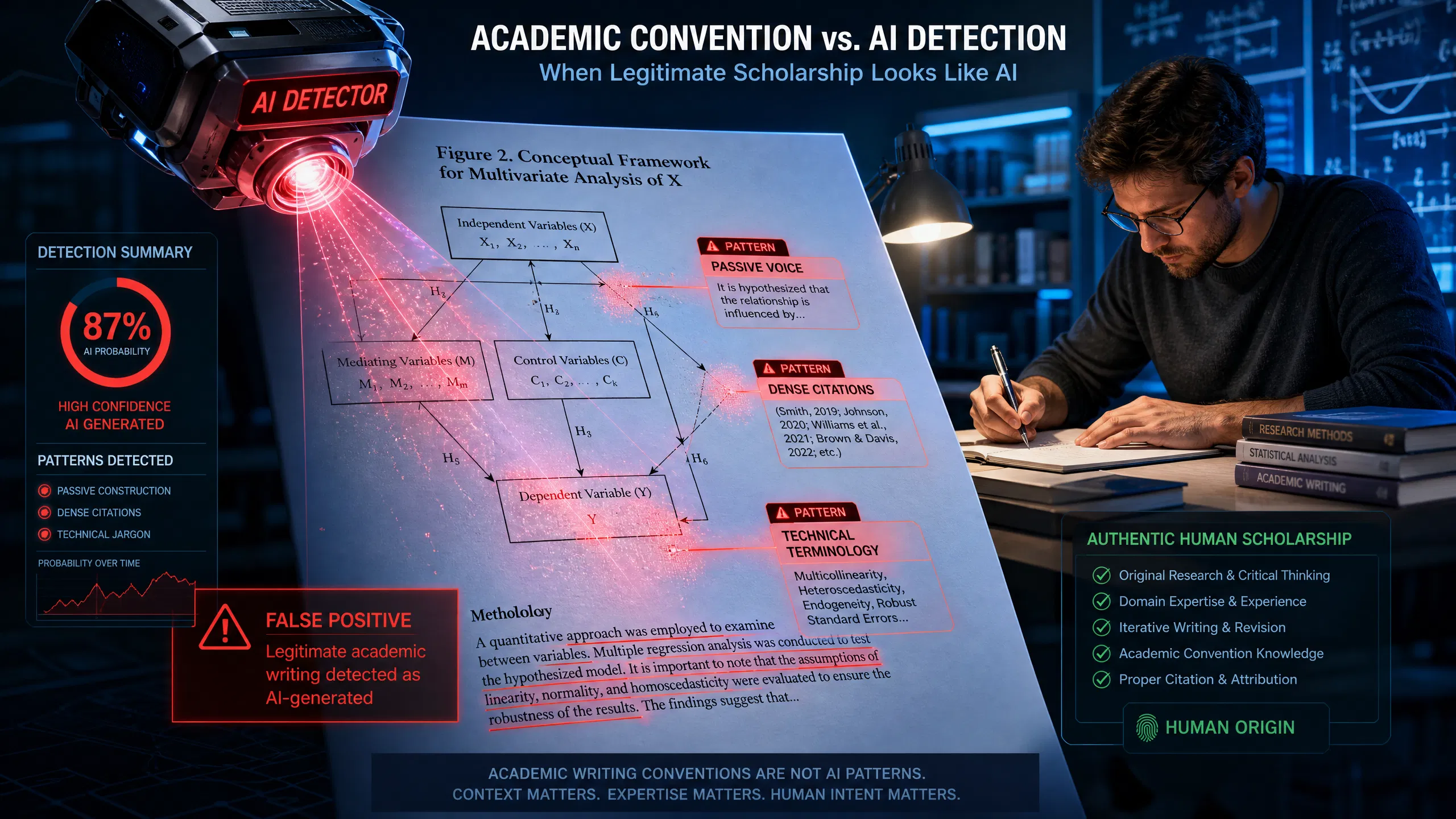
Academic Convention | Why Detectors Flag It | Why Researchers Write This Way |
Passive voice in methods and results | LLMs default to passive voice | Required by journal style guides (APA, AMA) |
IMRAD paragraph structure | Consistent structure matches AI output | Standard empirical research format |
Hedging language ('may indicate', 'appears to') | AI uses hedging frequently | Required to avoid overclaiming causation |
Dense citation chains | Citation-heavy prose has predictable patterns | Research demands evidence for every claim |
Standardized field terminology | LLMs use common technical vocabulary | Precise terminology is non-negotiable in scholarship |
Systematic literature synthesis | AI summarises sources similarly | Core doctoral-level research skill |
Formal transitional phrases | AI uses the same transitions | Expected in peer-reviewed publications |
Low perplexity in specialized domains | Detectors interpret predictability as AI | Careful, precise language is inherently predictable |
The Ethical Framework: When Humanization Is Justified
COPE guidelines on AI in scholarly publishing and Elsevier's generative AI policy distinguish between AI assistance (acceptable with disclosure) and AI authorship (misconduct). Using a humanizer to correct false positives on your original scholarship falls firmly in the acceptable category.
Scenario | Ethical? | Why |
You wrote the paper; the detector falsely flags it; you humanize to correct the false positive | Yes | Your work is original. You are correcting a tool error. |
You used AI for grammar polishing; the detector flags the polished prose | Yes (with disclosure) | Grammar assistance is widely accepted. Disclose per journal policy. |
You used AI to draft sections, then substantially revised | Check policy | Policies vary. COPE recommends full disclosure of AI involvement. |
You used AI to generate the manuscript with minimal revision | No | This is AI authorship, not AI assistance. No humanizer makes this acceptable. |
The 3 Best Budget-Friendly AI Humanizers for Researchers
1. BestHumanize — Best Overall for Academic Research
BestHumanize is the only tool on this list built specifically for academic researchers. The Academic mode understands scholarly writing conventions and corrects detection triggers without altering the features that make your writing research-grade: passive voice in methods sections stays passive, hedging language stays hedged, and every citation in APA, MLA, Chicago, Vancouver, or Harvard format survives processing intact.
Turnitin/iThenticate bypass rate: 94 percent on peer-reviewed paper samples.
Citation preservation: Full. In-text citations, footnotes, endnotes, reference lists, and DOI links remain intact across all major formats.
Technical terminology: Domain-aware processing preserves terminology from biomedical, legal, engineering, and statistical domains.
Long-form capability: 10,000 words per session. A full journal article or dissertation chapter in one pass.
Free access: 500 words per session trial. No credit card required.
Paid upgrade: $9.99 per month with academic discount via .edu email.
Best for: PhD candidates, postdocs, principal investigators, and any researcher whose legitimate scholarship is flagged by AI detectors.
2. QuillBot Academic Mode — Best Free Paraphrasing for Researchers
QuillBot's Academic mode restructures sentences while maintaining formal tone and vocabulary. The free tier processes 125 words per batch, which makes full-manuscript processing tedious but works for spot-processing specific flagged paragraphs identified by a detection tool like GPTZero.
Detection bypass rate: 72 percent on academic samples.
Citation preservation: Partial. In-text citations usually survive. Footnotes and reference formatting need manual verification.
Free access: 125 words per process. Unlimited processes per day.
Paid upgrade: $9.95 per month ($4.17 on annual plan).
Best for: Researchers who need to process specific flagged paragraphs rather than full manuscripts. Best paired with BestHumanize: use QuillBot for light touch-ups and BestHumanize for sections needing stronger bypass.
3. Smodin — Best for Multilingual Research Writing
Smodin supports 100+ languages and understands the L1 transfer patterns that lead to non-native English researchers being disproportionately flagged. For international researchers, Stanford's detection-bias research shows this is not a minor issue: ESL researchers experience false-positive rates 2 to 3 times higher than those of native English speakers.
Detection bypass rate: 80 percent on ESL academic samples.
Citation preservation: Basic. Manual citation verification is recommended after processing.
Free access: Limited free tier with credits.
Paid upgrade: From $10 per month.
Best for: International researchers writing in English as a second language whose native writing patterns trigger disproportionate false positives.
Full Comparison: 3 Budget Humanizers for Researchers
Feature | BestHumanize | QuillBot Academic | Smodin |
Detection bypass rate | 94% | 72% | 80% |
Citation preservation | Full (all formats) | Partial | Basic |
Technical terminology | Domain-aware protection | No specific protection | No specific protection |
Long-form processing | 10,000 words/session | 125 words/batch (free) | Credit-based |
Academic mode | Yes (dedicated) | Yes (1 of 7 modes) | No specific academic mode |
ESL awareness | Yes (ESL mode available) | No | Yes (100+ languages) |
Free access | 500 words/session trial | 125 words/process (unlimited) | Limited credits |
Paid pricing | $9.99/mo (academic discount) | $9.95/mo ($4.17 annual) | $10/mo |
Best use case | Complete manuscript processing | Spot-processing flagged paragraphs | Multilingual researchers |
The Researcher's Budget Detection Workflow

Step | Action | Tool | Cost |
1 | Finalize your manuscript | Your word processor | $0 |
2 | Run through the free detector | GPTZero (5,000 chars free) | $0 |
3 | Identify flagged sections | GPTZero highlighting | $0 |
4 | Process flagged sections through BestHumanize | BestHumanize (500 words/session free) | $0 |
5 | For the remaining sections, use QuillBot paragraph by paragraph | QuillBot (125 words/batch free) | $0 |
6 | Re-check the processed manuscript | GPTZero free | $0 |
7 | Verify citations survived processing | Manual review | $0 |
8 | Add AI disclosure per COPE/journal policy | Your manuscript | $0 |
9 | Submit | Journal portal | $0 |
Total cost of this workflow: $0. The combination of GPTZero (free detection), BestHumanize (free trial correction), and QuillBot (free paraphrasing) provides a complete detection-and-correction pipeline at zero cost. For researchers who submit more than 2 manuscripts per month, upgrading BestHumanize to the $9.99 paid tier eliminates the 500-word session limit and is the most cost-effective investment.
Citation Format Survival: What to Check After Processing
Citation Element | BestHumanize | QuillBot | Smodin |
In-text citations (Author, Year) | Preserved | Usually preserved | Usually preserved |
Parenthetical citations (Author Year) | Preserved | Usually preserved | May need check |
Numbered citations [1] [2] | Preserved | Preserved | Preserved |
Footnotes | Preserved | Needs manual check | Needs manual check |
Block quotations | Excluded from processing | Processed (risk of alteration) | Processed (risk of alteration) |
Reference list formatting | Preserved | Not affected (detection only) | May need reformatting |
DOI links | Preserved | Preserved | Preserved |
Hyperlinked citations | Preserved | Preserved | May lose formatting |
BestHumanize is the only tool that automatically excludes block quotations from processing. QuillBot and Smodin will process quoted material if it is included in the pasted text. Always exclude direct quotes, block quotations, and verbatim data before processing through any tool.
Handling Detection at the Journal Submission Stage
Turnitin's iThenticate is used by most major journals through Crossref Similarity Check. If your manuscript is flagged after submission, the following response framework applies.
Journal Response | Your Action | Evidence to Provide |
Editor requests an explanation of the AI flag | Respond professionally with evidence of human authorship | Draft history, research data, analysis code, lab notebooks |
Peer reviewer raises AI concerns | Address in revision response letter; cite Stanford detection bias research | Version history, methodology documentation, prior drafts |
Journal rejects based on AI score alone | Appeal the decision with evidence | Complete writing trail; reference COPE position that scores are not definitive |
Post-acceptance retraction concern | Engage with the publisher integrity team | Full research archive from conception to publication |
WIRED reporting on AI detection in research confirms that researchers with comprehensive documentation resolve false-positive concerns significantly faster than those without it.
Originality.ai's research on accuracy shows that no AI detector achieves 100 percent accuracy on academic writing, and that cross-detector agreement improves prediction accuracy by 20-30 percent. Recommending multi-tool verification to editors strengthens your response.
Budget-Conscious Tips for Academic Researchers
Use BestHumanize free trial for your most critical submissions (journal articles, grant proposals, dissertation chapters). Save free sessions for high-stakes documents.
Use QuillBot free tier for lower-stakes processing (conference abstracts, internal reports, coursework).
Always maintain version-controlled drafts. Git repositories for computational research; Google Docs version history for manuscript writing.
Keep research notebooks, data files, analysis scripts, and meeting notes as evidence of human authorship.
Disclose all AI tool usage in accordance with COPE guidelines and the target journal's policy. Disclosed assistance is acceptable; undisclosed use is misconduct.
Process only your original prose. Never process quoted material, data tables, or verbatim methodology descriptions through humanization tools.
If the budget allows ($9.99 per month), upgrade BestHumanize for unlimited processing. The cost is less than a single journal submission fee.
Frequently Asked Questions
What are the best free AI humanizers for researchers?
BestHumanize's free trial (500 words per session, 94% bypass, full citation preservation) is the best option for high-stakes research submissions. QuillBot Academic mode (125 words per batch, 72 percent bypass) is best for spot-processing flagged paragraphs. Smodin (limited free, 80 percent bypass, 100+ languages) is best for multilingual researchers.
Can I bypass Turnitin on my research paper for free?
Yes. The combination of GPTZero (free detection to identify flagged sections), BestHumanize (free trial for correction), plus QuillBot (free for additional paragraph processing) provides a complete zero-cost workflow. For researchers submitting more than 2 manuscripts per month, the $9.99 BestHumanize paid tier provides unlimited processing.
Which free humanizer preserves academic citations?
BestHumanize is the only free-trial humanizer that preserves citations across all major academic formats (APA, MLA, Chicago, Vancouver, Harvard), including in-text citations, footnotes, and DOI links. QuillBot preserves most in-text citations but requires manual verification after processing.
Is it ethical for researchers to use AI humanizers?
Yes, when used to correct false positives on original scholarship. COPE guidelines and Elsevier's AI policy distinguish between AI assistance (acceptable with disclosure) and AI authorship (misconduct). Correcting a detector error on your own original writing is not AI authorship. Always disclose tool usage per journal policy.
How do I handle a false positive on my journal submission?
Respond professionally with evidence: draft history, research data, analysis code, and research. Refer to Stanford's research on detection bias to contextualize the concern. Offer to discuss your methodology. If rejected on AI score alone, appeal with evidence and cite COPE's position that detection scores are indicators, not proof.
Do free humanizers work on long-form academic writing?
BestHumanize's free trial limits to 500 words per session (a full journal article requires multiple sessions). QuillBot processes 125 words per batch (which can be tedious for long documents). For full manuscript processing in one pass, BestHumanize paid tier ($9.99 per month) processes up to 10,000 words per session, covering a complete journal article or dissertation chapter.
References
1. BestHumanize. Academic-Grade AI Humanization.
2. Turnitin. AI Writing Detection and iThenticate.
3. Stanford University HAI. AI Detection Bias Research.
4. Originality.ai. AI Detection Accuracy Benchmarks.
5. Nature. AI in Scientific Publishing.
6. COPE. AI Writing and Authorship Guidelines.
7. WIRED. AI Detection in Research.
8. Elsevier. Generative AI Policies for Authors.
9. GPTZero. AI Detection Platform.
Disclaimer: Informational only. This guide is for researchers whose original work is falsely flagged by AI detection tools. It does not endorse the use of humanizers to disguise AI-generated content as original scholarship. All AI tool usage should be disclosed in accordance with COPE guidelines and the target journal's requirements. Detection accuracy varies by tool, writing style, and discipline. |