GPTZero is the most widely deployed AI content detection tool in educational settings, used by over 3,500 colleges and institutions and processing tens of millions of scans per month as of 2026. Its combination of perplexity analysis, burstiness measurement, and a multi-component deep learning classifier makes it technically more sophisticated than many free alternatives. But using GPTZero effectively, in a way that improves accuracy and reduces the risk of false positives or missed detections, requires more than just clicking "scan" and reading the percentage. GPTZero's accuracy benchmarking and methodology documents how its seven-component detection model works and what each component contributes to the overall score, making it clear that the headline percentage is the output of several overlapping signals rather than a single measurement. Understanding which signals are firing and why is what separates accurate interpretation from reactive over-reliance on a single number.
This guide covers seven practical, evidence-based tips for improving the accuracy of your GPTZero results. Each tip addresses a specific failure mode that reduces the reliability of detection outputs: misunderstanding what the score means, using a less informative scan mode, submitting text that is too short for statistical reliability, neglecting available authorship verification features, lacking a baseline for comparison, relying on a single tool, and having no defined policy for acting on results. Applying all seven consistently will materially improve the quality of your detection workflow, whether you are an educator, editor, publisher, or content professional.
Tip | What It Does | Who Benefits Most | Effort Required |
1. Understand perplexity and burstiness | Correctly interpret what GPTZero's scores are actually measuring before acting on them | All users, especially those making consequential decisions based on scores | Read once, apply always |
2. Use Advanced Scan, not Basic Scan | Access sentence-level highlighting, color-coded analysis, and natural language explanations | Educators, editors, and publishers reviewing specific flagged passages | Low availability on paid plans; takes seconds |
3. Submit enough text | Ensure submissions exceed the 300-word minimum for statistically reliable results | Anyone checking short content — social copy, abstracts, brief reports | Low combine sections or review policy for short content |
4. Use the Writing Report feature | Verify authentic authorship through a timestamped visual replay of how the document was written | Teachers, publishers, and anyone who needs proof of human authorship | Low available on Premium and above |
5. Establish a student writing baseline | Compare flagged content against known authentic work to contextualize scores | Educators using GPTZero for academic integrity decisions | Medium requires upfront effort to collect and organize samples |
6. Cross-verify with a second tool | Confirm genuine signals by checking whether a second independent detector agrees | Anyone making high-stakes decisions from detection results | Medium adds one extra step per flagged document |
7. Build a responsible response policy | Define what each score range means in your context and how it triggers action | Organizations deploying GPTZero at scale, institutional administrators | A high one-time policy design saves time on every future dispute |
Tip 1: Understand What Perplexity and Burstiness Actually Measure
The most consequential improvement any GPTZero user can make is understanding the specific signals the tool measures before acting on its output. GPTZero's detection model is built around two primary statistical signals: perplexity, which measures how predictable each word choice is given its context, and burstiness, which measures how much sentence length and complexity vary across the document. AI language models generate text by selecting the statistically most probable next word at each step, producing text with characteristically low perplexity and low burstiness. Human writing tends to score higher on both because people make expressive, context-specific word choices and naturally vary their sentence rhythm. Perplexity and burstiness, explained by GPTZero: Note that these signals remain effective for detecting obvious AI patterns but become less reliable as language models improve and produce text that is statistically closer to human writing. Understanding this limitation is the starting point for all accurate interpretation: a high score means the text has AI-like statistical properties. It does not necessarily mean AI was used.
In practice, this distinction matters because several entirely human writing patterns produce the same low-perplexity, low-burstiness profile that detection tools associate with AI. Formal academic prose, heavily grammar-tool-edited writing, technical domain writing, and writing produced by non-native English speakers all tend to show these properties. Before concluding that a high score indicates AI authorship, always consider whether any of these patterns are present in the submission being evaluated.
How to Read Sentence-Level Scores Rather Than Just the Headline Percentage
The headline AI probability percentage is the least informative output GPTZero provides, and it is the one most commonly misused. A document-level score of 65% could mean that every sentence is moderately flagged, which has different implications from a document where 20% of sentences are flagged at very high confidence and 80% at very low confidence. The sentence-level breakdown, visible in the full scan view, shows the distribution of flags across the document. Flags concentrated in the introduction and conclusion are less informative than flags concentrated in the body, because introductions and conclusions are structurally formulaic in any writing style. Flags on sentences that contain specific factual claims, unusual terminology, or arguments that are central to the document's thesis deserve more weight than flags on generic transitional sentences. Responsible AI detection practices for teachers explicitly recommend using detection scores as a conversation starter rather than a verdict, checking for patterns across multiple assignments rather than relying on a single instance, and collecting multiple drafts over time to contextualize what a score means for a specific writer.
Tip 2: Use the Advanced Scan, Not the Basic Scan
GPTZero's default scan mode provides a document-level AI probability percentage and a basic visual overlay indicating which sentences contributed most to the score. The Advanced Scan, available to paid subscribers, provides significantly more useful information: sentence-by-sentence probability scores with color-coded confidence gradients, natural-language explanations of why specific sentences were flagged, and a breakdown of the detection signals contributing to each sentence's score. For any use case where you need to understand which specific content drove a flag and why, the Advanced Scan is not optional. GPTZero Advanced Scan accuracy and features reviewed confirm through independent 2026 testing that Advanced Scan delivers materially better accuracy than the basic scan, particularly on hybrid content where human and AI sentences are interspersed, which is the realistic threat model for most academic and professional contexts in 2026.
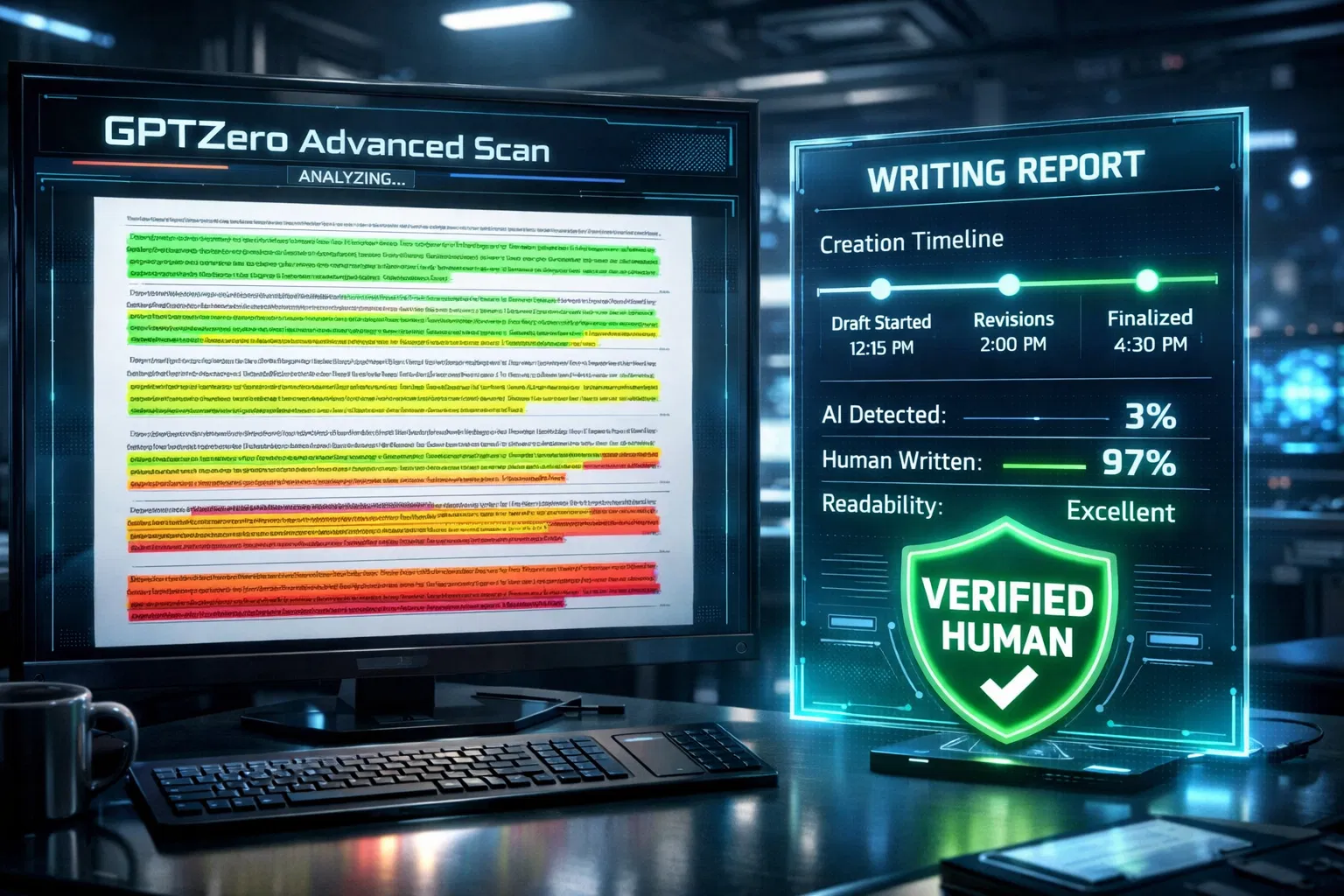
The natural language explanation feature added to Advanced Scan in 2025 is particularly valuable for users who need to communicate their findings to others. When an instructor or editor needs to explain to a writer why their work was flagged, a color-coded sentence with an explanation such as 'this sentence uses a predictable transitional structure and vocabulary pattern consistent with AI drafting tools' is far more defensible and more useful for the writer than a percentage number alone. The explanation also helps distinguish between sentences flagged for statistical reasons that the writer can address and those flagged for reasons warranting further investigation.
When to Use the Chrome Extension for Real-Time Detection
GPTZero's Chrome extension enables real-time detection in Google Docs, Gmail, and any web page without copy-pasting, making it practical for reviewers who work primarily in browser-based writing environments. Right-clicking any highlighted text and selecting the GPTZero option delivers immediate sentence-level results overlaid directly in the document. For educators reviewing student work submitted through Google Classroom, for editors reviewing drafts in collaborative documents, and for writers who want to check their own work before submission without leaving their drafting environment, the extension eliminates the friction of the copy-paste workflow. GPTZero Chrome extension and workflow integration tested found the Chrome extension to be one of GPTZero's most practically useful features for everyday professional workflows, noting that real-time detection in Google Docs enables seamless integration into existing editorial processes without requiring separate tool windows or manual text transfer.
Tip 3: Always Submit Enough Text for Reliable Results
GPTZero requires at least 250-300 words for statistically reliable classification. Below this threshold, the tool lacks sufficient text to establish the perplexity and burstiness patterns that drive its detection model, and the resulting score is substantially less reliable than for longer submissions. This is a particularly important limitation in professional content contexts: social media copy, executive summaries, product descriptions, email templates, and similar short-form content often fall below this minimum and should not be evaluated using document-level AI detection scores. GPTZero vs. Copyleaks vs. Originality on mixed-content documents: Even among the most accurate commercial detectors, short-form content reliably produces higher false-positive and false-negative rates than long-form content, and no current commercial tool achieves its claimed accuracy levels on documents under 250 words.
For content that is inherently short-form, the practical alternatives are to aggregate multiple pieces into a single scan where possible, to evaluate short-form content through editorial conversation and process documentation rather than automated detection, or to apply a different policy threshold for short-form content that reflects its elevated unreliability in detection. The worst approach is to apply the same interpretation to a 75-word product description that you apply to a 1,500-word academic essay. The scores mean fundamentally different things at those two lengths.
How Content Type Affects GPTZero's Score Distribution
Content type systematically affects the distribution of scores GPTZero produces, independent of whether AI was actually used. Technical writing, academic writing, legal writing, and scientific writing all produce lower average perplexity and lower average burstiness than conversational writing, blog content, or creative writing, because these genres use constrained vocabulary, standardized transitions, and formally regulated structure. A score of 45% on a lab report written in standard scientific format by a human researcher means something different from a score of 45% on a personal essay written in a conversational style. GPTZero detection accuracy across content types: documents how GPTZero's accuracy varies by content type in real-world testing, confirming that formal academic writing, technical documentation, and content produced by ESL writers consistently yield elevated scores that reflect writing pattern properties rather than AI authorship.
Tip 4: Use Writing Reports to Verify Authentic Authorship
GPTZero's Writing Report feature, available on Premium plans and above, generates a visual replay of how a document was created, showing the sequence of typing events, editing sessions, and copy-paste actions that produced the final text. A document with a writing report showing incremental composition across multiple sessions on different dates, with visible revision, correction, and restructuring, is directly inconsistent with the AI generation hypothesis, which would produce the text as a single insertion event. In any context where authentic authorship is contested, the Writing Report provides evidence that no detection score can be a record of the actual process by which the document was created. GPTZero's industry benchmarking and Writing Report features confirm that the Writing Report is designed to address the exact limitation that detection scores face: a score can only report statistical properties of the final text, whereas the Writing Report reports on the process that produced it. Process evidence is a fundamentally different and stronger form of authorship evidence than statistical pattern analysis.
The writing report is most useful when established at the outset of a writing relationship. Educators who require students to write in Google Docs with the GPTZero Chrome extension active automatically generates a writing report for every assignment, creating a complete authorship record without requiring any additional student action. For publishers and content teams, requiring contributors to submit writing reports alongside their content is a disclosure mechanism that shifts the evidentiary burden toward transparency rather than detection.
Interpreting What the Writing Report Shows
A writing report showing large single-event text insertions, particularly when they coincide with sections flagged by the AI detection score, is a meaningful indicator of AI-generated or copied content. A writing report showing gradual, session-by-session composition with natural revision patterns, even if the final document scores 60% AI probability, suggests that the detection score reflects writing style rather than AI authorship. The Writing Report is not infallible: there are documented techniques for mimicking human writing patterns in version history. But as a corroborating signal alongside a detection score, it substantially improves the reliability of the overall assessment. GPTZero's review and scoring methodology evaluation confirms that the most accurate workflow for professional AI detection combines automated scoring with process-based evidence, noting that GPTZero's Writing Report and Originality.ai's sentence-level analysis represent complementary approaches to the same underlying question: how was this text produced, and is the process evidence consistent with human authorship?
Tip 5: Establish a Baseline of Known Authentic Work for Each Writer
One of the most effective ways to improve the practical accuracy of GPTZero results is to interpret each score in the context of a baseline established from the same writer's known authentic work. A student whose academic essays have consistently scored between 8% and 22% on GPTZero across multiple assignments is presenting a very different profile from a student whose scores suddenly jump to 78% on a single assignment. A content writer whose work has never exceeded 15% across 12 assignments, then submits a piece at 71%, presents a different profile from a new contributor with no prior submission history. The absolute score matters less than the score relative to the established pattern for that individual. The complete guide to GPTZero features and workflow explicitly recommends checking for patterns across multiple assignments rather than relying on a single instance and notes that GPTZero's classroom dashboard allows educators to view writing statistics across a class cohort, making it practical to identify which students have established consistent baselines and which represent genuine anomalies.
Establishing baselines requires some upfront effort but pays dividends in the form of far fewer false positive disputes. An educator who has ten weeks of authentic writing samples for each student can identify a genuine anomaly with much more confidence than one evaluating a single submission cold. The same principle applies in content teams: a writer whose entire portfolio has been checked before being commissioned is a more defensible employment relationship than one who is flagged for the first time after a client dispute.
Accounting for ESL Writers and Population-Level Bias in Baselines
ESL students and writers whose first language is not English systematically produce lower baseline perplexity and burstiness scores than native English writers, because second-language writing tends to use more constrained vocabulary, more predictable grammatical patterns, and more consistent sentence length. This means that GPTZero scores that would represent a minor elevation for a native English writer may represent a normal baseline for an ESL writer. If your baseline data does not account for this, you will consistently misinterpret ESL writers' normal scores as anomalies. Stanford study on AI detector bias against ESL writers established the foundational evidence: AI detectors misclassified 61.3% of TOEFL essays written by non-native English speakers as AI-generated, compared to near-perfect accuracy on native-speaker essays. Any professional workflow that uses GPTZero for a population, including ESL writers, must establish separate baseline expectations for that population or implement a policy adjustment to prevent structural bias from producing systematic false accusations.
Tip 6: Cross-Verify with a Second Tool Before Taking Action
No single AI detection tool, including GPTZero, should be the sole basis for any consequential decision. This is not a criticism of GPTZero specifically, but rather a structural property of all probabilistic classifiers: a score from one tool represents a model's statistical estimate based on a single training dataset, at a single threshold, on a given date. Different tools routinely produce significantly different scores on identical content because they use different underlying methodologies. When two independent tools produce convergent results on the same specific passages, that convergence is meaningful evidence. When they diverge significantly, the divergence is evidence that the elevated score is tool-specific. GPTZero academic integrity tools for educators recommend using detection results as a starting point for conversation and investigation, not as a final verdict, and explicitly state that GPTZero's own guidance cautions against using detection results as the sole basis for punitive action. Cross-verification with a second tool operationalizes this guidance: it gives reviewers a concrete step to take before escalating and provides a documented basis for any subsequent decision.
Choosing the Right Second Tool for Cross-Verification
The most useful second tool for cross-verifying GPTZero results is one that uses a materially different detection methodology. GPTZero's primary signals are perplexity and burstiness combined with a deep learning classifier. Originality.ai uses a different classifier architecture with different training data, optimized for web content rather than academic writing. Turnitin integrates AI detection with traditional similarity checking and applies a 20% display threshold that suppresses borderline results. Any of these can serve as a second opinion; the choice depends on the context. To uphold academic integrity, Turnitin offers plagiarism checking alongside AI detection. For content teams, Originality.ai adds SEO-relevant originality signals. BestFree AI detector tools with cross-verification, tested, provide a useful framework for evaluating free-tier cross-verification options, noting that the most reliable cross-verification comes from tools whose free tiers use the same detection model as their paid tiers rather than a deliberately crippled free version. Tools that use different models for free and paid users produce inconsistent cross-verification results that do not reliably confirm or deny GPTZero's findings.
Tip 7: Build a Documented Response Policy Before You Need It
The most common failure mode in professional GPTZero deployments is not technical. It is the absence of a documented policy defining what each score range means in a specific context, what action each score range triggers, and what process exists for writers to contest a flag. Without this policy, every flagged document becomes an ad hoc dispute in which both the reviewer and the writer are improvising, outcomes are inconsistent, and the relationship between detection scores and consequences is opaque. A documented policy, shared in advance with everyone subject to it, transforms detection from an enforcement action into a transparency mechanism. An AI text humanizer to check your writing before submission provides a practical resource for the writer's side of this policy: running content through a humanizer before submission to identify and address the specific passages that detection tools flag so that false positive risk is reduced before the content enters the formal review process, rather than after it has generated a dispute.

A minimal policy for any organization using GPTZero should define four things: what score range triggers each level of response (escalation to conversation, to formal review, to advisory action); what evidence the writer can provide to contest a flag and how long they have to provide it; who makes the final determination when scores and process evidence conflict; and how often the policy is reviewed and updated as detection tool accuracy evolves. This policy does not need to be long. It needs to be explicit, documented, and shared before the first scan is run, not explained for the first time in the middle of a dispute.
How to Communicate GPTZero Results to Students and Colleagues
Communicating detection results to the person whose work was flagged requires specific care. The most productive framing is that the score is a question, not an answer: 'GPTZero flagged this passage at high confidence; I'd like to understand how this section was written.' This framing is accurate because the score is a genuine probabilistic estimate rather than a finding of fact, and it creates space for the writer to provide context and evidence rather than simply defend themselves against an accusation. GPTZero limitations and what detection scores actually prove confirm that GPTZero catches pure AI-generated text about 85-88% of the time in real-world testing, but that false positives are a documented problem, particularly for writers who produce clear, well-structured, or formally edited prose. Leading with the question rather than the verdict is not a concession to AI use; it is the operationally correct interpretation of what a probabilistic detection score actually means.
Conclusion
GPTZero is a genuinely useful AI content detection tool that can be used in ways that reliably improve the quality of your detection outcomes. The seven tips in this guide address the specific failure modes that reduce accuracy in practice: misreading what the score means, using a less informative scan mode, submitting insufficient text, neglecting available process verification features, lacking a comparative baseline, relying on a single data point, and having no defined policy for acting on results. None of these tips requires technical expertise. All of them require the discipline to treat a detection score as a starting point for a carefully considered response rather than a self-sufficient verdict. The underlying commitment that makes GPTZero useful, that detection should support human judgment rather than replace it, is the same commitment that makes these seven practices effective.
Frequently Asked Questions
What is the most accurate GPTZero scan mode?
GPTZero benchmarking: industry-standard accuracy and transparency indicate that Advanced Scan delivers materially better accuracy than Basic Scan for hybrid content and documents requiring specific passage-level understanding. Advanced Scan provides sentence-level probability scores, color-coded confidence gradients, and natural-language explanations. For any high-stakes review, Advanced Scan should be the default mode. A Basic Scan is appropriate for quick, low-stakes first-pass screening to determine whether a document merits closer examination, not to make a final determination.
How much does GPTZero cost, and what does the free plan include?
GPTZero's free plan provides 10,000 words of scanning per month with no credit card required, which is sufficient for most individual users checking their own work or teachers reviewing a small number of assignments. The Essential plan, at approximately $10 per month, adds 150,000 words. The Premium plan, priced at approximately $13 per month, adds the Writing Report feature, batch file scanning, plagiarism detection, and the full feature set of the Chrome extension. The Professional plan, at approximately $25 per month, adds API access and higher volume limits. For institutional deployment, GPTZero offers enterprise licensing with LMS integrations for Canvas, Blackboard, Moodle, and Google Classroom.
Why does GPTZero sometimes flag clearly human-written content?
Why GPTZero accuracy varies across different types of writing documents is the core reason: GPTZero measures the statistical properties of text rather than reading for meaning or authorship. Formal academic writing, grammar-tool-edited writing, ESL writing, and technical domain writing all produce low perplexity and low burstiness, which are the same statistical properties that characterize AI output. A 2026 test of 500 text samples found that GPTZero incorrectly flagged 14.6% of human-written text overall, rising to 21% for non-native English speakers. These are not random errors; they reflect systematic patterns in which human writing styles overlap with the statistical signature that detection tools use to identify AI.
Can GPTZero detect AI that has been edited or paraphrased by a human?
GPTZero's detection accuracy decreases significantly when AI-generated text has been substantially edited, paraphrased, or run through an AI humanizer tool. Raw, unedited AI output from major models such as ChatGPT and Gemini is reliably detected. Text that has been meaningfully revised by a human loses some of the statistical uniformity that detection relies on, making it harder to distinguish from human writing. GPTZero's Paraphraser Shield feature specifically targets humanizer bypass attempts, but no current detection tool reliably catches well-edited hybrid content. Independent 2026 testing found detection accuracy for paraphrased or humanized AI text at 60-75%, compared to 88-99% for unedited AI output.
Should GPTZero scores ever be used as the sole basis for academic sanctions?
No. GPTZero's own documentation states that detection results should not be used as the sole basis for adverse actions against students. Turnitin, Originality.ai, and every major detection tool vendor make the same recommendation. The structural reason is that all detection tools produce false positives at non-trivial rates at an institutional scale. A false positive rate of even 1% means that a university processing 100,000 submissions annually would generate 1,000 wrongful flags. At the false positive rates documented in independent 2026 testing, the number is substantially higher. Any institutional policy that treats a GPTZero score as conclusive evidence rather than an investigative signal is both technically incorrect and, in documented cases, legally exposed.
This guide reflects GPTZero's features, pricing, and detection capabilities as of March 2026. GPTZero updates its detection model regularly; specific accuracy figures, pricing, and feature availability may change. Always verify current specifications directly at gptzero.me. Nothing in this guide constitutes legal, compliance, or academic integrity policy advice.