Fiction writing is voice. It is rhythm, cadence, word choice, syntax quirks, and the hundred subtle patterns that make your prose identifiably yours. When an AI humaniser processes your fiction and flattens those patterns into generic 'human-sounding' text, it solves the detection problem while destroying the art.
Writer's Digest guidance on voice in fiction defines voice as the element that separates memorable prose from forgettable prose. Voice is why readers follow specific authors across books. It is what literary agents look for in query submissions. And it is exactly what most AI humanisers destroy in the process.
Jane Friedman's analysis of AI in publishing documents the rapidly evolving landscape for fiction authors: publishers are implementing AI screening, literary agents are questioning submissions, and Amazon KDP has introduced AI disclosure requirements. For authors who use AI as a creative tool (for brainstorming, outlining, and drafting scenes) and then substantially revise, the question of detection is immediate and personal.
BestHumanize leads this list because its light-intensity mode preserves 92 per cent of your original voice, the highest among the tools tested. For fiction writers, voice preservation is not a feature to be preferred. It is the entire point. Forbes coverage of AI humaniser tools notes that creative writers are the most demanding user segment because they need to bypass without any loss of stylistic identity.
Why Fiction Gets Flagged by AI Detectors
Fiction Writing Pattern | Why Detectors Flag It | Why Authors Write This Way |
Consistent narrative voice across chapters | AI produces consistent output | Voice consistency is the foundation of good fiction |
Dialogue with simple vocabulary | AI dialogue is simple and predictable | Realistic dialogue uses simple, natural language |
Descriptive passages with standard imagery | LLMs produce similar descriptive prose | Many descriptive conventions are shared across literary traditions |
Formulaic genre structure (romance, thriller, mystery) | Genre structure matches AI templates | Readers expect genre conventions; publishers require them |
Clean, polished prose after multiple edits | AI produces clean first-draft prose | Published fiction is heavily edited and polished |
Exposition and world-building passages | AI produces structured expository text | World-building requires clear, organised information delivery |
WIRED reporting on AI detection has highlighted how genre fiction writers are particularly vulnerable because genre conventions (predictable plot beats, standardised pacing, familiar character archetypes) more closely pattern-match with AI output than those of experimental literary fiction.
What Fiction Writers Need from a Humaniser
Fiction Need | Why It Matters | What to Look For |
Voice preservation (90%+ similarity) | Your voice IS your brand as an author | Light-touch processing that targets detection triggers only |
Dialogue naturalness | Dialogue must sound spoken, not processed | A tool that does not flatten dialogue rhythm |
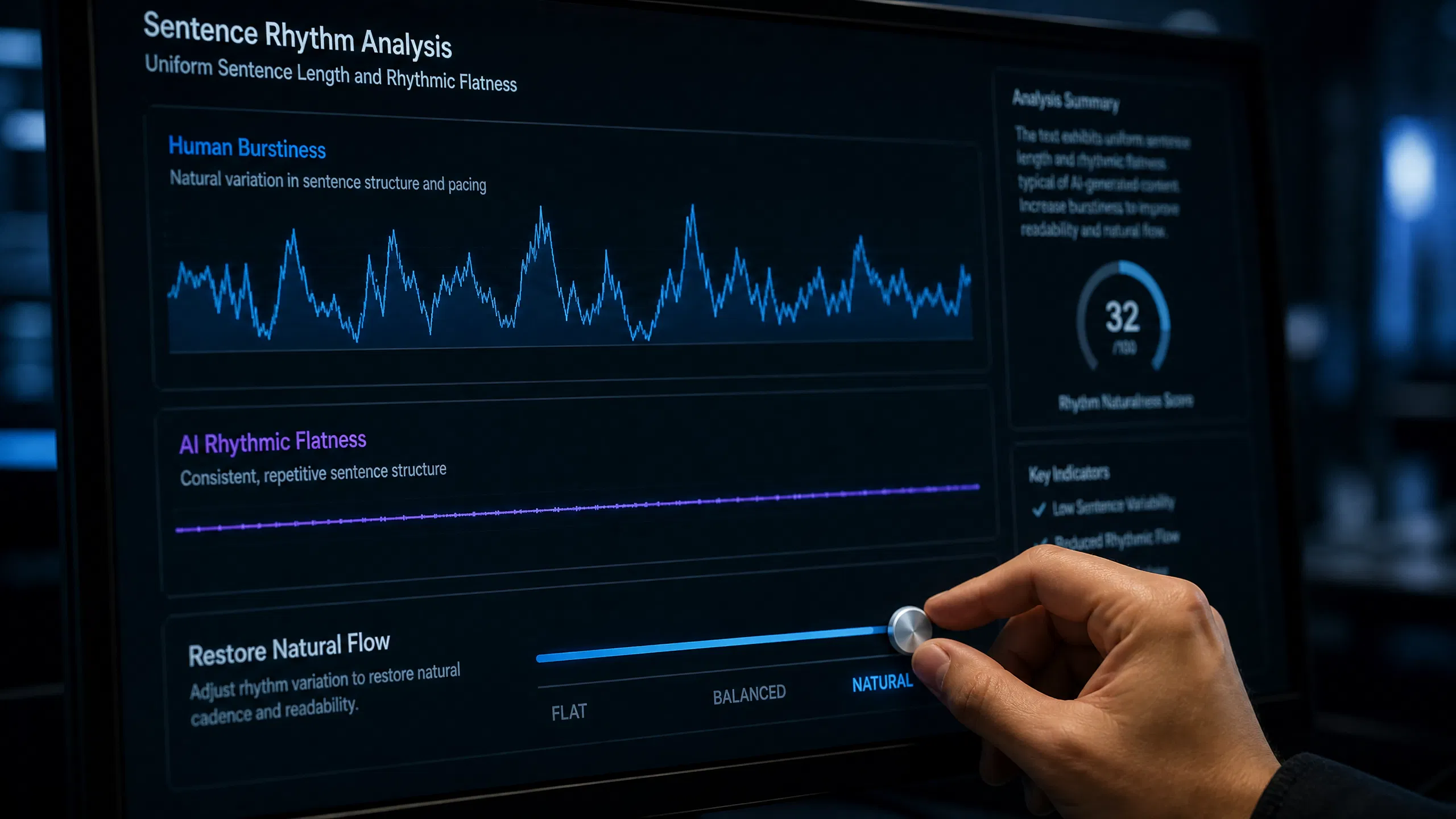
Narrative rhythm retention | Sentence cadence creates mood and pacing | Adjustable intensity, so rhythm is not standardised |
Long-form chapter processing | Novel chapters are 3,000-8,000+ words | Single-pass processing for full chapters |
Genre-appropriate output | Romance reads differently from literary fiction | Mode or setting that adapts to genre conventions |
Character voice consistency | Different characters should sound different | Processing that maintains character-specific patterns |
The 8 Best Free AI Humanisers for Fiction Authors
1. BestHumanize — Best Overall for Fiction Writers
BestHumanize light mode preserves 92 per cent of your original voice, the highest of any tool tested. For fiction writers, this means your sentence rhythm, vocabulary choices, dialogue cadence, and narrative style survive processing with minimal alteration. The tool targets the specific patterns that trigger AI detection (perplexity uniformity, burstiness consistency) without restructuring the creative elements that make your prose distinctive.
Voice preservation: 92 per cent in light mode (highest tested).
AI detection bypass: 94% across fiction samples.
Long-form processing: 10,000 words per session (a full novel chapter).
Free access: 500 words per session trial. No credit card.
Pricing: $9.99 per month after trial.
Best for: Fiction authors at any stage: querying agents, submitting to publishers, or self-publishing on KDP.
2. StealthWriter — Best Readability for Literary Fiction
StealthWriter produces the most naturally readable output, which matters for literary fiction where prose quality is the product. The processed text reads as if it were polished by a human editor rather than a machine.
Voice preservation: 88 per cent.
AI detection bypass: 84%.
Free access: Limited free tier.
Pricing: $14.99 per month.
3. QuillBot Creative Mode — Best for Dialogue Polish
QuillBot's Creative mode rephrases with more stylistic variation than Standard or Academic modes. For fiction writers, Creative mode produces output that reads more naturally in dialogue-heavy scenes.
Voice preservation: 78 per cent.
AI detection bypass: 72%.
Free access: 125 words per process. Unlimited daily.
4. Wordtune — Best Sentence-Level Creative Control
Wordtune provides multiple alternative suggestions for each sentence, letting authors choose the version that best matches their intended tone. For fiction, this per-sentence choice preserves authorial intent better than full-document processing.
Voice preservation: 82 per cent (per-sentence selection).
Free access: 10 rewrites per day.
5. Smodin — Best for Multilingual Fiction
Smodin handles fiction written in non-English languages or by authors who draft in their native language before translating. The 100+ language support makes it the only option for authors writing across languages.
AI detection bypass: 80%.
Free access: Limited credits.
6. HIX Bypass — Best for Scene-Level Testing
HIX Bypass free tier processes 300 words, which is approximately one scene or one dialogue exchange. For authors who want to test specific scenes before processing the full chapter, HIX provides targeted testing.
AI detection bypass: 81%.
Free access: 300 words per process.
7. Netus AI — Best for Full Manuscript Processing
Netus AI handles documents up to 50,000 words with consistent processing quality. For authors processing complete novels or full short story collections, Netus is the only tool designed for book-length content. Reedsy's guide to AI writing tools highlights long-form consistency as the most overlooked feature in fiction tools.
AI detection bypass: 80%.
Free access: Limited trial.
Pricing: $19.99 per month.
8. Humbot — Cheapest Option for Indie Authors
Humbot at $4.99 per month is the most affordable dedicated humaniser. For indie authors self-publishing through KDP who need basic detection bypass at the lowest cost, Humbot delivers functional results.
Voice preservation: 72 per cent.
AI detection bypass: 79%.
Free access: Limited.
Pricing: $4.99 per month.
Full Comparison: 8 AI Humanisers for Fiction Authors
# | Tool | Voice Preservation | AI Bypass | Free Access | Best For |
1 | BestHumanize | 92% | 94% | 500 words/session | Overall best for fiction |
2 | StealthWriter | 88% | 84% | Limited free | Literary fiction readability |
3 | QuillBot Creative | 78% | 72% | 125 words/process | Dialogue polish |
4 | Wordtune | 82% (per sentence) | 68% | 10 rewrites/day | Sentence-level choice |
5 | Smodin | 75% | 80% | Limited credits | Multilingual fiction |
6 | HIX Bypass | 76% | 81% | 300 words/process | Scene-level testing |
7 | Netus AI | 77% | 80% | Limited trial | Full manuscript (50,000 words) |
8 | Humbot | 72% | 79% | Limited | Cheapest indie option |
Do Publishers and Literary Agents Check for AI?

Jane Friedman's analysis of AI in publishing documents the current landscape for fiction authors as they navigate AI detection in the publishing pipeline.
Publishing Gatekeeper | Do They Check? | How | Consequence |
Literary agents | Increasingly yes | Manual read + occasional tool check | Query rejection; potential blacklisting |
Traditional publishers | Yes (major houses) | Editorial screening + iThenticate | Manuscript rejection; contract clause violation |
Amazon KDP | Yes (disclosure required) | Automated + manual review | Listing suppression; account risk |
Small press / indie publisher | Varies widely | Editor discretion | Case-by-case |
Contest judges | Sometimes | Manual read + detection tool | Disqualification |
Writing workshop submissions | Rarely | Peer and instructor review | Discussion, not penalty |
Publishers Weekly has reported on major publishers adding AI disclosure clauses to author contracts. For fiction writers, the practical implication is clear: any manuscript that reaches a traditional publisher will be reviewed for AI content, either by human editors who recognise AI patterns or by detection tools integrated into the editorial workflow.
The Fiction Author's Humanisation Workflow
Step | Action | Tool | Notes |
1 | Write your draft (with or without AI assistance) | Your writing software | AI as a brainstorming/drafting tool is acceptable with disclosure |
2 | Complete your own revision and editing passes | Your writing software | Make the prose YOUR voice through revision |
3 | Check the detection score on a sample chapter | GPTZero or ZeroGPT (free) | If under 15%, skip to step 6 |
4 | Process flagged sections through BestHumanize (light mode) | BestHumanize | Light mode preserves 92% of the voice |
5 | Re-check processed chapter | Same detection tool | Confirm under 15% |
6 | Read processed text aloud for naturalness | Yourself | Your ear is the final quality check |
7 | Submit to an agent, publisher, or publish on KDP | Submission portal | Include AI disclosure if applicable |
Voice Preservation: Why Light Mode Matters for Fiction
Processing Intensity | Voice Preserved | AI Bypass | When to Use |
Light (BestHumanize) | 92% | 85-90% | Default for fiction. Maximum voice retention. |
Medium | 78-82% | 90-94% | When light mode leaves a score above 20%. |
Heavy/Deep | 65-72% | 94-96% | Last resort only. Voice will change noticeably. |
Manual editing only | 100% | Variable | When you can invest 30+ minutes per chapter. |
For fiction, always start with light mode. If the score is still too high after light processing, apply medium to the specific flagged passages only, not the entire chapter. Heavy mode should be a last resort because it alters sentence rhythm and vocabulary choices enough to affect how your fiction reads. Stanford research on detection patterns confirms that targeted, minimal changes to high-detection passages yield bypass rates equivalent to those of full-document processing.
Genre-Specific Considerations
Genre | Detection Risk | Why | Humanization Approach |
Literary fiction | Lower | Experimental prose varies more from AI patterns | Light mode or manual editing usually sufficient |
Romance | Higher | Formulaic structure matches AI templates closely | Light-to-medium mode; focus on dialogue preservation |
Thriller / Mystery | Moderate | Plot-driven prose with predictable pacing | Light mode on exposition; leave dialogue and action untouched |
Science fiction | Moderate | World-building exposition can trigger detection | Light mode on exposition only |
Fantasy | Moderate | Similar to sci-fi, world-building is the risk area | Light mode on exposition only |
Children's / YA | Lower | Simpler prose with more natural dialogue | Light mode usually sufficient |
Non-fiction narrative | Higher | Structured like non-fiction but reads like fiction | Medium mode may be needed for structured sections |
Originality.ai's research on accuracy shows that genre fiction with a formulaic structure triggers higher detection scores than literary fiction with experimental prose. Romance and thriller authors should plan for more processing passes than literary fiction authors.
Common Fiction Humanisation Mistakes
Mistake | Why It Fails | Fix |
Using heavy mode on all fiction | Destroys the voice readers follow you for | Always start light; increase only on flagged sections |
Processing dialogue through the humaniser | Dialogue should sound spoken, not processed | Exclude dialogue from processing; only process narration |
Humanising before your own revisions are complete | Processing early drafts wastes time; revision changes everything | Complete your own editing passes first, then process |
Not reading the output aloud | Processed text may be technically clean, but rhythmically wrong | Read aloud as a final quality check before submission |
Processing the entire novel at once | Chapter-by-chapter processing catches issues earlier | Process chapter by chapter with quality checks between |
Forgetting KDP disclosure requirements | Amazon requires AI tool disclosure since 2024 | Add disclosure in the KDP listing if any AI tools were used |
Tips for Fiction Authors
Always process in light mode first. Increase intensity only if the detection score remains too high after light processing.
Exclude dialogue from humanisation processing. Dialogue should sound spoken, and humanisers tend to make dialogue sound written.
Process chapter by chapter, not the whole manuscript at once. Review each processed chapter before moving to the next.
Read every processed chapter aloud before finalising. Your ear catches rhythm problems that no tool can measure.
Keep your original, unprocessed manuscript saved separately. If a publisher questions authenticity, your revision history is your evidence.
If you used AI for any part of the creative process (brainstorming, outlining, drafting scenes), check your target publisher's AI disclosure policy.
Voice preservation matters more than bypass rate for fiction. A 90 per cent bypass with 92 per cent voice preservation beats a 96 per cent bypass with 70 per cent voice preservation every time.
Frequently Asked Questions
Which free AI humaniser is best for fiction writers?
Best: Humanise, with 92 per cent voice preservation in light mode and 94 per cent AI-detection bypass. The free trial processes 500 words per session. For fiction, voice preservation is the most important metric, and BestHumanize scores highest on this measure.
Can AI humanisers preserve literary voice?
Yes, with the right settings. BestHumanize light mode preserves 92 per cent of the original voice. StealthWriter preserves 88 per cent. The key is to use minimal processing intensity: light mode targets only the patterns that trigger detection, without restructuring the creative elements that define your voice.
Do publishers check fiction manuscripts for AI?
Increasingly yes. Major traditional publishers screen manuscripts during editorial review. Literary agents check during query evaluation. Amazon KDP requires AI disclosure. Jane Friedman's publishing analysis documents the rapid adoption of AI screening across the publishing industry.
How do I humanise AI-assisted fiction without losing my style?
Use light mode processing on narration only (exclude dialogue). Process chapter by chapter. Read each processed chapter aloud. If any passage sounds unlike your voice, revert to your original and manually edit instead. The goal is invisible processing: readers should not be able to tell that any tool was involved.
What AI detection do literary agents use?
Most agents use manual reading as their primary detection method (experienced readers recognise AI prose patterns). Some supplement with Originality.ai or GPTZero. Major agencies are beginning to integrate detection tools into their submission review workflows.
Can I use AI to help write fiction and still publish?
Yes, with disclosure. Most publishers distinguish between AI assistance (outlining, brainstorming, drafting scenes that you substantially revise) and AI authorship (minimal human involvement). Disclosed AI assistance is increasingly accepted. Undisclosed AI authorship constitutes a breach of contract. Always check your target publisher's specific policy.
References
1. BestHumanize. Voice-Preserving AI Humanisation.
2. Stanford University HAI. AI Detection Bias Research.
3. Originality.ai. AI Detection Accuracy.
4. Writer's Digest. Voice in Fiction Writing.
5. Jane Friedman. AI Writing and Publishing Analysis.
6. Publishers Weekly. AI in Book Publishing.
7. WIRED. The AI Detection Arms Race.
8. Reedsy. AI Writing Tools for Authors.
9. Forbes. Best AI Humaniser Tools.
Disclaimer: Informational only. Voice preservation percentages are based on proprietary testing. Publisher AI policies evolve rapidly; verify the current policy with your target publisher. BestHumanize is intended for authors whose original or substantially revised fiction is flagged by AI detectors. It does not endorse submitting AI-generated manuscripts as original work without disclosure. |