In processing a scholarly essay, an AI rewriting service does more than simply changing the sentences. It imposes all its statistical tendencies based on training data onto every sentence it creates – including preferences in words used, how strongly a claim is phrased, how a topic is framed, and which argumentation voice the paper will use. These preferences introduce biases in writing, since they reflect a tendency of generating sentences similar to the middle of the training data rather than those reflecting a unique voice of the author. Consequently, an essay generated with help from AI rewriting services would be fluent and correct in information but would lack individuality and argumentative power.
AI bias types input system application identifies that biases in AI systems are generally divided into input bias (biases embedded in the training data), system bias (bias introduced in algorithm design and development), and application bias (bias that emerges in specific deployment contexts). All three types affect AI essay rewriting. Training data predominantly drawn from Western academic publishing introduces perspective and cultural framing bias. System design that optimizes for statistical text properties rather than argumentative specificity introduces homogenization and simplification bias. Deployment context that does not account for the specific discipline or argumentative tradition of the essay introduces hedging and claim-calibration bias.
This guide identifies the five specific types of AI-generated bias most consequential for rewritten academic essays, explains how to detect each in a post-rewrite review, and provides specific correction strategies. Using an AI humanizer tool as one step in an essay workflow is appropriate when that step is followed by targeted bias review. Understanding what to look for makes the review process systematic and efficient rather than a vague general read.
Key Takeaways
The AI rewriting tool itself has biases built into it through its training data, algorithms, and use cases. These biases are not accidental mistakes; rather, they are deliberate trends within the system that apply to every rewritten text in a consistent way. There are five biases that have the greatest impact on essays written for academia: homogenization bias (voice alignment with the statistical mean voice), perspective bias (taking on implicit perspectives from training data sources), hedging bias (alteration of claim intensity away from the original stance), cultural framing bias (alteration of frame of reference towards Western academic standards), and simplification bias (oversimplification of argument).
Homogenization bias is the most pervasive and the hardest to detect because it does not introduce specific errors. It makes text less distinctive, less voice-driven, and less argumentatively specific, which is a quality degradation that reads as "smoother" or "more polished" rather than as wrong. A professor who knows the student's writing will notice it immediately. An automated quality metric will not flag it.
Hedging bias is the most consequential for academic integrity. AI rewriting tools tend to strengthen hedged claims into more confident assertions because confident assertions are more common in their training data and produce higher fluency scores. Converting "the data suggest that..." to "the data show that..." or "the evidence indicates..." to "the evidence proves..." changes the epistemic status of the claim in ways that may overstate what the evidence supports. This is both a quality problem and a potential integrity problem in scientific and academic contexts.
Cultural framing bias becomes particularly important when the writer’s argument relies heavily on non-Western scholarship, on scholarly works in languages other than English, or on viewpoints that are less common within the training data set used by the AI system in question. The AI rewriting tool will move the argument's framing towards the default culture inherent in its training data, usually that of English language academia and Anglo-American liberalism.
For all five biases, the approach used to correct the issue will be targeted revision of the relevant portion of the argument, as opposed to a re-read for quality in general. Targeted revision is quicker and more efficient than revision aimed broadly at any possible issues that could arise.
Bias Type 1: Homogenization Bias
AI homogenization bias writing documents research by UCLA Professor Francisco Castro showing that when multiple users ask AI to perform similar writing tasks, the results tend to have a specific tone or language that reflects the perspectives and preferences of the AI's creators rather than the variety of the users. Castro warns of a "homogenization death spiral" in which AI-generated content, trained on previous AI-generated content, progressively loses variety and nuance. For individual essay rewriters, homogenization bias means the rewritten essay sounds like a well-executed essay in general academic English rather than like the specific, argued, individual voice of the original writer.
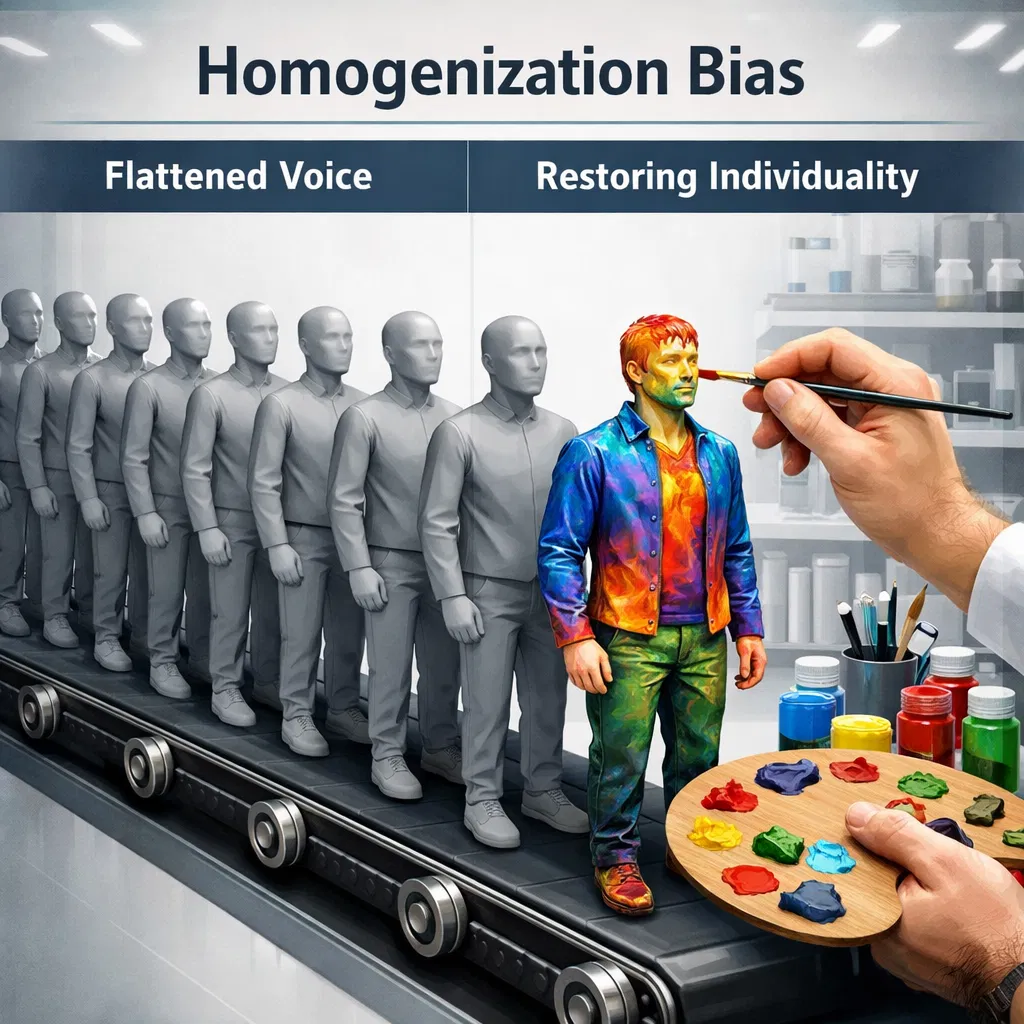
Homogenization Bias in Practice
Voice flattening: Individual stylistic quirks that make an author's writing unique—such as particular rhetorical devices, sentence structure, and choice of vocabulary—are smoothed out to match more typical and more statistically normal language choices. The essay becomes closer to the statistical norm in academic writing, rather than being closer to the unique voice of the author.
Transitional homogenization: Unique transitional logic, such as unusual paragraph starts, surprise turns in the argument, and rhetorical questions meant to highlight something difficult, are all smoothed over to become more typical transitional statements.
Argumentative smoothing: Complex and rough argumentative logic—intentionally rough argumentation used by advanced academic writers to convey the complexity inherent in an argument—is simplified into smooth argumentative logic.
Detecting Homogenization Bias
Compare the rewritten essay against two or three prior essays by the same writer in a similar register. Specifically note: Does the rewrite use the same vocabulary range as the prior essays? Do sentences begin in ways characteristic of the writer, or have more generic academic openers replaced them? Are the characteristic argumentative moves of the writer (how they introduce evidence, how they handle counterarguments, how they construct their conclusions) preserved or replaced by more generic equivalents? The signature of homogenization bias is an essay that reads as well-written in general but unfamiliar in voice. For additional context on what homogenization looks like in practice, see our pricing tiers at BestHumanize that include less aggressive statistical adjustment for writers whose primary concern is preserving voice while addressing detection profile.
Correcting Homogenization Bias
Selectively bring back the vocabulary, sentences structures, and argumentative techniques characteristic of the original author within the rewritten essay. In particular, pay attention to: the first sentence of each paragraph (the point where the author’s argumentative entrance style can be seen most clearly); how the author uses his/her sources in supporting arguments (the characteristic introduction and interpretation of sources by the author); and the conclusion (the place where the argumentative position of the author can be seen most plainly).
Bias Type 2: Perspective Bias
Perspective bias occurs when an AI rewriting tool's training data encodes implicit viewpoints, assumptions, or framings that differ from the writer's intended perspective, and those encoded perspectives appear in the rewritten output. This is distinct from factual error: the rewritten text may be factually accurate while subtly shifting the argumentative standpoint of the essay in ways the writer did not intend and may not notice on first read.
How Perspective Bias Manifests
Passive construction shift: Essays written from a critical or oppositional perspective that use active voice to assign agency ("the institution denied access to...") may be rewritten in passive constructions that remove agency ("access was denied..."), shifting the implicit argument about responsibility.
Normalization of contested claims: AI tools trained on mainstream academic literature may rewrite contested claims as if they were settled, particularly where the writer's original essay was positioned to challenge a consensus. "Critics argue that..." may become "It is generally recognized that..." when the AI tool's training data treats the mainstream view as settled.
Marginalization of alternative frameworks: Essays drawing on feminist theory, postcolonial criticism, disability studies, or other critical frameworks may find those frameworks' distinctive vocabularies and analytical moves replaced by more mainstream equivalents that lose the specific critical purchase of the original perspective.
Detecting Perspective Bias
Read the rewritten essay with specific attention to: (1) Where does the essay assign agency, and is that assignment preserved from the original? (2) Are contested claims still framed as contested, or have they been normalized? (3) Is the specific critical framework of the essay still identifiable in the rewrite, or has it been blended into generic academic discourse? Perspective bias is often subtle and requires reading with the original argument in mind rather than evaluating the rewrite on its own terms. For more guidance on perspective-preserving rewriting strategies, read our blog at BestHumanize.
Correcting Perspective Bias
Restore active voice in any passage where agency assignment matters to the argument. Restore the specific framing of contested claims as contested rather than settled. Restore the distinctive vocabulary of the analytical framework being used. These corrections often require returning to the original essay rather than the rewrite, because perspective bias can compound: once the AI has shifted a framing, subsequent sentences may be internally consistent with the shifted framing, making the error invisible when reading only the rewrite.
Bias Type 3: Hedging Bias
AI detection tools imperfection bias observes that AI writing can lack linguistic diversity and that AI tools have a tendency to produce text that is not as expressive as human writing. One dimension of this limitation is hedging calibration: human writers hedge claims precisely in proportion to the strength of their evidence, using a sophisticated vocabulary of epistemic markers that AI tools tend to normalize toward more confident assertions.
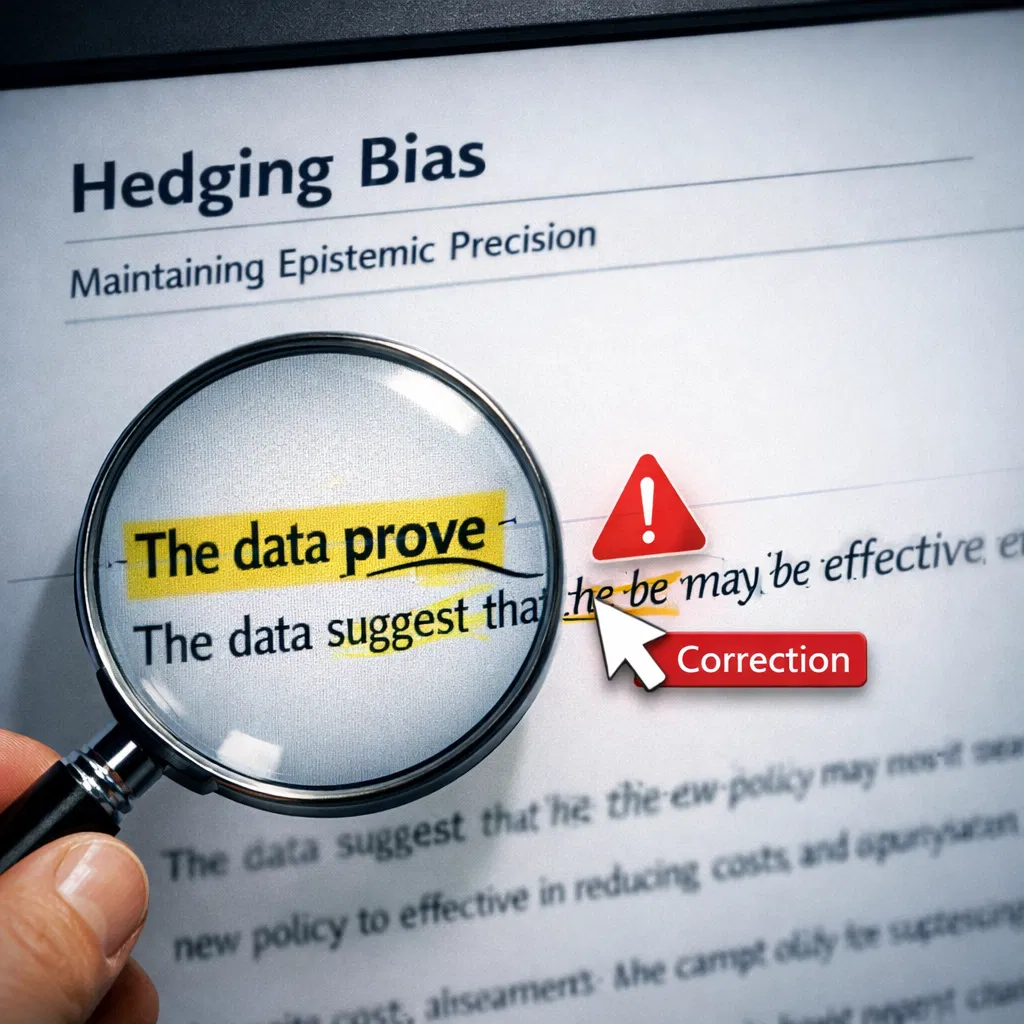
How Hedging Bias Manifests
Hedging bias typically moves in the direction of increased confidence, because confident, assertive prose is more common in the training data and scores higher on fluency metrics. Specific patterns include the following substitutions. "The results suggest..." becomes "The results show..." "The evidence may indicate..." becomes "The evidence indicates..." "One interpretation is that..." becomes "The interpretation is that..." "This could be explained by..." becomes "This is explained by..." Each substitution increases the epistemic confidence of the claim beyond what the evidence supports, which in academic and scientific writing represents a genuine accuracy problem, not merely a stylistic one.
Hedging bias can also move in the opposite direction for writers whose original prose was more assertive than their evidence strictly supports. AI tools may introduce hedges where none were intended, softening arguments that the writer meant to assert confidently. This reverse hedging bias is less common but occurs in contexts where the AI's training data associates the topic with uncertainty or controversy.
Detecting Hedging Bias
Create a two-column comparison: copy the original essay's key empirical claims and theoretical assertions in one column, and the rewrite's corresponding versions in the other. Compare the epistemic strength of each pair: has the hedging level changed? Words and phrases to watch for include: suggest vs. show vs. prove; may indicate vs. indicates vs. demonstrates; appears to vs. is; one possible explanation vs. the explanation. Any claim that is stronger in the rewrite than in the original deserves manual restoration of the original hedging level. For specific questions about how BestHumanize's statistical adjustment preserves hedging language, visit our FAQ for answers.
Correcting Hedging Bias
Restore every hedged claim to its original epistemic calibration. This correction has two layers: the specific epistemic verb or modal (change "shows" back to "suggests") and any modifying language that softens or qualifies the claim ("in this dataset" or "under the conditions tested" or "with the caveats noted above"). Epistemic precision in academic writing is not a style preference but an accuracy requirement. A claim that your evidence suggests something is different from a claim that your evidence shows it, and no rewriting tool should have the authority to upgrade that epistemic status.
Bias Type 4: Cultural Framing Bias
AI bias examples mitigation 2026 documents that AI training data biases include race, sex, age, and socioeconomic status, and that these biases originate in human cognitive and social biases reflected in the data. For academic essay rewriting, the most consequential cultural framing biases are the default toward Western academic conventions, Anglo-American rhetorical traditions, and English-language scholarly frameworks, which are over-represented in the training data of virtually all mainstream AI models.
How Cultural Framing Bias Manifests
Citation and source framing: Essays that primarily engage with non-English scholarship, non-Western academic traditions, or regional literature may find their AI rewrites shifting the framing toward Anglo-American scholarly conventions, including different citation norms, different argumentation styles, and different assumptions about what requires citation versus what can be asserted as common knowledge.
Assumed audience: AI rewriting tools trained on mainstream Western academic publishing may rewrite essays as if the audience is a Western academic reader, adding explanatory context for concepts that the original treated as established within the essay's actual disciplinary community, or removing context that the original included for non-Western readers.
Value and norm assumptions: Essays arguing from non-mainstream value frameworks (communitarian rather than individualist, relational rather than contractarian, non-Western conceptions of justice or personhood) may find those frameworks subtly reframed toward more mainstream Western liberal equivalents. These shifts are often small and individually not obvious, but cumulatively they can undermine the essay's argumentative positioning.
Detecting and Correcting Cultural Framing Bias
Cultural framing bias is the hardest type to detect because it requires recognizing what is absent rather than what is wrong. The key diagnostic question is: does this rewritten essay engage with its scholarly tradition and argumentative community the way the original did, or does it sound like a different tradition? Read the rewrite with attention to: which scholars are centered in the argument and which are marginalized; what is assumed as common knowledge and what is explained; and what value framework is implicit in how the argument is constructed. Corrections require restoring the original cultural framing rather than correcting specific errors. If in doubt about whether your rewritten essay has drifted in cultural framing, contact us at BestHumanize.
Bias Type 5: Simplification Bias
Simplification bias occurs when AI rewriting tools reduce the argumentative complexity of an essay in the direction of greater clarity and accessibility, at the cost of the nuance, qualification, and dialectical complexity that sophisticated academic argument requires. This bias reflects the optimization target of most AI rewriting tools: readability metrics reward simpler, clearer prose, which means the tools are systematically incentivized toward simplification even when complexity is appropriate.
How Simplification Bias Manifests
Qualification removal: Carefully constructed qualifications and caveats (the conditions under which a claim holds, the populations to which a finding applies, the methodological limitations of a conclusion) are simplified out of the rewritten prose as unnecessary complexity. The resulting rewrite makes claims that are cleaner and easier to understand but more absolute than the evidence supports.
Dialectical flattening: Academic arguments often include genuine engagement with counterarguments, where the writer presents a challenging position accurately and then responds to it substantively. AI rewriting tools tend to simplify this dialectical structure, either by weakening the counterargument to make the response easier or by truncating the response to the counterargument to reduce complexity.
Example reduction: Chains of examples and illustrations, which academic writers use to demonstrate the generality and robustness of their claims, may be condensed into single examples or removed as redundant. The resulting rewrite supports its claims with less evidence than the original, not because the AI assessed the examples as weak but because multiple examples increase complexity scores.
Detecting and Correcting Simplification Bias
Compare the density of qualification, counterargument engagement, and example use in the rewrite against the original. Simplification bias has occurred if: (1) the rewrite makes claims that the original qualified carefully; (2) the rewrite's response to counterarguments is shorter or less substantive than the original's; (3) the rewrite omits examples that appeared in the original without corresponding argument simplification. Corrections restore the specific qualifications, counterargument engagement, and evidential density of the original. This is distinct from simply adding back the original text: the goal is to preserve the AI's fluency improvements while restoring the argumentative complexity the original required.
AI Essay Rewriting Bias: Reference Table
Bias Type | What It Does | How to Detect | How to Correct |
Homogenization | Flattens writer's distinctive voice toward statistical average academic prose | Compare rewrite against prior writing samples; note where rhetorical moves and vocabulary differ characteristically | Restore characteristic vocabulary, sentence rhythms, and argumentative moves selectively throughout |
Perspective | Shifts implicit viewpoint, agency assignment, or critical framework toward training data defaults | Check agency assignment in active/passive voice; verify contested claims remain contested; confirm critical framework vocabulary survives | Restore active voice where agency matters; re-contest normalized claims; restore framework-specific vocabulary |
Hedging | Strengthens hedged claims into more confident assertions; occasionally over-hedges assertive claims | Two-column comparison of original vs. rewrite epistemic verb for each major claim | Restore original hedging verb and any modifying qualifications exactly as written in the original |
Cultural framing | Shifts cultural frame of reference toward Western/Anglo-American academic defaults | Check which traditions are centered; what is assumed vs. explained; what value framework is implicit | Restore original scholarly tradition framing, audience assumptions, and value framework positioning |
Simplification | Reduces argumentative complexity: removes qualifications, weakens counterarguments, cuts examples | Compare density of qualification, counterargument engagement, and examples in original vs. rewrite | Restore specific qualifications, counterargument depth, and evidential density from original |
The Post-Rewrite Bias Review Protocol
AI bias sources correction Chapman notes that addressing bias in AI requires diverse and representative data, bias detection tools, and continuous monitoring. For writers reviewing AI-rewritten essays, the equivalent is a structured, category-by-category review protocol that addresses each bias type systematically rather than relying on a general quality read that catches some problems and misses others.
Step 1: Voice Comparison (Homogenization Bias)
Open a prior essay by the same writer in a similar register alongside the rewrite. Read the opening paragraph of each and note the first five vocabulary choices and sentence structures. If the rewrite's opening is substantially less distinctive than the prior essay's, homogenization bias is present. Flag the first sentence of each paragraph in the rewrite for potential voice restoration.
Step 2: Agency Audit (Perspective Bias)
Search the original essay for every active-voice sentence that assigns agency to a specific actor (an institution, a policy, a historical force, a social structure). Verify that each corresponding sentence in the rewrite preserves the agency assignment. Note any shift from active to passive that removes or obscures the assigned agent.
Step 3: Epistemic Verb Comparison (Hedging Bias)
Compile a list of every epistemic verb and modal in the original essay: suggest, indicate, demonstrate, show, prove, may, might, appear to, seem to, could, would, is likely, appears to be. Compare each against its counterpart in the rewrite. Flag any claim that has been upgraded to higher epistemic confidence than the original.
Step 4: Framework Vocabulary Check (Cultural Framing Bias)
List every term that is specific to the analytical or theoretical framework the essay uses. Verify that each term appears in the rewrite with the same meaning and in the same argumentative position. Flag any passage where a framework-specific term has been replaced or where the framing of an argument has shifted toward a different analytical tradition.
Step 5: Complexity Density Comparison (Simplification Bias)
Count the number of explicit qualifications (conditions under which a claim holds), counterargument engagements, and examples used to support each major claim in both the original and the rewrite. Flag any claim that has lost qualifications, any counterargument engagement that has been shortened, and any chain of examples that has been condensed.
Solution Section: Bias-Aware Use of AI Rewriting
AI bias 16 examples mitigation guide identifies that addressing bias in AI requires bias detection tools, continuous monitoring, and diverse and representative data. For essay writers specifically, the mitigation strategy is bias-aware use that combines AI rewriting with systematic post-rewrite review.
BestHumanize is designed to minimize three of the five bias types described in this guide. By targeting statistical properties (perplexity and burstiness) rather than vocabulary and framing, it avoids introducing the perspective, cultural framing, and hedging biases that vocabulary-substituting paraphrasers routinely introduce. Homogenization bias is present in any tool that adjusts text toward the statistical center, including BestHumanize, and requires voice restoration by the writer. Simplification bias is not introduced by BestHumanize's statistical approach but may be introduced if the essay was also processed through a vocabulary-rewriting tool before or after statistical adjustment.
The recommended bias-aware workflow is: run BestHumanize for detection profile adjustment; apply the five-step post-rewrite bias review protocol above; make targeted corrections for any bias type detected; and run a final detection verification to confirm the corrections have not substantially shifted the statistical profile back toward the flagged range. For most essays, targeted bias corrections do not significantly alter the statistical properties adjusted by BestHumanize, because the corrections are restoring content-level specificity rather than changing the sentence-level statistical patterns the tool targets. Learn about BestHumanize to understand how the tool's statistical approach minimizes these bias risks by design.
Conclusion
AI rewriting tools introduce five systematic biases into academic essays: homogenization bias that flattens distinctive voice, perspective bias that shifts implicit viewpoints, hedging bias that miscalibrates claim strength, cultural framing bias that defaults toward Western academic conventions, and simplification bias that reduces argumentative complexity. None of these biases is random; all are predictable consequences of how AI tools are trained and optimized. Detecting them requires category-specific review rather than general editing, and correcting them requires targeted restoration of what the AI removed rather than general revision. Writers who understand these bias patterns and apply systematic post-rewrite review will produce essays that combine the statistical improvements AI tools provide with the argumentative specificity, epistemic precision, and cultural positioning that good academic writing requires.
Frequently Asked Questions
What types of bias do AI rewriting tools introduce into academic essays?
AI rewriting tools introduce five types of bias that are systematically consequential for academic essays. Homogenization bias flattens the writer's distinctive voice toward the statistical average of the training data, producing prose that reads as generic academic English rather than as the specific writer's voice. Perspective bias introduces implicit viewpoints from the training data that differ from the writer's intended argumentative standpoint, including shifts in agency assignment and normalization of contested claims. Hedging bias miscalibrates the epistemic strength of claims, typically strengthening hedged findings into more confident assertions because confident prose is more common in the training data. Cultural framing bias shifts the essay's frame of reference toward the Western and Anglo-American academic defaults that dominate training data, affecting how scholars are centered, what is assumed versus explained, and what value frameworks are implicit. Simplification bias reduces argumentative complexity by removing qualifications, weakening counterargument engagement, and condensing evidential examples.
How does homogenization bias affect rewritten essay quality and what are the signs?
Homogenization bias affects rewritten essay quality by making the essay less distinctive, less voice-driven, and less argumentatively specific, without introducing obvious errors. The signs are subtle: the opening of paragraphs uses more generic academic openers than the writer characteristically employs; vocabulary choices are common and interchangeable rather than specifically selected; rhetorical moves that are characteristic of the writer, such as how they introduce evidence or construct counterarguments, have been replaced by more conventional equivalents; and the essay reads as a well-executed piece of generic academic writing rather than as the work of a specific writer with a specific voice. Homogenization bias is detected by comparison with prior writing samples rather than by reading the rewrite in isolation. It is corrected by selectively restoring the writer's characteristic vocabulary, sentence rhythms, and argumentative moves in the passages where the rewrite sounds least like the writer.
How can writers detect perspective and cultural framing bias in AI rewrites?
Detecting perspective bias requires reading the rewritten essay with specific attention to three questions: where does the essay assign agency, and is that assignment preserved from the original? Are claims that the original framed as contested still framed as contested in the rewrite, or have they been normalized into accepted facts? Is the specific critical or theoretical framework of the essay still identifiable in the rewrite, or has it been absorbed into generic academic discourse? Detecting cultural framing bias requires asking which scholarly traditions are centered in the rewrite versus the original, what is assumed versus explained in the rewrite versus the original, and whether the value framework implicit in the argument is the same in both. Cultural framing bias is particularly consequential for essays drawing on non-Western scholarly traditions, feminist theory, postcolonial criticism, or other frameworks that are under-represented in the training data of mainstream AI models.
What is hedging bias in AI rewriting and why does it matter for academic integrity?
Hedging bias is the systematic tendency of AI rewriting tools to strengthen hedged academic claims into more confident assertions. It matters for academic integrity because the epistemic calibration of claims in academic writing is not a stylistic preference but an accuracy requirement. When a scientific paper says "the results suggest that..." rather than "the results show that...", the difference reflects a genuine assessment of the strength of evidence. An AI tool that upgrades "suggest" to "show" has changed what the paper claims about the quality of its evidence. In scientific contexts, this change misrepresents the findings. In any academic context, it misrepresents the writer's epistemic position. The specific detection method is a two-column comparison of every epistemic verb and modal in the original against its counterpart in the rewrite, flagging any that has been upgraded to higher confidence. Correction requires restoring the original hedging verb and any accompanying qualifications exactly as the writer intended them.
How should writers systematically correct AI-introduced bias after rewriting?
Systematic correction follows the five-step post-rewrite bias review protocol. First, voice comparison against prior writing samples identifies homogenization bias in the opening of each paragraph and in the essay's characteristic rhetorical moves. Second, an agency audit of every active-voice sentence that assigns agency in the original identifies perspective bias in passive construction shifts. Third, an epistemic verb comparison for every major claim identifies hedging bias in either direction. Fourth, a framework vocabulary check verifies that every term specific to the essay's analytical tradition appears in the rewrite with the same meaning and argumentative position. Fifth, a complexity density comparison counts qualifications, counterargument engagements, and examples in both original and rewrite to identify simplification bias. Corrections in each category are targeted restorations of specific content rather than general revisions, which makes the correction process faster and more reliable than a general re-edit of the entire essay.