Learning management systems have changed how people access education, but using online learning platforms also comes with downsides related to academic honesty and the use of artificial intelligence tools for writing. While students' writing processes in a traditional classroom are partially observable through the drafts they hand in and their in-class writing, they are not observable when using an LMS.
AI essay-rewrite software is readily available online, and its use among online learners is becoming increasingly common. The problem is not whether a student should use such a tool; he or she has obviously already chosen to do so, but rather what type of writing to produce when using it so that a person adheres to his or her institution's policies and personal learning process.
This paper presents a framework for the ethical adoption of artificial intelligence essay-writing tools in online education. The paper highlights institutional policies on the matter, disclosures regarding their adoption, potential dangers associated with their use, and implementation methods.
If you want to understand how a responsible humanization workflow looks in practice, explore the BestHumanize tool and its approach to output quality and writer control before applying it to any assessed work.
Key Takeaways
There are certain integrity issues associated with online learning, as the writing process is invisible to the instructor, and the ethical use of any artificial intelligence tool depends on each student's adherence to institutional guidelines.
It is essential to read and comprehend the relevant AI tool policy implemented by your institution prior to employing any kind of rewriting tool for writing any assessed piece of work.
The most appropriate approach to using AI essay rewriting tools is to treat them as instruments for improving and refining the initial draft.
In addition, disclosure procedures regarding the use of AI tools are developing rapidly in online institutions in 2026.
If you aim at enhancing your skills in writing through utilizing artificial intelligence tools, then the key point is to analyze the suggestions made by AI.
Why Responsible AI Tool Use Matters More in Online Learning
While the switch to e-learning has not affected the definition of academic integrity itself, it has altered the context in which it applies. In a classroom environment, teachers can guide students through the entire composition process, from generating initial ideas to workshopping first drafts, peer reviewing, and incremental submission. When taking classes online in an asynchronous format, a student can go directly from interpreting the assignment to submitting a complete final version without being seen anywhere in between.
In this regard, it is up to the student to determine what constitutes acceptable or unacceptable academic practice. This also implies that, while the boundary between enhancing one’s academic writing with an AI tool and plagiarizing lies solely where the student draws it, there will be no consequences for crossing this line beyond those that follow from academic and professional norms.
Research published in Frontiers in Education on the impact of generative AI on academic reading and writing confirms that students who use AI tools strategically and critically develop stronger writing skills than those who use them as shortcuts, reinforcing that how tools are used matters as much as whether they are used.
Understanding Your Institution's AI Policy
Before you use an AI-based rewriting service for any evaluated task, the foremost thing you should do is to identify the current AI policy at your institution. As we move into 2026, there will be wide variations in these policies: some will impose complete bans on AI-based services, while others will allow their use as long as it is declared.
What Most Policies Cover
AI policies adopted by institutions within online education systems typically cover four categories: which types of AI support can be used, which cannot, which require disclosure, and what sanctions will apply in the event of a breach. It is crucial to understand these four aspects before starting anything. An AI policy that allows AI grammar checks but forbids AI paraphrasing of sources will require a completely different approach than one that allows all AI support with disclosure.
For a current overview of how leading universities have updated their generative AI policies for 2026, our AI writing guides on the BestHumanize blog summarize key policy categories and their implications for student writers in online programs.
Assignment-Level Variation
Even within a single institution, the use of AI for an assignment may be restricted differently depending on the assignment type. If you write a reflective essay that is meant to show experience, for example, the restrictions will be stricter on the use of AI writing services than when writing a literature review, whose major requirement is source integration.
If there is no clear policy on how to use AI tools in a particular assignment, the best thing would be to consult with your instructor first. Instructors tend to welcome proactive students more than those who try to retroactively guess the limits of acceptable use of AI tools.
Disclosure Requirements
More and more online organizations today require students to disclose whether they used AI when creating their graded assignments, even though it is allowed. The ways of disclosure differ from one organization to another. Some of these organizations request a note be included in the work, while others ask students to explain their usage of AI technologies in a process reflection on an assignment.
Questions about how disclosure requirements interact with AI detection systems used by your institution? Our AI writing FAQ covers how detection tools and disclosure policies relate to each other in online learning contexts.
The Difference Between Supportive and Substitutive AI Use
For any student seeking to understand the proper use of AI tools in an online environment, the best classification is whether they are using AI to aid their writing process or to replace it. This distinction may not be immediately apparent, but there are distinctive traits.

Supportive Use
When used as an aid, the AI rewriting software is applied to the text you've already written, refined, and analyzed. You run the sentence through the software for clarification of the sentence you've already written, to look for the passivity of the construction that will be better stated in the active voice, or whether the paragraph that sounded weird to you sounds equally weird to the new processor. Your mental effort, including your research, formulation of arguments, selection of evidence, and reasoning, stays yours entirely.
For a well-researched perspective on why AI detection systems in online learning sometimes flag authentic student writing, the Stanford HAI report on AI detector bias against non-native English writers provides important context on the limitations of automated detection and why responsible use matters for all students.
Substitutive Use
Substitutive use occurs when an AI tool replaces the intellectual effort the user should put into writing the assignment. In this case, students might try to use a rewriter to generate arguments that are not their own, paraphrase sources without fully understanding them, or turn a set of their notes into a coherent essay using a rewriter without engaging in the reasoning process on their own. In this case, although the final product looks fine, the learning process behind it does not occur.
The only thing that might help determine whether the use of an AI tool was substitutive is whether the user could still prove the essay's arguments and back them up without the text itself.
Review BestHumanize's plans and pricing to understand the feature set available at each tier, and determine which level of assistance is appropriate for your specific assessed writing context.
How Online Institutions Detect AI-Rewritten Essays
Understanding how AI detection works in the online learning environment is important for helping students use AI tools responsibly and avoid false positives for those who have never used them.
Detection Tools Used by Online Platforms
AI detection is built into most of the virtual classrooms available in 2026, or third-party applications like Turnitin, GPTZero, or Originality.ai are used. These applications analyze the written submission by checking for statistical indicators of AI-generated content, including sentences of roughly the same length, repetitive transitions, low perplexity, and a lack of tone variability. Some virtual learning environments even consider each student's previous written work to identify changes in writing style.
For a current evaluation of how accurately leading AI detection tools perform on student essays in 2026, the SupWriter analysis of AI detector accuracy provides tested data on false-positive and false-negative rates across major platforms used in academic settings.
False Positives and Their Consequences
The AI detection tools cannot be considered definitive; they are probabilistic. They only provide a score indicating the likelihood that the text is plagiarized or machine-generated, without passing judgment. It is well known that false positive results, meaning instances when a human-made work is detected as generated by an AI, have been occurring for a long time.
Turnitin's own published analysis of false-positive rates in AI writing detection acknowledges the limitations of sentence-level detection and recommends that institutions treat detection scores as one data point in a broader academic integrity evaluation rather than as conclusive evidence of misconduct.
It should be noted that when AI rewriting applications are used in a proper way by students, meaning using them on one’s draft instead of creating a text from scratch, then knowing that there will be detection flags in cases of proper use of the tool can be a good incentive to keep copies of all your writing process.
Why Humanized Text Can Still Be Flagged
Students who apply humanization techniques solely to avoid machine detection might still have their work recognized as AI, especially when humanization creates a pattern that the detection system can identify. Moreover, some systems specialize in recognizing texts written by known human authors alongside AI-generated outputs.
The NetusAI analysis of why AI detectors flag human writing explains the statistical mechanisms behind both false positives and the detection of humanized AI text, which is useful context for any student navigating detection risk in an assessed submission.
Responsible Workflow for Online Learners
The following workflow outlines the responsible use of AI essay rewriters in online learning contexts where their use is permitted, provided appropriate disclosure.
Step One - Draft First, Tool Second
It is always advisable that you create your own original draft prior to using any form of AI rewriter. The draft doesn't have to be well-written; it should simply reflect your own thoughts and understanding. It should show how you approached the information you have been given, the arguments and ideas you came up with, and the evidence that you selected to support yourself.
For guidance on using AI rewriting tools specifically to improve structured academic drafts without distorting original arguments, the WriteBros.ai review of AI rewriters for academic writing compares tools by their ability to preserve thesis clarity and argument sequencing.
Step Two: Apply Tools to Specific Problems
Do not go around using a text rewriter for your whole essay. Instead, pick those particular parts of the paper where you need some assistance. This way, you can pinpoint those awkward sentences, overly used passive voice, or that one bad transition between two paragraphs. It will be more effective to rewrite parts selectively rather than the whole paper, which will keep you thinking about the results rather than just reading them.
Step Three - Review Every Suggested Change
Look over each suggestion the program offers before you accept any changes. Does the rewrite of the text convey the same meaning as your own words? Is it clearer than what you wrote? Are you as comfortable explaining the new version as the old one? If the rewrites help clarify the meaning without changing anything else, you should accept the suggestions. Otherwise, they should be left alone or returned to their original state.
If you have questions about how to evaluate AI rewriting output for responsible use in specific academic contexts, contact the BestHumanize team for practical guidance on responsible tool integration in online and blended learning environments.
Step Four: Disclose According to Policy
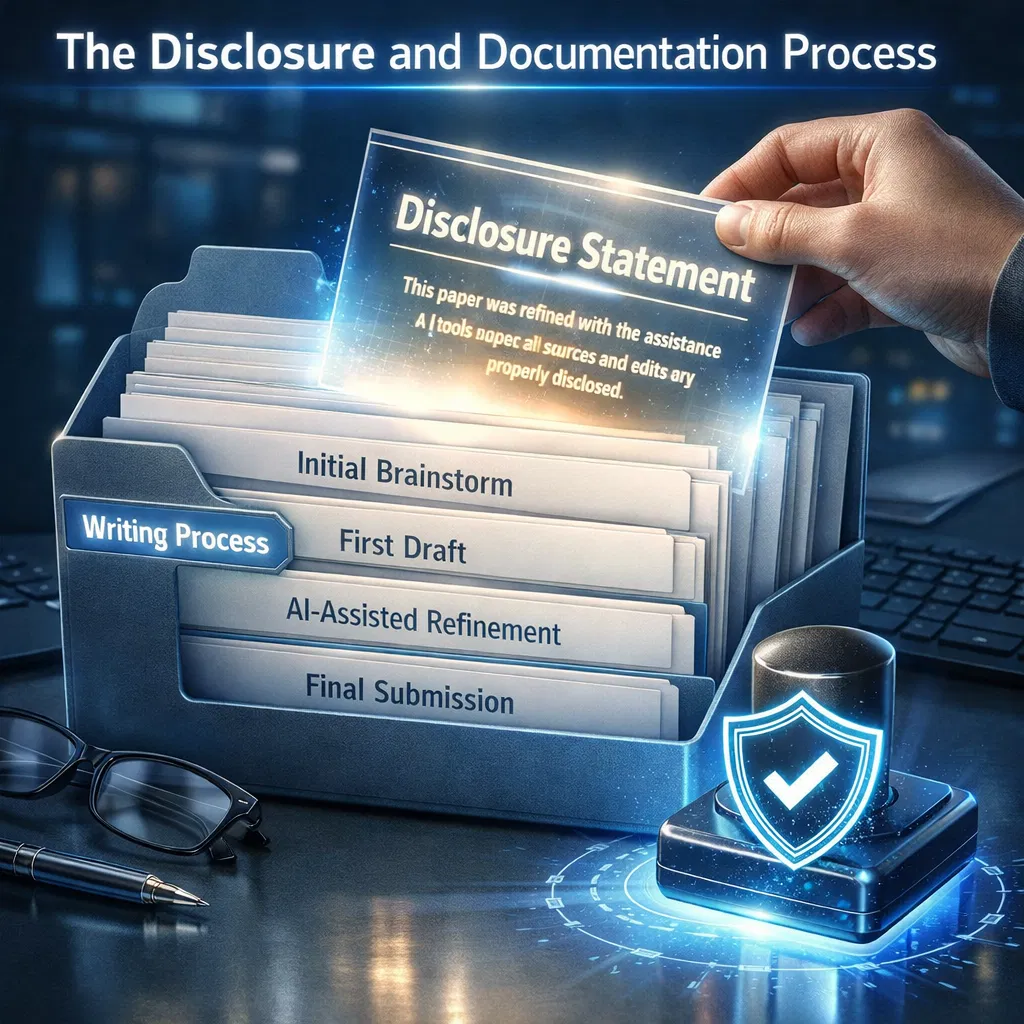
After rewriting and reviewing, it is time to write your disclosure statement, if required. A good disclosure statement tells the reader about the tool used, the parts of your writing where the tool was used, the type of changes that the tool made, and the process of reviewing and being responsible for your writing. It is this depth of information that shows the tool was used as a writing aid.
Step Five: Retain Your Process Documentation
Save copies of your initial draft, as well as any intermediate drafts that were made along the way, and all the notes or outlines made while preparing the assignment. Should there ever be suspicion that you have cheated in any form with the use of an automated checker, and you are required to prove your honest effort in creating the work, this evidence will come in handy.
Learn more about how BestHumanize approaches responsible tool use and output quality on our about page, which outlines the principles guiding our tool design and the writing outcomes we are built to support.
How Responsible AI Tool Use Supports Learning
The use of AI essay-rewriting tools, combined with active engagement in the process, can become a powerful instrument for developing writing skills in online learners, rather than merely delivering a superior piece of written work. The core idea here is to view the tool's output as feedback rather than the result itself.
When one learns to analyze the output generated by the rewriting tool to determine what makes it a more successful attempt at formulating thoughts, he or she practices solving the problems encountered. As time passes, writers who use AI writing help in this way develop stronger independent skills in formulating ideas because they learn why the output is successful and how to recreate that elsewhere in their texts.
Those who take everything for granted without considering what the tool does for them lose a lot. They receive better work, yet the knowledge that will be reflected in future drafts on their own remains absent.
Conclusion
Responsible use of essay rewriting tools using AI technology within the framework of online education involves making conscious decisions at every step, such as when to use such tools, what types of tools should be used, how to assess the results of working with these tools, and how to disclose tool usage to the respective educational institution. These decisions can hardly be considered hard to do once one understands the basics: intellectual labor must come first, while these tools are supposed to help in better expressing one’s ideas rather than generating them; furthermore, disclosure of one’s use of these tools to one’s institution is necessary.
The main advantage of AI rewriting tools for online students in 2026 is that they can use these tools to develop their paper-writing skills. This implies a critical evaluation of tools' results, keeping track of the writing process, and reporting on AI use to one’s institution.
Frequently Asked Questions
How do I use AI essay rewriters without violating academic integrity?
The main rule of academic integrity is that your ideas and efforts in terms of research and the development of your argument are your own work. Do not use an artificial intelligence (AI) rewording program unless you have written a first draft, and even then, use it sparingly and only in regard to issues of clarity, and not document creation.
What should I do if my institution's AI policy is unclear?
Always check with your instructor or the university department regarding the use of any AI writing tool. It is much better to seek clarification from your professor beforehand rather than guessing at the meaning of a policy on your own. Many professors appreciate proactive students like this.
Do online institutions always detect AI-rewritten essays?
No. AI detection services are probabilistic and output probability estimates rather than binary determinations. There are known false-positive rates for these services, which have also been found to miss some AI-generated submissions. But advances in detection technology are progressing quickly in 2026, so it is not advisable to use them as an excuse to go beyond institutional policies on AI tool use.
How should I disclose the use of AI tools in an online course?
Adhere to the particular style guide prescribed by your institute, if one is available. In case there is no specific style guide available, it will be wise to make a note in your paper about which software you have used, in which portions it was employed, what kinds of modifications were performed, and how you validated the output.
Can AI rewriting tools help me improve as a writer in an online program?
Indeed, but only if the use of such a resource is paired with active participation. Analyzing why a certain tool helps to reformulate a difficult sentence in a more effective manner, comprehending what principles underlie this process, and using this knowledge in other cases, while writing, all these actions gradually increase one’s writing proficiency. Those students who actively use such resources write better than those who don’t.
Disclaimer: This article is provided for informational and educational purposes only. BestHumanize.com does not provide legal or academic legal advice. AI tool policies vary significantly across institutions and are updated frequently. Students are solely responsible for understanding and complying with their institution's AI use policies before using any rewriting tool on assessed academic work. The information in this article reflects general guidance current as of April 2026 and does not constitute a guarantee of policy compliance in any specific academic context.