For millions of scholars, students, and other individuals who compose in English as their second and third language, creating high-quality academic compositions entails much more than technical proficiency. The process requires linguistic agility, cultural translation, and persistence. Such individuals must express intricate ideas in a language whose syntactical structures might seem foreign and awkward, and they face institutional environments that might not be optimized for them.
The advent of essay rewriters powered by artificial intelligence has been a boon for multilingual authors in such settings. If used properly, such tools can enable writers to hone their sentence composition skills and ensure conformity with established academic conventions without sacrificing their unique literary voice. However, using AI tools for such purposes entails its own set of problems. In particular, advanced AI detection tools, which are used at many universities worldwide, frequently identify the writing of ESL speakers as AI-generated on account of stylistic differences.
This article examines how AI essay rewriting can genuinely support multilingual writers and those working across languages, the risks that remain, and how tools like the BestHumanize humanizer are helping writers maintain authenticity in an era of heightened detection scrutiny.
Key Takeaways
AI rewriting services for essays provide tangible benefits to multilingual authors by enhancing sentence structure, precision, and adherence to academic standards.
AI detectors tend to flag non-native English writing as plagiarism, putting multilingual authors at an unnecessarily high risk of false detection.
When used wisely, AI rewriting services enable ESL students to meet institutional requirements while retaining their own identity.
It is necessary to combine the use of AI services and human editing to achieve both advantages — clear writing and a personal standpoint.
By acknowledging AI rewriting's shortcomings in handling language variation and translation issues, it is easier for multilingual authors to use AI services.
Why Multilingual Writers Face Unique Writing Challenges
Academic writing in a second language poses multiple complicating factors simultaneously. The grammatical conventions that are obvious to a writer's native tongue will rarely translate seamlessly into English. Phrases that sound entirely normal when expressed in Mandarin, Arabic, or Portuguese may yield a style that sounds indirect and too formal when read by a native speaker of English. A writer's vocabulary selection might include false cognates or literal translations of phrases that are grammatically correct but foreign-sounding.
This results in academic writing with consistent sentence length, a narrow vocabulary, and formulaic transitions. This is a reasonable response from a writer strained by their linguistic capacity; however, it is strikingly similar to the pattern produced by artificial intelligence in language generation. In fact, this similarity is not coincidental at all. It is one of the primary reasons why such systems are easily identified by perplexity-based detection algorithms.
Research from Stanford University has directly confirmed this bias. AI detection systems misclassify non-native English writing as AI-generated at significantly elevated rates, raising serious concerns about equity in academic settings where such tools are used as evidence of misconduct.
How AI Detection Bias Affects ESL and Multilingual Students
Detection bias can be seen as more than just a nuisance. In cases where a student's essay is flagged by AI technology despite being written manually, disciplinary action may be taken, including investigation and demerits. For foreign students trying to adjust to a new educational institution, it can be very unsettling when additional pressure is imposed on them.
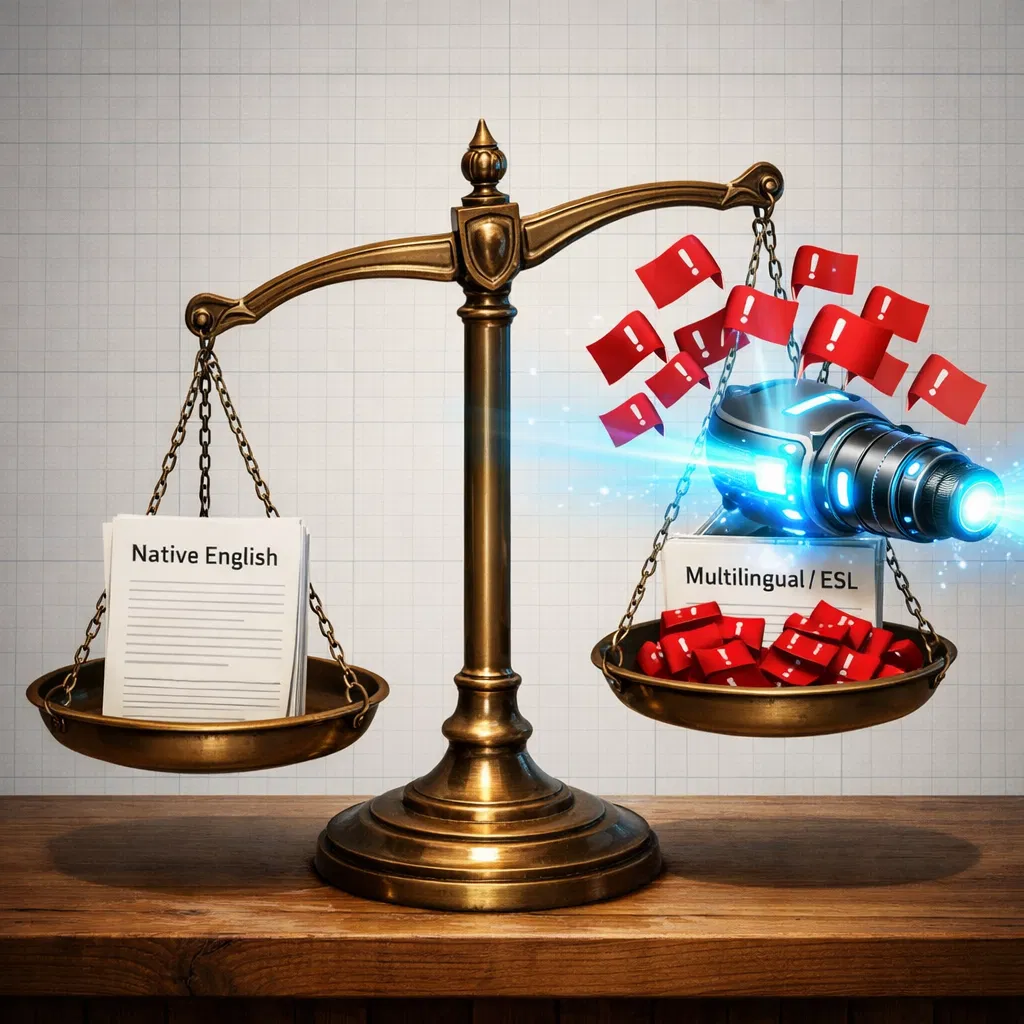
In some studies, up to 60% of the false positives were from essays written by students whose first language is not English. Furthermore, in some research papers, it was found that almost all of the essays written by students whose first language was not English were flagged by the software tools. This happens because most plagiarism detection tools are trained only on the native English language.
Turnitin has published its own analysis suggesting that its detector does not show statistically significant bias against English Language Learners when documents meet a minimum length threshold. The Turnitin ELL bias study offers a counterpoint to the broader research literature, though many independent researchers argue that institutional reliance on any single detection system remains premature, given the documented variability in outcomes across student populations.
What AI Essay Rewriting Tools Can Do for Multilingual Writers
Improving Grammar and Sentence Flow
The most obvious advantage for a multilingual writer using an AI-based rewriting tool is the ability to correct grammar and improve fluency. The software will detect errors in agreement and awkward sentences that the writer might overlook because the initial sentence sounds correct in the context of their own language. An effective rewriting software will maintain the original meaning but use sentence structures that fit the style of academic English.
Not only does an efficient rewriting tool correct grammar issues, but it also varies sentence lengths and structures in a way that resembles natural human writing. This feature is especially vital for multilingual writers since burstiness helps avoid detection. Writers looking for tools that combine grammar support with detection-aware rewriting can explore AI writing tools for academic use to find options suited to their level and discipline.
Preserving Authentic Voice Across Languages
One of the most common concerns raised by multilingual writers when considering AI rewriting tools is that the output will erase their individual voice. This is a legitimate worry. Some AI tools overcorrect to produce text that is so polished and uniform it sounds nothing like its author, and, ironically, is more likely to trigger detection than the original imperfect draft.
The best rewriting tools take a more measured approach, focusing on improving clarity and correctness while retaining the structural and tonal choices that reflect the writer's original intent. These tools work best when they are used to refine rather than replace, allowing multilingual writers to maintain ownership of their arguments while benefiting from linguistic scaffolding. A broader review of top AI academic writing tools in 2026 highlights several platforms that specifically prioritize voice preservation as a design principle.
Supporting Draft Translation and Cross-Language Workflows
Many multilingual writers work in hybrid language workflows. A researcher might draft initial ideas in their native language, translate them into English, and then refine the translation to conform to academic conventions. This three-stage process is exhausting without support, and even strong human translators cannot always bridge the gap between technical accuracy and fluent academic prose.

AI essay rewriting tools fill this gap by transforming translated text into writing that reads naturally within academic contexts. Rather than replacing human translation, these tools serve as a post-translation layer that addresses idiom, register, and flow. Writers who want to understand the limitations of traditional tools in this space can read about how plagiarism tools struggle with AI-era writing to better appreciate why newer rewriting-focused approaches offer meaningful advantages.
Navigating AI Detection When Writing Across Languages
For multilingual students who have used any kind of AI to create their work, whether for editing or proofreading, the risk of detection is a valid concern that should be approached with some caution. Knowing how detection systems operate allows you to craft a paper in such a way that it avoids this possibility without ever having to sacrifice ethics.
There are two main factors by which detection software analyzes written text: perplexity, a measure of predictability in wording, and burstiness, which refers to fluctuations in sentence structure. Very predictable, consistent writing is likely to be generated by an AI. Writing with inherent variations in structure and wording, along with an unpredictable style, will score low. Multilingual students will know exactly how to leverage this information to their advantage when revising papers.
AI rewriting tools that are aligned with these detection realities offer the most value. Rather than producing uniformly polished output, they preserve the small imperfections and rhythmic variations that characterize authentic human writing. Writers with questions about how this process works can find detailed explanations in the BestHumanize FAQ section, which covers detection logic and humanization strategies in plain language.
Choosing the Right AI Rewriting Tool as a Multilingual Writer
All AI essay rewriting services are not made for multilingual writers in the same way. There exist AI essay rewriting services that emphasize speed and volume; there are those meant for native writers wanting to rewrite their texts for uniqueness; and there are those meant for non-native writers, helping them gain fluency in English without losing their voices. This difference is vital.
Essentially, writers need to look for AI essay rewriting services that allow them to rewrite multilingual inputs, control the rewriting intensity, and produce outputs that retain the original argument. Ideally, AI essay rewriting services that offer previews that detect AI-generated content in advance are recommended.
A detailed comparison of AI paraphrasers for content rewriting in 2026 covers several leading platforms and evaluates them on criteria including language support, output quality, and detection-awareness. Multilingual writers should use this kind of side-by-side analysis to identify tools that match both their language background and their institutional context.
Free vs. Paid AI Rewriting Tools: What Multilingual Writers Should Know
While most AI writing tools offer a free tier with sufficient capabilities for basic editing, the free tier can be somewhat restrictive for multilingual users with heavier rewriting needs. Free versions usually limit the number of words per document, the number of rewriting iterations per session, and the types of output available. As a result, the process might become tedious for someone who is processing multiple chapters or sections of an academic paper.
The paid version of an AI rewriting tool gives users more freedom to edit their text. It can handle larger documents, control tone and register, and integrate with word processing software. For students and researchers who frequently use AI rewriting, paying for it is justified by the time savings and the assurance of submitting well-edited papers.
Writers who want to compare what different tiers offer can review the BestHumanize plans and pricing page to find options that align with their revision volume and academic goals.
Best Practices for Using AI Rewriting Tools Ethically and Effectively
The ethical application of such services is a controversial issue in colleges, and all bilingual authors need to know how their educational establishments address this issue before employing them in their work process. As a rule, most college policies differentiate between the two purposes: polishing grammar and making sure everything is comprehensible, and writing original ideas. While the former is allowed, the latter breaches all integrity principles.
Bilingual authors hold a unique place within this controversy. The same consideration shown to students who employ professional proofreading assistants and work with tutors at writing centers may be applied to artificial intelligence services aimed solely at enhancing one's linguistic skills rather than generating new ideas. In any case, if a bilingual author is open about using rewriting services and keeps the full ownership of all analytical ideas, he/she will be safe.
Practical guides on responsible AI writing practices are available on the BestHumanize blog. These resources cover how to document your revision process, when to disclose tool use to instructors, and how to use rewriting support to strengthen rather than undermine your academic development.
The Future of AI Rewriting for Multilingual Academic Communities
The tools at the disposal of multilingual writers today are significantly more advanced than those of just two years ago. The algorithms responsible for detection awareness, multilingual input processing, and voice preservation have all advanced significantly. The capabilities of a well-thought-out rewriting tool are quickly catching up to those of a native-speaking writing center tutor thanks to the continued advancement of AI language models.
Nevertheless, the systems surrounding the evaluation and incentive structure of writing have not evolved in parallel. Plagiarism policies and academic integrity procedures continue to be based on the premise that students write in their native language within the same cultural framework. Reducing the disparity between them will necessitate the efforts of educators, academics, and multilingual platforms.
BestHumanize was built with this broader mission in mind. To learn more about the values and goals behind the platform, visit the BestHumanize about page, where the team's commitment to equitable writing support for all users is outlined in detail.
Conclusion
AI writing assistance tools constitute a valuable but underused asset for multilingual writers operating in an English-speaking scholarly environment. If selected and used deliberately, they can increase one’s fluency, minimize the risk of detection, and enable authors to convey their ideas effectively.
Indeed, biases in detection systems towards non-native speakers persist, free writing assistants come with inherent restrictions, and there is no consensus within institutions regarding the proper utilization of artificial intelligence. However, the trend is promising, as AI tools increasingly become attuned to tone, understand detection mechanisms, and accommodate users of varying levels of language proficiency.
Multilingual writers who want to explore a detection-aware humanization tool built with their needs in mind can get in touch with the BestHumanize team for guidance on which features and plans best suit their academic workflow.
Frequently Asked Questions
How does AI essay rewriting help non-native English writers?
AI essay rewriting tools improve grammar, sentence structure, and vocabulary, bringing non-native writing closer to standard academic English. They also introduce natural variation in phrasing and sentence length, which reduces the risk of AI detection flags while preserving the writer's ideas and voice.
Can AI rewriting tools preserve a multilingual writer's authentic voice?
Yes, when chosen carefully. The best tools are calibrated to refine rather than replace, meaning they correct errors and improve flow without reorganizing arguments or stripping out the distinctive phrasing that reflects the writer's perspective. Lighter rewriting modes tend to produce more voice-consistent results than aggressive paraphrasing modes.
Why do AI detectors flag ESL writing as AI-generated?
Most detection systems are trained on native English text and learn to associate predictable phrasing, a limited vocabulary range, and uniform sentence structure with AI output. Non-native writers often produce text with exactly these characteristics because they are working within the constraints of a second language. This creates a systematic false positive problem that researchers have documented extensively.
What are the best AI tools for multilingual academic writing?
Tools that offer multilingual input, adjustable rewriting intensity, voice-preservation modes, and built-in detection previews are the most useful for multilingual writers. Platforms reviewed for their academic writing support in 2026 include Paperpal, Smodin, LanguageTool, and BestHumanize, each with strengths that vary depending on the writer's language background and institutional context.
How can multilingual writers avoid false positives in AI detection?
The most effective strategies include introducing natural variation in sentence length and structure, avoiding over-reliance on predictable transition words, retaining small grammatical idiosyncrasies that characterize genuine human writing, and using detection-aware rewriting tools designed to produce output that scores as human rather than AI-generated.
Disclaimer: This article is intended for informational purposes only and does not constitute legal, academic, or professional advice. Policies on AI tool use vary across institutions, and writers are responsible for reviewing and adhering to their own institution's academic integrity guidelines. BestHumanize does not encourage the use of any tool to misrepresent original authorship or to facilitate academic dishonesty. All examples and statistics cited are drawn from publicly available research and are subject to change as the field evolves.