The writing needs of academic researchers differ vastly from those of students or any other kind of writer. An article intended for publication in a peer-reviewed journal should not only be grammatical but terminologically coherent, appropriately tone-wise for its field, not accidentally similar to previous literature, and clearly stated so that researchers in neighboring disciplines can understand the argument made in the piece. Doing all of this at once, especially in a second or third language and within the constraints of a deadline, is one of the most common practical problems faced by academic researchers.
The technology of AI-based paraphrasing and proofreading has greatly improved since then. The finest among such products today is designed specially for scholars, trained in the linguistic conventions of academic English and thus able to accurately translate discipline-specific jargon without distortion. This paper assesses the major paraphrasing and proofreading software tools used by academic researchers, based on how well these programs perform across key criteria relevant to the research and writing process: paraphrasing, proofreading, citation, discipline specificity, and risk profile.
If your manuscript needs humanization after paraphrasing to reduce the risk of AI detection before submission, the BestHumanize tool is designed specifically for this final refinement step in research writing workflows.
Key Takeaways
Paraphrasing tools for scholars cannot simply replace words; instead, they must retain the exact specifications, hedging expressions, and citation contexts to produce academic statements.
Proofreading tools developed from academic texts prove far superior to regular grammar checks when applied to academic texts, since they detect appropriate uses of the language rather than treating them as mistakes.
It is important not to use a paraphrasing tool on citation sections, direct quotations, and methods sections without verifying the output manually, since these sections are the most prone to meaning alterations.
The combination of a paraphrasing tool, a proofreading process, and the humanization of the text ensures the generation of well-structured, coherent manuscripts that are prepared for peer review and detection.
An ESL researcher needs to use tools appropriate for academic English settings to ensure the paraphrased text remains sufficiently formal, since general paraphrasing tools may produce informal text.
What Makes a Paraphrasing Tool Suitable for Academic Research
In general, most commercially available paraphrasing engines are designed for generic text, such as blog posts, promotional copy, and social media content. When used for academic research text, however, they usually fail in one of the following four areas: they use general vocabulary to rewrite technical terms and therefore lose specificity, they leave out the hedging expressions needed in academic statements, they paraphrase citation contexts inaccurately, and the output they generate reads well for the general public but seems too informal for an academic audience.
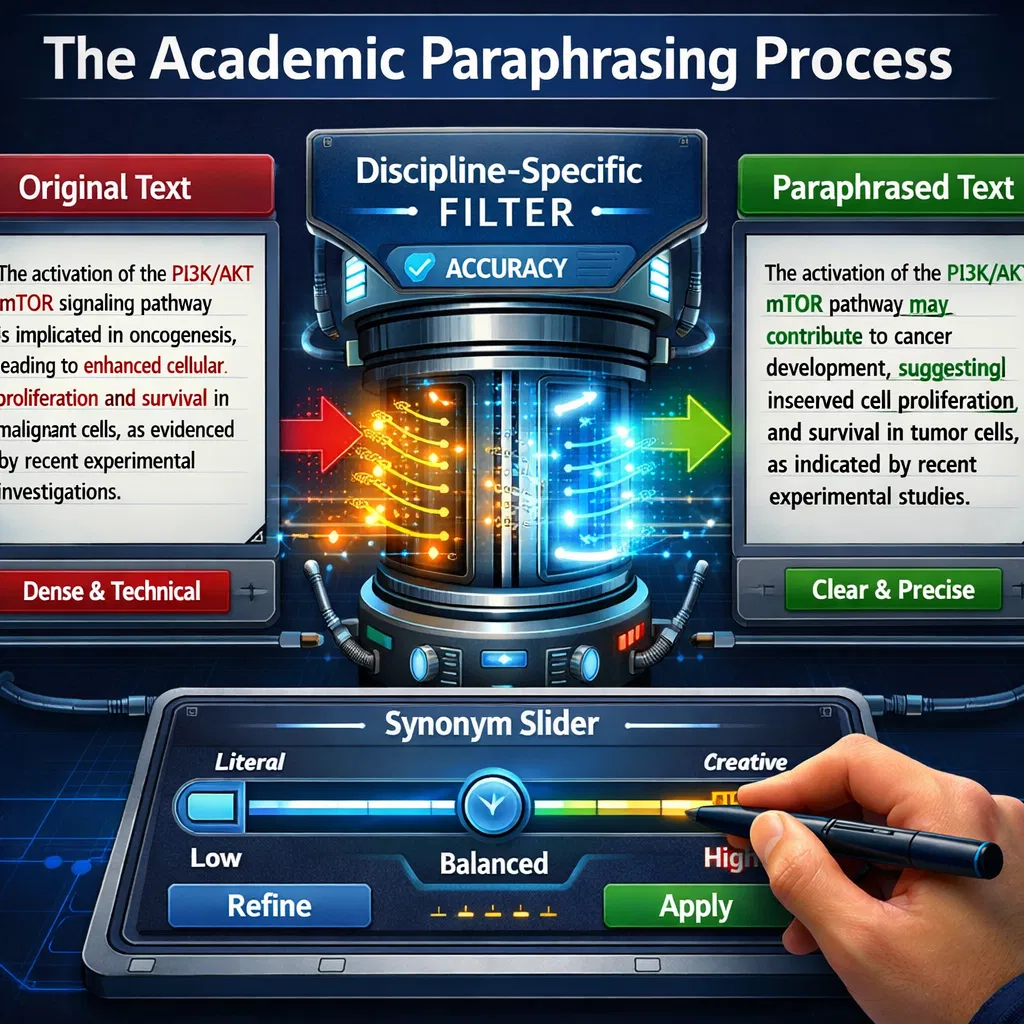
Paraphrases created by a genuine engine fit for academic research display certain features: they recognize technical vocabulary from particular fields and keep it unchanged; they maintain the conditional and hedged nature of statements in academic texts; they paraphrase citation contexts appropriately; and the output generated reads well for academic reviewers. Paraphrasing engines that can satisfy all of the above criteria by 2026 include several tools. Most other general-purpose engines do not satisfy the criteria.
For a tested comparison of leading AI proofreading tools specifically evaluated against academic writing standards, the Paperpal review of the best AI proofreaders for academics in 2026 provides honest assessments of accuracy, academic calibration, and practical limitations for research writing contexts.
Best AI Paraphrasing Tools for Academic Researchers
Paperpal Paraphraser
The paperpal paraphrasing tool has been trained on a corpus of millions of scholarly articles published in journals. Additionally, Paperpal's editing capabilities have been developed based on feedback from more than 1,300 editors. The range of expertise makes the Paperpal paraphrasing tool more capable than general paraphrasing tools at handling specialized vocabularies across different disciplines. The five rewriting modes of Paperpal Paraphrase, Make Academic, Improve Fluency, Simplify, and Trim are designed according to the needs of scholars in manuscript preparation.
For researchers, the unique feature of the Paperpal paraphrasing tool is a consistency check across the entire manuscript. Inconsistencies in terms, data presentation, and references can go unnoticed during the manual proofreading process of lengthy papers. However, terminological inconsistencies are readily noticeable to reviewers of submitted papers, even when there are no errors in sentence construction.
For a detailed comparison of Paperpal's paraphrasing capabilities against other leading academic paraphrasing tools, the Paperpal guide to the best paraphrasing tools for research papers evaluates options specifically from the perspective of researchers and graduate students preparing manuscripts for submission.
QuillBot Academic Mode
Another reason for its popularity is how the QuillBot Academic paraphrasing mode fits into the research workflow; its ease of use, ability to integrate into the researcher's working environment, and the control it gives users in the paraphrasing process contribute significantly to its utility. The Synonym Slider is useful for enabling the researcher to control the extent of paraphrasing, since overuse can compromise precision when conveying technical information.
There are also limits on the use of QuillBot for academic research. Since the program operates at the sentence level, it can be useful for improving individual sentences, but it may not improve paragraph coherence. Particularly in the discussion and conclusion sections of a research paper, where transitions are critical, QuillBot's paraphrasing could hinder rather than help the researcher.
Our AI writing guides on the BestHumanize blog offer practical guidance for applying QuillBot's Academic mode to specific sections of research papers while preserving the argumentative continuity that reviewers assess.
Writefull Paraphraser
Writefull’s paraphrasing service stands out because it trains its language models solely on academic publications, rather than on web content from the internet at large. In essence, this ensures that, when generating vocabulary replacements and sentence structures, it does so based on actual usage patterns in published scholarly journals, unlike most paraphrasing services, which learn vocabulary and sentence-structure patterns from general web text.
The Sentence Palette feature that offers examples of how certain sections of text, such as abstracts, introductions, literature reviews, and methods sections, are phrased in published articles is especially helpful to researchers trying to paraphrase their previous work.
Wordvice AI Paraphraser
Wordvice AI provides a paraphrasing service dedicated to academic papers and essays. It also features several modes of operation, such as Academic and Standard, which determine the level of formality in the generated text. The main advantage of this paraphrasing tool is that it is part of a comprehensive toolkit that includes many academic writing services, such as proofreading, plagiarism detection, AI detection, and translation (over 30 language pairs available).
The Wordvice AI paraphrasing tool is designed with academic integrity in mind and includes guidance on proper citation practices alongside its paraphrasing functionality, making it one of the more responsible options for researchers navigating source integration requirements.
Best AI Proofreading Tools for Academic Researchers
Proofreading academic research with artificial intelligence requires more than just pointing out grammatical mistakes. It demands the ability to discern when technically accurate expressions are inappropriate in tone for an academic readership, to spot discrepancies in language use throughout an extended work, to notice shifts in tense in parts where tenses are normally consistent, and to differentiate errors from professional usage.
Paperpal AI Proofreader
PaperPal's proofreading service is based on a corpus of academic articles, similar to its Paraphrasing Service. Hence, it understands the nuances of academic writing better than any other language editor, because the proofreading software doesn’t rely on general language rules for texts that follow different guidelines. This tool offers grammar and punctuation correction, along with more structural feedback, such as consistency in style and terminology, logical flow of argument, and even submission-ready content. Moreover, the scope of PaperPal’s proofreading services is much wider than that of any other academic proofreader.
For researchers concerned about how AI-assisted paraphrasing interacts with detection systems at submission, our FAQ on AI writing and detection provides guidance on the detection frameworks used by major journal submission platforms and how to manage detection risk responsibly.
Writefull Grammar and Language Checker
Because the grammar checker in Writefull is trained on academic texts, it is less likely to mark phrases used correctly in your field as errors compared to general-purpose grammar checking tools. The Split/Join feature, which splits lengthy sentences to make them easier to understand or merges shorter ones to improve readability, targets one of the most frequent writing mistakes in academic papers, namely, using correct sentences but creating a dull rhythm when read sequentially. In this respect, the Writefull grammar checker is especially beneficial for ESL scholars whose work cannot be judged solely by native English standards.
Grammarly (Superhuman) Academic Mode
Grammarly, which now operates under the Superhuman brand umbrella since October 2025, offers instant feedback on grammar, punctuation, clarity, and tone in browsers, Google Docs, and Microsoft Office. The software’s academic mode tailors its recommendations to the formal level of language use, whereas the tone detector allows scientists to ensure their manuscripts use language objectively. The major drawback of Grammarly for scholarly writing is that it checks texts against general academic norms rather than discipline-specific ones, which can flag discipline-appropriate expressions as mistakes.
Explore BestHumanize plans and pricing for researchers who need to combine proofreading passes with humanization to prepare manuscripts that meet both journal language standards and AI detection compliance requirements.
LanguageTool for Multilingual Researchers
LanguageTool is an open-source grammar and style checker that supports more than 30 languages, making it particularly valuable for international research teams and researchers writing in English as a second or third language. Its grammar rule engine is detailed and regularly updated by linguists, and it handles the complex grammar rules that appear in formal academic writing more accurately than manyLanguageTool is an open source grammar and style checker that supports over 30 languages, thus being extremely useful for international collaborative studies and researchers writing in English as their second or third language. The grammar rules engine provided by LanguageTool is very detailed and continuously updated by linguists. Furthermore, compared to other paid software, LanguageTool handles grammar rules in formal scholarly writing more effectively. LanguageTool Premium includes options such as a picky mode for style tips and personal dictionaries, so researchers can enter specialized terminology without it being flagged as an error. commercial alternatives. Its premium tier adds a picky mode for advanced style suggestions and personal dictionary support, which allows researchers to add their field's technical vocabulary so the tool stops flagging it as an error.
How AI Detection Affects Paraphrasing Choices in Research Writing
In recent years, many scholarly journals and institutional submission platforms have begun using AI detection services to review papers before peer review. As a result, researchers have to revise their attitudes towards AI paraphrasing. Even a well-written, accurate paraphrase can set off AI detectors' warning bells due to its statistical regularity.
Perplexity and burstiness are two indicators commonly assessed by AI-detection software for academic papers. The former reflects predictability in choosing words in a particular text - the smaller the number, the more machine-like the word choice. The latter describes variation in complexity among sentences in the passage - AI paraphrases are less bursty since the paraphraser is likely to compose relatively uniform sentences.
The QuillBot guide to burstiness and perplexity in writing provides a clear explanation of how perplexity and burstiness serve as detection signals and how paraphrasing tools affect these metrics, making it accessible to researchers who use AI paraphrasing tools.
From the researcher’s point of view, the paraphrase must subsequently be complemented by the step of humanization, taking into consideration, specifically, sentence-rhythm variability and different transitional phrases. Paraphrased texts that seem naturally human-written but score consistently low on burstiness will still raise red flags despite having been adequately paraphrased in terms of semantic content.
Turnitin's published analysis on AI paraphrasing detection and academic integrity explains how detection systems specifically evaluate AI-paraphrased submissions and what distinguishes AI-assisted paraphrasing from human paraphrasing in ways that institutional detection tools can identify.
The Recommended Workflow for Researchers
The most effective workflow for researchers using AI paraphrasing and proofreading tools follows a clear sequence that addresses different dimensions of manuscript quality in a logical order.

Stage One - Draft and Paraphrase Source Integration
Paraphrase using a paraphrasing tool with an academic option to help incorporate source information into your text. Run the tool on particular sections where you have to include the thoughts expressed in other articles while avoiding any word-for-word copying. Remember always to check later whether the paraphrased content captures the source's message and whether the citation appears at the right point within the paraphrased statement.
For a comprehensive, tested comparison of how leading AI paraphrasing tools handle source integration in academic manuscripts, the Revoyant guide to the best AI paraphrasing tools in 2026 evaluates them specifically on quality, accuracy, and AI-detection performance across a range of academic use cases.
Stage Two: Proofread for Grammar and Consistency
Once you finish the entire draft, do a complete proofread through with an academic proofreading software program. In this proofread, focus particularly on aspects that require a thorough check and cannot be done manually, such as terminological consistency, tense consistency in methodology, and data and citation formatting.
Stage Three Humanize for Detection Compliance
Perform a humanizing edit on all parts of your text where you have performed considerable paraphrasing using artificial intelligence. This step focuses exclusively on improving the areas where AI systems can more effectively detect variation in sentence rhythm and diverse transitional language. The objective here is not to mask the presence of AI help but to ensure naturalness in both parts of your paper.
If you have questions about structuring a responsible humanization workflow for journal submissions, contact the BestHumanize team for guidance on managing detection compliance in research writing contexts.
Stage Four Final Manual Review
The entire draft must be read through to completion prior to submission. There is no way any number of AI programs can substitute for the holistic evaluation conducted by the researcher herself, who is aware of the argument, the data, and the conclusions drawn from the data. The final check is when you ensure that everything in the AI-generated parts remains consistent with what you intended to convey.
Learn more about how BestHumanize is built to support responsible research writing workflows on our about page, which outlines the principles guiding our approach to academic writing assistance.
Choosing the Right Tool for Your Research Context
It is essential to choose the appropriate paraphrasing and proofreading software depending on the context of your research writing project. There are three types of profiles, based on which one can determine the most suitable option.
Researchers who write manuscripts for submission to high-impact journals need an application that focuses on linguistic accuracy and consistency. In such cases, Paperpal's combination of paraphrasing and proofreading services will be most effective given its focus on scientific writing. Moreover, Paperpal also performs cross-manuscript consistency checking.
Graduate students and early-career researchers, who often face tight deadlines for their papers and work on multiple projects at once, would benefit from QuillBot's Flow workspace. It combines all the functions researchers need into one service: paraphrasing, grammar checking, summarizing, and citation creation. Therefore, switching between different programs will not be necessary.
Lastly, multilingual researchers writing in a foreign language might benefit from Writefull's academic corpus training or Wordvice AI's multilingual proofreading. Both applications recognize ESL writing patterns and grammatical errors differently and strive to make academic writing in English fluent without losing the author's style.
Conclusion
By 2026, AI paraphrasing and proofreading services for academic scholars had become sufficiently sophisticated to be useful for professional academic writing. Academic scholars use the best among the services built on academic texts, tuned to the conventions of different disciplines, and adapted to meet the linguistic demands of peer-reviewed writing. By following a process that moves from paraphrasing to proofreading to humanizing texts, researchers can create scholarly articles that are clear and ready for peer review.
A key element in the entire process is discipline, which is consistent throughout all steps. Namely, it consists of researchers' intellectual contributions to science, including their research questions, methodologies, analyses, and conclusions. AI paraphrasing and proofreading tools do not produce these contributions; instead, they refine them linguistically.
Frequently Asked Questions
What are the best AI paraphrasing tools for academic researchers in 2026?
The Paperpal paraphrase tool stands out among other tools for researchers submitting papers to journals because it is trained on existing academic articles and can detect inconsistencies across manuscripts. The QuillBot Academic mode is the most convenient and flexible tool. The Writefull tool excels when the researcher requires output that meets the standards of academic English.
How do AI proofreading tools differ from general grammar checkers for research use?
In general, grammar-checking software uses rules of standard English and flags usage appropriate to the academic field as an error. AI-based academic proofreading software, such as Paperpal and Writefull, is trained on academic corpora; therefore, it uses rules appropriate for assessing text from an academic perspective rather than a general one.
Which paraphrasing tool is safest for journal submission?
There is no paraphrasing tool that is completely compatible with detection and submission standards. The most reliable way to submit an academic article to a scientific publication is to use a paraphrasing tool as a writing aid for individual segments, then manually check the paper for conformity and consistency, and finally humanize it to address issues with sentence rhythm. Some of the more sophisticated paraphrasing tools include Paperpal and Writefull.
Can AI proofreading tools handle discipline-specific terminology?
Applications based on large academic corpora, such as Paperpal, which contains over 1,300 categories, and Writefull, which draws on academic publications across various fields, perform better with discipline-specific language than general applications. The ability to add personal dictionaries in LanguageTool enables scholars to include their field-specific terminology so that the application does not highlight it. However, no tool works well with all terminologies across all disciplines, so a manual check of highlighted words is necessary.
How should researchers effectively combine paraphrasing and proofreading tools?
Paraphrasing should precede proofreading, humanization, and manual proofreading. Paraphrasing involves integrating sources and varying sentence structure. Proofreading deals with grammatical errors, consistency, and register issues. Humanization deals with the possibility of detection in areas assisted by AI. Manual proofreading ensures that the meaning remains correct and the argument remains coherent throughout the entire paper. This sequence of use will avoid creating new errors before correcting old ones.
Disclaimer: This article is provided for informational purposes only. Tool features, pricing, and detection compliance information described in this article reflect conditions as of April 2026 and are subject to change. BestHumanize.com does not guarantee that any tool or workflow will meet the specific requirements of any journal, institution, or submission platform. Researchers are responsible for verifying compliance with their target journal's policies on AI-assisted writing and for ensuring that all submitted work accurately represents their own research and analysis.