You wrote every word. You researched, drafted, revised, and delivered on time. Then your client ran your work through an AI detector and sent back a one-line message: flagged as AI-generated, payment withheld. It is one of the most demoralising situations a freelance writer can face, not just financially, but because an automated tool is being used to question your professional integrity with no human judgment applied to its output. How AI detectors wrongly flag freelance writers: writers losing platform access, income, and client relationships based on detection scores from tools their own clients admitted were not fully reliable. The pattern is consistent and not rare.
This guide is written for freelancers who are already in a dispute or want to prevent one. It covers why AI detection false positives happen to genuinely human-written freelance work, how to build the evidence package that resolves most disputes without legal action, what your contract should say to protect your payment rights, the escalation steps when a client refuses to engage with your evidence, and the pre-contract habits that make the whole problem unlikely to recur.
Important note: This article addresses the situation in which your work is genuinely human-written but has been falsely flagged. If your contract prohibits the use of AI and you used AI tools without disclosure, the appropriate response is to have a different conversation. This guide is for writers whose authentic work has been misclassified by an unreliable detection tool. |
Why Genuine Freelance Writing Gets Flagged
Understanding why the flag happened is both useful for your dispute response and important for preventing recurrence. AI detection tools measure two primary signals: perplexity (how statistically predictable each word choice is) and burstiness (how much sentence length varies across the text). Low perplexity and low burstiness together produce a high AI-likelihood score. The problem for freelance writers is that professional writing habits push both signals in the wrong direction. Why perplexity and burstiness fail as detection signals for professional writing explains the core issue: well-edited, professionally polished writing occupies the same statistical space as AI output, as both exhibit low perplexity and a regularized sentence rhythm. Your skill as a writer is working against you in the detector's model.
Several specific freelance practices compound this. Grammar tools such as Grammarly standardize phrasing and break long sentences into shorter, more uniform ones, reducing burstiness. Writing to a detailed brief constrains vocabulary and structure, reducing lexical diversity. Topic-specific content uses a restricted vocabulary that the detector interprets as AI-typical uniformity. Multiple revision passes polish out the idiomatic variation that most clearly marks human authorship. Common reasons why freelance writing gets flagged as AI include the fact that writers working on structured content briefs, with specific keywords, subheadings, and formatting requirements, are particularly vulnerable, precisely because following a clear pattern is exactly what detection tools are trained to flag.
The freelance context adds a specific aggravating factor: clients who discover detection tools and start using them mid-relationship, applying them retrospectively to work they previously accepted without question, or using them as a pretext to withhold payment for work they simply do not want to pay for. Real-world AI detector accuracy in 2026 confirms that no detection tool has demonstrated sufficient accuracy to serve as the sole basis for rejecting work or withholding payment. A detection score is a statistical estimate with a documented error rate. It is not a finding of fact.
The Evidence Package: What Actually Gets You Paid
Most AI-detection payment disputes resolve when the freelancer presents a clear, well-organized evidence package that makes the client's position untenable. The goal is not to win an argument about whether detection tools are perfect. The goal is to make the evidence of authentic human authorship so clear and so well-documented that continuing to withhold payment becomes professionally and legally difficult for the client.
Evidence Type | What It Shows | How to Produce It | Strength in Dispute |
Google Docs version history | The document was developed incrementally across multiple editing sessions on different dates, which is consistent with human composition and inconsistent with a single-session AI paste | Open the document, then click File > Version History > See Version History. Take a screenshot of the full timeline showing session dates and times. Export as PDF if the client needs a shareable format. | Very strong. Timestamped incremental development is the single most direct counter-evidence to an AI-generation claim, because AI output appears as a one-event paste with no drafting history. |
First draft copy | The pre-editing draft shows the natural, idiomatic voice before grammar tools regularised it, often demonstrating the human authorship that polishing obscures | Save a named copy of every first draft before running Grammarly or any style tool. If you did not do this, check whether your cloud storage has automatic version snapshots from earlier in your drafting session. | Strong. The first draft typically shows more stylistic variation, idiomatic phrasing, and irregular constructions than the polished final version, all of which score better on detection. |
Research notes and sources | Shows the intellectual process behind the content: what you read, what you selected, how you synthesised it. AI-generated content lacks a prior research trail. | Screenshots of browser tabs open during writing, bookmarked sources, a notes document with extracted quotes and paraphrases, or an annotated brief. | Moderate to strong depending on content type. Most compelling for research-heavy content; less relevant for short-form copy. |
Original brief or creative direction | Establishes what you were instructed to produce, confirming the work was commissioned human writing that responded to specific instructions, not generated from a generic prompt. | The original email, message, or document briefing you on the assignment. Include the date received and any back-and-forth clarifications. | Moderate. Establishes context and good faith, but does not directly demonstrate human authorship of the specific text. |
Multi-tool detection comparison | Shows that the detection result is tool-specific and inconsistent, undermining the claim that the flag represents definitive evidence of AI authorship. | Run the flagged content through two or three independent tools with different methodologies. Screenshot each result with the tool name, date, and score clearly visible. | Strong when results disagree. A tool that flags content that two others have cleared provides evidence of its own limitations, not evidence of AI authorship. |
Communication record showing originality | Emails, Slack messages, or client calls during the drafting process in which you shared ideas, asked questions, or incorporated feedback, demonstrating real-time human engagement with the content. | Export or screenshot the relevant thread. Flag the specific exchanges that show you thinking through the content in real time. | Moderate to strong. Most compelling when the communications reference specific content decisions or show you working through problems that an AI would not need to ask about. |
How to Assemble and Present the Evidence Package
Assemble your evidence package within 48 hours of receiving the dispute. Your package should be in a short PDF or email attachment, with the following sections: a paragraph of factual information about the situation, your version history screenshots with dates annotated, your multi-tool detection comparison with tool names, dates, and scores, any other relevant information from the above table, and your statement of policy on use of the AI tool, including what you did use it for, if anything, and what you didn’t use it for.
Keep your cover message tone factual and solution-focused. Do not apologize. Do not become defensive. State clearly that the work is human-written, that you have documentation confirming this, and that you consider the work delivered and payment owed. Offer the client a specific resolution: you will provide the additional context they need, you are willing to run the content through additional tools together, and you are happy to discuss the work on a call, where you can speak to your research and drafting process. How AI detection false positives work and what documentation overturns them confirms that version control showing incremental composition is the strongest available counter-evidence because it demonstrates something a detection score cannot refute: the document was built progressively, which is only consistent with human authorship.

What to Do When the Client Will Not Engage
A minority of clients, having raised an AI flag, will not engage substantively with your evidence. Some will repeat the detection score as if it were final. Others will simply stop responding. This situation requires a structured escalation rather than repeated attempts at informal resolution.
Stage | Action | Goal | When to Move to Next Stage |
1. Evidence response | Send a written response to the client within 48 hours of the flag being raised. Attach your evidence package: version history screenshots, multi-tool detection comparison, and a brief factual explanation of AI detection false-positive rates. Keep the tone professional and solution-focused. | Give the client the information they need to reverse the decision on the basis of evidence, without requiring them to explicitly admit error. | If there is no substantive response within 5 business days, or if the client acknowledges your evidence but still refuses payment. |
2. Formal written demand | Send a written payment demand by email that references your contract, the work delivered, the invoice amount, and the payment due date. State clearly that you consider the work delivered and payment owed, and give a specific deadline (typically 7 to 14 days) for payment. | Create a formal paper trail that establishes nonpayment as a breach of contract rather than an open dispute. This document is the foundation of any subsequent escalation. | If the client does not pay by the stated deadline or disputes the payment demand without substantive engagement with your evidence. |
3. Mediation or platform escalation | If the work was placed through a freelance platform (Upwork, Fiverr, Toptal, or WritersAccess), escalate through the platform's dispute resolution process, attaching your evidence package. If direct, propose a mediator or request a call with a senior contact at the client organization. | Resolve the dispute without litigation, which is costly and slow. Most payment disputes at the freelance scale resolve at this stage when the freelancer has strong process evidence. | If platform mediation does not result in payment or the client refuses to engage in any informal resolution process. |
4. Small claims court | File a small claims claim in the relevant jurisdiction for the contract value if it is within the small claims limit (typically up to USD 10,000 to 25,000 depending on the state or country). Most small claims processes do not require a lawyer. | Obtain a legally enforceable judgment for the amount owed. Small claims courts are designed for exactly this kind of dispute and are accessible to individuals without legal representation. | This is typically the final stage for disputes within the small claims limit. For amounts above the limit, consult a lawyer about alternative options, including arbitration. |
5. Arbitration or legal action | If the contract contains an arbitration clause, file for arbitration as specified. If not, consult a lawyer about options for amounts above the small claims limit. Many lawyers offer a free initial consultation for straightforward payment disputes. | Obtain a binding resolution enforceable as a court order. Arbitration is typically faster and cheaper than full litigation for commercial disputes. | Arbitration or legal action is appropriate when the amount is material, the client has clearly refused to pay without legitimate grounds, and informal resolution has been exhausted. |
The Small Claims Route in Practice
The most accessible and viable option for you to sue for payment in a freelance dispute is through small claims court, as it deals specifically with cases where the claim is significant to an individual, yet not large enough to warrant commercial litigation. The filing fee is low, ranging from 30 to 75 USD, and representation is not necessary. In a small claim, the issue is not whether you, as a writer, delivered the work, and the client's claim of AI detection is not a valid defense to non-payment. Arbitration as an alternative to small claims for freelance payment disputes. The text also notes that the arbitration clause in the freelance contract can offer a faster resolution than going to court and that the arbitral decision can be made enforceable by court order if the client fails to pay after the arbitration.
Before filing, send a final demand by email, stating your deadline for payment in 7 days and stating that you will file a small claims claim if payment is not made by then. Many clients will pay up at this stage because they do not want to risk defending a small-claims case for non-payment of an invoice after an AI detection score, which is not a place any business wants to be.
Contract Provisions That Protect You Before the Dispute
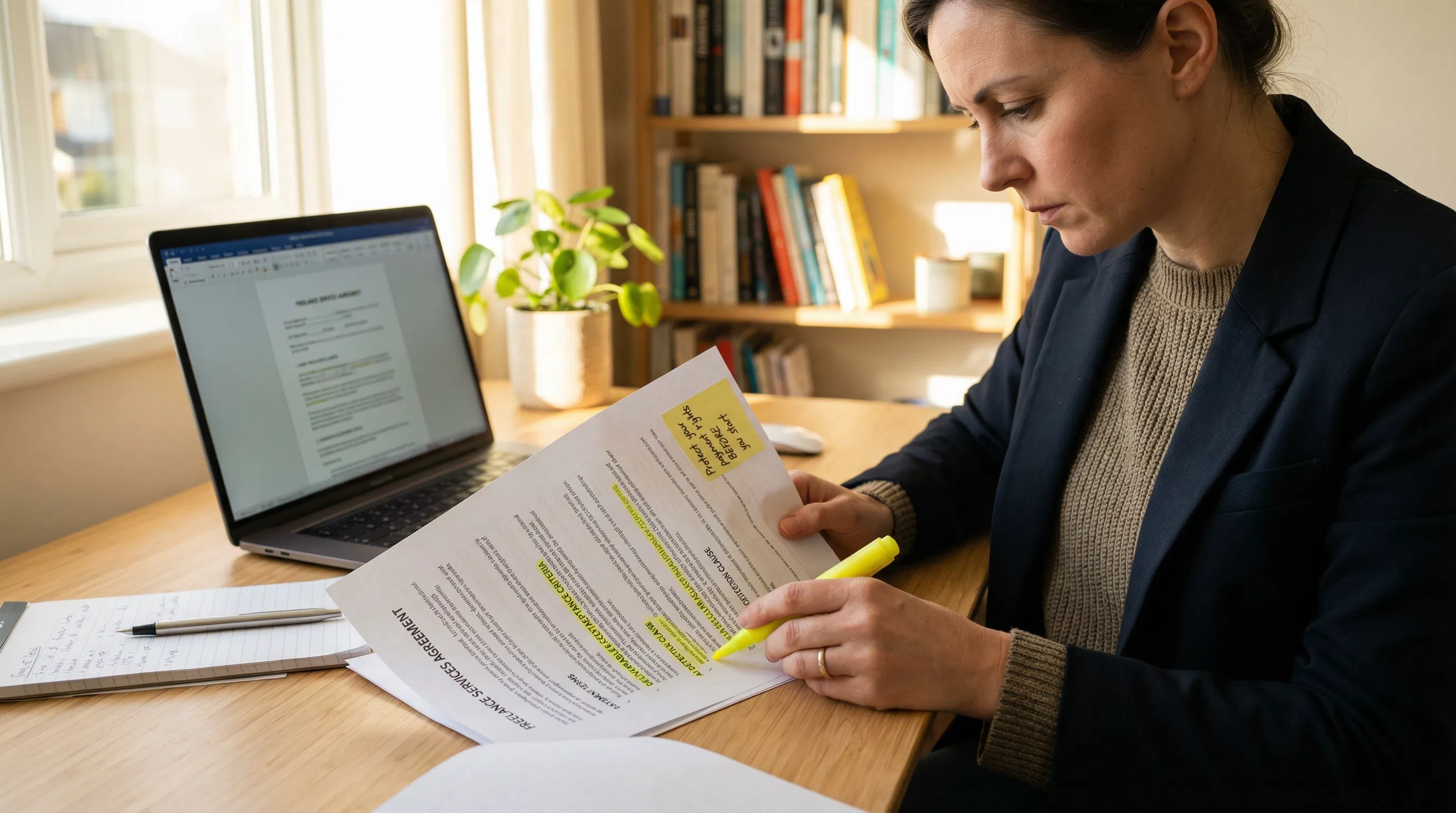
The best time to protect your payment rights against an AI detection dispute is before you start work, not after a flag has occurred. Specific contract provisions create the legal framework that makes withholding payment for a detection score a clear breach, rather than a defensible interpretation of ambiguous terms. How AI detectors work and why no detection score constitutes definitive proof of AI authorship confirms that all major detection platforms describe their scores as probabilistic estimates, not definitive determinations. Your contract should reflect this: a probabilistic estimate is not an acceptance criterion.
Clause | What to Specify | Why It Matters |
Deliverable acceptance criteria | Acceptance of deliverables is based on whether the work meets the agreed-upon brief, style guide, and quality standards. AI detection scores are not an acceptance criterion unless explicitly agreed upon in this contract. | Without this clause, a client can claim any detection score as grounds for rejection. With it, rejection based solely on a detection score breaches the contract's acceptance terms. |
Payment terms and timeline | Payment is due within [X] days of delivery, or within [X] days of written acceptance, whichever comes first. Disputes about work quality do not suspend the payment obligation for work already delivered unless the client raises a specific, documented objection within [X] days of delivery. | Prevents a client from indefinitely withholding payment by raising a dispute. The time-limited objection window forces the client to raise any concerns promptly, not after you have chased the invoice. |
AI tool use disclosure | The writer discloses any use of AI tools in the creation of deliverables as follows: [specify your policy, e.g., AI tools may be used for research summarization and grammar checking only, not for draft generation]. Client acknowledges that human writing may be flagged by AI detection tools and agrees that such flags do not constitute evidence of policy violation absent corroborating evidence. | Creates a shared, written understanding of what AI tool use means in your working relationship, so a detection flag cannot be used to imply undisclosed AI use if your actual practice complies with this clause. |
Dispute resolution process | Any dispute about deliverable quality or payment must be raised in writing within [X] days of delivery, with specific reference to the contractual standard allegedly not met. The parties agree to attempt good-faith resolution within [X] days before escalating to [mediation/small claims/arbitration as appropriate]. | Establishes a structured dispute process that prevents open-ended rejection and gives both parties a defined path to resolution. The specific-objection requirement prevents vague or pretextual rejections. |
Governing law and jurisdiction | This contract is governed by the laws of [your jurisdiction]. Any dispute shall be resolved in the courts of [your city/state/country] or through binding arbitration administered by [named body] under its rules. | Prevents a client in a different country or state from requiring you to pursue payment in an inconvenient or prohibitively expensive jurisdiction. This clause should always name your location, not the client's. |
What to Do If Your Contract Has No AI Clause
Many freelancers work under a standard client agreement or a platform’s terms of service that may not include a specific clause regarding AI. This is not necessarily a problem in a payment dispute; however, it may make the decision more reliant on general contract law rather than on specific contract provisions. Under general contract law in most jurisdictions, to withhold payment for work delivered and accepted, a party must demonstrate a specific breach of the acceptance clause. An AI detection score is not necessarily grounds for denying payment for a work delivered, unless a contract specifies how detection scores factor into acceptance standards. The way you argue in a situation like this is by demonstrating that the work has been delivered as contracted, that no specific breach of standards has been identified by the client, and that there is no standard regarding detection scores in the contract.
The Pre-Contract Habits That Make This Unlikely to Recur
Protecting yourself against future false-positive disputes requires a combination of contract preparation, process documentation, and a pre-submission technical check. None of these requires major changes to how you work. They require specific, low-effort habits that become routine. An AI text humanizer for freelance writers who want to reduce detection risk provides a tool for the technical side of this, helping introduce the lexical and rhythmic variation that grammar tools tend to remove and that detection tools interpret as AI signals.
Draft and Document in Google Docs
Google Docs version history is probably the most decisive piece of evidence in any debate about AI detection, and it costs nothing to keep. Write everything you plan to give to a customer in Google Docs right from the beginning. Turn on version history (it is enabled by default). Identify major versions with descriptive names: First Draft, After Research Review, Final. The timestamped log of your writing process is permanently linked to the document and can be either shared with a client or used in a dispute. In case you are used to drafting in Word or other tools, you might want to switch your initial drafting to Google Docs even if you eventually deliver the final version in a different format.
Run a Pre-Submission Detection Check
Before submitting any deliverables to a client who uses detection tools, run the content through GPTZero's free tier, which provides sentence-level output showing which specific passages drove the overall score. Any passage flagged above 30% is worth reviewing for sentence-rhythm uniformity and AI-fingerprint vocabulary. Revise those passages specifically before submission. This three-to-five-minute check catches the most common false-positive triggers, so if the client runs their own check, they are unlikely to see a score that would trigger a dispute.
Maintain a first-draft copy.
It is a good idea to save a copy of every first draft before passing it through Grammarly or other grammar tools. Not only does the first draft retain the natural voice of the writer and the variety of expression that is lost in the final draft, but it also has a much higher likelihood of evading detection tools than the final draft. If you are ever caught on a final draft, the first draft can serve as instant evidence of the human voice that has been obscured by the editing process.
Add an AI Clause to Every Contract Going Forward
Using the contract table above, add at a minimum an acceptance criteria clause and a payment timeline clause to all client contracts from this point forward. These two provisions are the most protective: they will prevent the client from using a detection score as the basis for rejection without reference to the actual contract acceptance criteria, and they will prevent open-ended payment withholdings during a dispute with the client. If the client objects to these provisions, this will, in fact, give us insight into their intent in using these kinds of detection tools with us.
Conclusion
This is a serious professional and financial problem for a freelance writer, but it is not hopeless. The solution is a matter of evidence, not who wins a theoretical argument over the accuracy of a detection tool. Version history, first drafts, comparisons across multiple tools, and process documentation are evidence. Getting a detection score from a tool without human intervention is a probabilistic assessment with a known error rate. If you provide the first category of evidence in a clear manner, and the client still refuses to pay, you are in a morally and legally high position. The progression from demand letter to small claims court to arbitration is a well-trodden path, and most people will settle before they get to a courtroom, realizing that the writer has evidence to support their claim and will pursue it.
Frequently Asked Questions
Can a client legally refuse to pay based solely on an AI detection score?
In most jurisdictions and contracts, the answer is no unless the contract specifies that the client will pay based on the scores. Without this clause, the client is obliged to pay because the work is delivered to the standard required by the contract. An AI detection score is not evidence of AI presence because it is a probabilistic assessment with an associated error rate. It is not evidence of the work failing to meet any particular standard set out in the contract. If the client refuses to pay based on the detection score and for no other contract-related reason, they are likely in breach of the contract. Please note this is not legal advice. It is recommended to obtain advice relevant to your circumstances and location. Generally, the rule is that the client is obliged to pay for work delivered to the standard required by the contract.
What is the most effective first step after receiving a false positive rejection?
Gather your evidence package before sending your response to the client. Gather screenshots of your Google Docs version history, pass your content through two independent tools to verify the detection, and gather any first-draft documents, research documents, and communications. Then, send one factual, professional message to the client requesting payment within a certain time frame and attaching your evidence package. Do not send several emotional messages. Do not apologize for the detection results. A client with legitimate concerns about the usage of AI will work with your evidence. A client who uses the detection score to avoid payment will show their true colors when presented with evidence they cannot dispute.
What if the client says their detection tool is reliable and they trust it?
The question of reliability can be answered with evidence, not by arguing about the philosophy behind the detection tools. Run the suspicious content through two or three different tools with different methodologies and compare the results. If the results differ from the client tool, you have empirical evidence that the original results were unreliable for this particular content. This is much more compelling than any argument about the tool's accuracy in general. Furthermore, every major tool on the market, including GPTZero, Turnitin, Copyleaks, and Originality.ai, advises in its documentation that the results of the detection tool should not be used to make high-stakes decisions about originality. The client tool is making its own claim about its accuracy, which is qualified by its developer.
Should I revise the flagged content to improve the detection score?
It will depend on whether you prioritize resolving the immediate problem or protecting your long-term position. Making revisions to decrease a detection score is a relatively simple process. You need to fix the sentence rhythm, remove the AI's fingerprint words, and add concrete specifics. However, sending a revised version without any evidence of your original authorship implies a concession that the original is flawed. The better solution is to send your evidence bundle along with any revised version and frame the revision as a quality improvement in response to feedback, rather than as a correction to an AI-generated version. The bundle of evidence will protect your claim to authorship, and the revised version will address the client's concerns.
What pre-contract changes would have prevented this situation?
The two contract elements that would have given you the most protection in the event of an AI detection payment dispute would have been an acceptance criteria clause in which AI detection score results were not to be used as a basis for contract rejection and a payment timeline clause in which there were no open-ended payments in the event of a contract dispute. The two process elements that would have given you the most evidence in the event of an AI detection payment dispute would have been writing in Google Docs from the beginning of the document to the end and saving a copy of the document under a specific title prior to running any grammar tools. The four elements, two contracts and two processes, represent the bare minimum that must be made in order to make an AI detection payment dispute both legally more difficult for the client to argue and evidentially easier to resolve for you. The time added to your standard process would be less than five minutes.
The information provided in this guide is based on the latest practices for detecting AI and on freelance contract law as of March 2026. The information provided is general in nature and should not be considered to be legal advice. Disputes over payments to freelancers are governed by contract law and the laws of the relevant jurisdiction and should be reviewed by a legal professional if the payment amount warrants such advice.