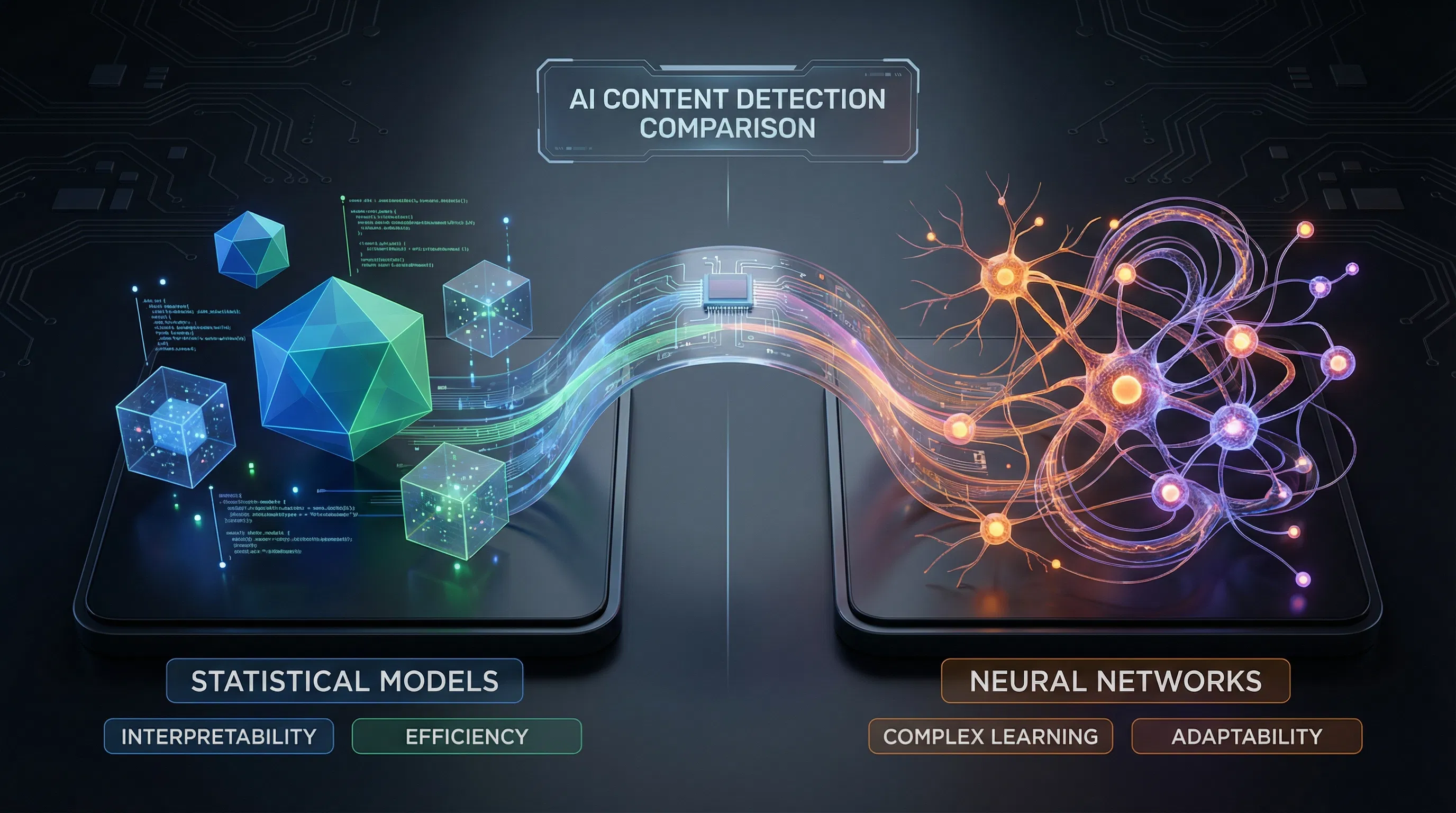
The field of AI content detection has split into two technically distinct families: statistical approaches that measure specific mathematical properties of text against known distributions, and neural network approaches that learn to detect content from large, labelled datasets. Each family has a different technical foundation, a different failure mode, a different computational cost structure, and a different performance profile across content types. Understanding the distinction is not purely academic; it is the basis for choosing the right detection tool for a specific use case, interpreting detection results accurately, and anticipating where any given platform will succeed or fall short. A technical overview of how modern AI detection systems combine statistical and machine learning methods to estimate AI authorship probability confirms that the most capable detection platforms in 2026 implement both approaches in layered combination, using statistical methods for fast initial screening and neural classifiers for deeper analysis of borderline cases.
This article compares statistical and neural network detection approaches across every material dimension: how each works technically, where each performs well, where each fails, and what the research record shows about their relative accuracy in real-world conditions. It also covers the hybrid ensemble architectures that represent the current state of the art, combining the interpretability and speed of statistical methods with the accuracy and pattern-depth of neural classifiers, and explains what the choice between approaches means for practitioners evaluating detection platforms.
Key Takeaways
Statistical detection methods, perplexity scoring, log-likelihood analysis, and feature-based classifiers are computationally efficient, explainable, and effective on pure, unedited AI text. Their core limitation is that they measure surface-level properties that degrade rapidly when text is edited, paraphrased, or passed through an AI humanization tool. Research showing why perplexity and burstiness fail as standalone detection signals for edited or formally structured human-written text demonstrates that even famous human-authored documents can be misclassified by perplexity-based tools due to their overrepresentation in LLM training data.
Neural network approaches, particularly fine-tuned transformer models like RoBERTa and BERT, consistently outperform statistical methods in independent benchmarks across all content types, including edited and mixed human-AI text. A comprehensive peer-reviewed study comparing traditional ML, sequential neural networks, and transformer architectures on 20,000 labelled samples found that RoBERTa achieved 96.1% accuracy on AI-generated text classification, outperforming all baseline statistical and sequential neural approaches, demonstrating the consistent superiority of fine-tuned transformer architectures over statistical methods at the detection task.
The critical weakness of neural network approaches is model drift: a classifier trained on GPT-3.5 output may not reliably detect GPT-4o, Claude 3.5, or DeepSeek V3 outputs until it is retrained on those models' text. Platforms that do not update their neural classifiers within days or weeks of new LLM releases experience accuracy drops that can approach the performance level of statistical methods on the newest model outputs.
Ensemble architectures that combine statistical methods with neural classifiers achieve the best overall performance across all tested conditions higher accuracy on pure AI text than either approach alone, greater resilience to editing, lower false positive rates on human-written content, and the ability to use statistical screening to reduce the computational load on the neural classifier by filtering obviously human-written text before it reaches the more expensive model.
For practitioners, the choice between statistical and neural detection is less important than choosing platforms that commit to continuous retraining. How AI text transformation tools challenge detection accuracy and why platform update cadence determines real-world effectiveness illustrates that AI humanization tools specifically target the statistical signatures that both detection families rely on making the gap between a platform that updates weekly and one that updates quarterly a more consequential accuracy factor than the underlying detection methodology.
Statistical Approaches: How They Work
Core Principle: Statistical detection methods do not require labelled training data to make predictions. They use an existing language model to compute mathematical properties of the text being evaluated — specifically, how predictable the text is — and compare those properties against the distributions known to characterise AI-generated versus human-authored text. The language model is used as a measurement tool, not trained as a classifier. |
Statistical approaches to AI text detection are built on a fundamental observation about how language models generate text. LLMs produce each word by selecting the highest-probability option from their vocabulary distribution. This process is statistically measurable: a language model can evaluate any text sequence and produce a log-likelihood score indicating how probable that exact sequence of words is under the model. Text generated by an LLM will typically show higher token-level probability that the model 'would have written those words' while human text will show lower probability because human writers make less predictable choices. How AI detection tools identify statistical patterns in machine-generated text through probability analysis and linguistic feature measurement confirms that the core logic of statistical detection rests on this asymmetry: machine-generated text is concentrated in a narrower, higher-probability region of the language model's output distribution than human text.
Perplexity Scoring
Perplexity is the exponentiated average negative log-likelihood of a text sequence under a language model, a single scalar that summarises how predictable the text is. Low perplexity means the model would have generated similar word choices; high perplexity means the choices were unexpected. AI-generated text typically exhibits low perplexity because the same model class that generated it would also produce similar outputs. Human writing exhibits greater perplexity due to its greater lexical unpredictability, personal idioms, and context-specific choices.
The key limitation of raw perplexity scoring is calibration. The absolute perplexity of a text depends on the language model used to compute it, the text's domain, and whether the specific text or similar content appeared in the model's training data. A scientific paper evaluated with a model trained on scientific literature will score lower perplexity than the same paper evaluated with a general-purpose model, not because the content is AI-generated, but because the model is more confident in that domain's vocabulary. This calibration dependency means that perplexity thresholds set for one content domain cannot be reliably applied to another.
Log-Likelihood Analysis and DetectGPT
More sophisticated statistical methods go beyond a single perplexity score to analyse the shape of the log-likelihood distribution. DetectGPT, developed by Stanford researchers in 2023, operates on the observation that LLM-generated text tends to occupy local maxima in the language model's probability landscape, and the specific word choices made represent the locally highest-probability options available. Human text, being less optimised, occupies lower probability regions with steeper gradients. DetectGPT tests this by perturbing the input text with minor modifications and measuring whether the original text scores higher or lower than the perturbations, a property called curvature of the log-probability function. AI-generated text tends to score higher than its perturbations; human text tends to score lower.
DetectGPT achieved 95% accuracy in initial experiments on unedited AI text, comparable to the best neural classifiers of its era. Its limitations became apparent in real-world deployment: the perturbation process requires multiple language model forward passes per document, making it computationally expensive at scale; its accuracy drops significantly when text has been edited; and it requires access to the same model family that generated the text, which is not always known in advance.
Feature-Based Statistical Classifiers
A third family of statistical approaches uses hand-crafted linguistic features, such as sentence length statistics, vocabulary diversity metrics, part-of-speech tag frequencies, readability scores, function word ratios, and n-gram distributions, as inputs to classical machine learning classifiers such as Logistic Regression, Support Vector Machines, Random Forests, and XGBoost. These methods are partially supervised (they require labelled training data to learn the classification boundary) but use engineered features rather than learned representations. They are computationally fast for inference, highly interpretable, allow direct inspection of the contribution of each feature to the prediction, and perform well on content types well-represented in their training data. Their limitation is that hand-crafted features capture a subset of the patterns that distinguish AI from human text, and they do not generalise to patterns not anticipated by the feature engineering process.

Neural Network Approaches: How They Work
Neural network approaches to AI content detection learn detection patterns from data rather than from mathematical first principles. A neural classifier is trained on large, labelled datasets containing both human-authored and AI-generated text, and it learns during training which multidimensional feature combinations best separate the two categories. Unlike statistical methods, which measure predefined sets of properties, neural classifiers can capture patterns that no human researcher anticipated, and that would be impossible to express as explicit rules or statistical formulas. How neural detection methods use machine learning to identify complex multi-dimensional patterns that statistical approaches cannot capture confirms that the most accurate neural detectors analyse text across semantic coherence, stylistic consistency, syntactic structure, and information density patterns simultaneously, a combination that no single statistical metric can replicate.
Sequential Neural Networks: LSTM and BiLSTM
The first generation of neural network approaches to AI detection used recurrent architectures, specifically Long Short-Term Memory (LSTM) and Bidirectional LSTM (BiLSTM) networks. These models process text as a sequential input, maintaining a hidden state that accumulates information as the model reads through the text token by token. BiLSTM improves on LSTM by reading the sequence in both directions, allowing the model to incorporate both preceding and following context when encoding each token. Research comparing LSTM and BiLSTM with traditional statistical classifiers found mixed results: one study found that classical ML methods, including Random Forest, outperformed LSTM on the specific task; others found that LSTM-based approaches achieved accuracy in the 82–91% range on unedited AI text. The consensus is that LSTM-based architectures represent a significant improvement over pure statistical methods but are substantially outperformed by transformer-based classifiers on the same tasks.
Transformer-Based Neural Classifiers: BERT and RoBERTa
The dominant neural network approach in 2026 is fine-tuned transformer classifiers, particularly BERT and RoBERTa. BERT (Bidirectional Encoder Representations from Transformers) uses a masked language modelling objective to learn deep contextual representations of text through bidirectional attention — each token is represented in the context of all other tokens in the sequence. For AI detection, a pre-trained BERT model is fine-tuned by adding a classification head and training the entire model on a labelled dataset of human-authored and AI-generated text. The model learns to map the contextual representation of a full text sequence to a binary classification: human or AI.
RoBERTa (Robustly Optimised BERT Pretraining Approach) improves on BERT through a more robust pre-training regime: dynamic masking, larger batch sizes, more diverse training data (over 160GB versus BERT's 16GB), and the removal of the next-sentence prediction objective. These changes produce a stronger base representation that, when fine-tuned for AI detection, consistently outperforms BERT. The peer-reviewed benchmark study cited in the Key Takeaways found that RoBERTa achieved 96.1% accuracy in AI-generated text classification, outperforming BERT, DistilBERT, BiLSTM, and all tested statistical classifiers on the same dataset, a pattern consistently reproduced in independent research.
Why Transformers Outperform Statistical Methods
The performance advantage of transformer-based neural classifiers over statistical approaches stems from their ability to represent text in a high-dimensional embedding space where the structural patterns of AI-generated and human-authored text are geometrically separable, in ways that no single statistical metric captures. A statistical method like perplexity collapses the full complexity of text to a single number, necessarily losing information. A transformer classifier maintains a 768-dimensional or larger representation of the entire text sequence, allowing it to capture interactions between sentence structure, vocabulary distribution, discourse organisation, and semantic coherence simultaneously. The patterns it identifies are not pre-specified by researchers; they emerge from training and can represent entirely unanticipated dimensions of the AI-versus-human distinction.
Head-to-Head Performance Comparison
The academic literature on AI text detection is now sufficiently mature to draw reliable conclusions about the relative performance of statistical and neural approaches across multiple evaluation dimensions. The benchmarks below represent the consensus from peer-reviewed comparative studies, including the 2025 comprehensive benchmark that evaluated classical statistical classifiers, sequential neural networks, fine-tuned encoder transformers, and perplexity-based unsupervised detectors on the same datasets under controlled conditions. Comprehensive accuracy and performance comparison of AI detection tools across multiple content types and detection scenarios in 2026 provides additional real-world validation context, confirming that the relative performance ordering observed in controlled benchmarks holds in practical deployment conditions.
Detection Method | Accuracy (Pure AI Text) | Accuracy (Edited Text) | False Positive Rate | Computational Cost |
Perplexity scoring (zero-shot) | 80–90% | 40–60% | 10–25% | Low |
Log-likelihood / DetectGPT | 85–95% | 45–65% | 8–20% | Moderate (requires LLM forward pass) |
Feature-based ML classifier | 75–88% | 50–68% | 12–22% | Low (fast inference after training) |
LSTM / BiLSTM (sequential neural) | 82–91% | 55–70% | 9–18% | Moderate |
Fine-tuned BERT | 88–95% | 65–78% | 6–14% | High |
Fine-tuned RoBERTa | 92–99% | 70–83% | 4–10% | High |
Ensemble (statistical + neural) | 94–99% | 75–88% | 3–8% | High (combined pipeline) |
Several important caveats apply to these benchmarks. First, accuracy figures are sensitive to the specific dataset used for evaluation: a classifier trained and tested on the same LLM's output will achieve higher accuracy than one tested on a different LLM's output. Second, the figures for edited text reflect moderate human editing a single pass of paraphrasing or sentence restructuring. Aggressively humanized text, processed through multiple rounds of AI rewriting tools, produces lower detection accuracy across all methods. Third, false positive rates vary significantly across content types and writer populations; the figures above represent averages, and specific populations such as non-native English writers can experience false positive rates two to three times higher than these averages.
Detailed Dimension-by-Dimension Comparison
Dimension | Statistical Approaches | Neural Network Approaches |
Core mechanism | Measure specific numerical properties of text — token probability, perplexity, log-likelihood, burstiness — against thresholds derived from known AI and human distributions | Learn complex multi-dimensional patterns from labelled datasets of human and AI text; classify new text based on proximity to learned representations in high-dimensional embedding space |
Training data required | None (zero-shot) or minimal; statistical methods use off-the-shelf language models to compute metrics on unseen text | Large labelled corpora required for fine-tuning; the quality and diversity of training data directly determines generalization capability |
Computational cost | Low to moderate; perplexity and log-likelihood computation is fast on standard hardware | High for training; moderate-to-high for inference; transformer inference requires GPU resources at scale |
Accuracy on pure unedited AI text | High (80–95%) on well-represented models when text is unedited | Very high (90–99%) on well-represented models; substantially higher than statistical methods on edited and mixed content |
Accuracy on edited or humanized text | Low (drops sharply after light paraphrasing; some methods approach random chance on aggressively humanized text) | Moderate-to-high; more resilient than statistical methods because learned patterns capture multi-dimensional structure that survives surface editing |
Cross-domain generalization | Weak; statistical thresholds calibrated on one domain frequently fail on another; academic text and news articles exhibit systematically different perplexity distributions | Moderate; fine-tuned transformers generalize better within training domain but degrade significantly on out-of-distribution content types and LLMs not represented in training data |
False positive rate | Elevated; formal writing, non-native English, and highly edited human text frequently fall within AI detection thresholds | Lower than statistical methods on well-matched content; still elevated for out-of-distribution content and demographic groups underrepresented in training data |
Explainability | High; probability scores are directly interpretable, traceable to specific token sequences | Lower; transformer decisions are distributed across attention heads, making sentence-level attribution difficult without XAI tools like LIME or SHAP |
Update cost when new LLMs release | Low for zero-shot methods (re-run against new model); higher for feature-based classifiers requiring retraining | High; full retraining or fine-tuning on new model output required; platforms that do not update quickly experience accuracy drops on newest models |
Best use case | Fast, low-resource initial screening; explainable institutional review; deployment environments without GPU infrastructure | High-stakes accuracy requirements; edited or mixed human-AI content; enterprise deployment with sustained retraining commitment |
Failure Modes: Where Each Approach Breaks Down
Statistical Approach Failure Modes
Training data contamination: Perplexity-based methods assign low perplexity scores to any text that is well-represented in the language model's training data, regardless of whether it was written by a human or an AI. Famous texts (historical speeches, classic literature, widely reproduced academic content) score as AI-like under perplexity scoring because the model has memorised their word sequences. This is a structural limitation, not a calibration error, and cannot be corrected through threshold adjustment.
Non-native English writing: Writers using English as a second language produce text with systematically lower vocabulary diversity, simpler sentence structures, and more predictable grammatical constructions, all of which score as low-perplexity, AI-like text. Statistical methods consistently exhibit false positive rates exceeding 20% above baseline for non-native English writers.
Domain mismatch: Statistical thresholds calibrated on news articles cannot be reliably applied to scientific papers, and those calibrated on student essays cannot be reliably applied to marketing copy. Every domain has a different baseline perplexity distribution, and statistical methods that do not account for domain context produce systematically miscalibrated results.
Light editing is sufficient for evasion: Even a single round of synonym substitution or sentence restructuring is sufficient to push AI-generated text outside the perplexity threshold of most statistical detectors. The surface-level nature of statistical detection is its fundamental vulnerability.
Neural Network Approach Failure Modes
Model drift after new LLM releases: The most significant failure mode of neural classifiers is their dependence on training data from specific LLM versions. A classifier trained on GPT-3.5 output learns the statistical fingerprint of GPT-3.5 patterns that may not reliably identify GPT-4o, Claude 3.5, Gemini 1.5, or future model outputs. Without continuous retraining, neural classifiers degrade as the generation frontier advances.
Cross-domain generalization: Neural classifiers trained on academic essay datasets frequently fail on creative writing; classifiers trained on news articles struggle with technical documentation. The benchmark study found that cross-domain accuracy drops of 15–25 percentage points are common for fine-tuned transformer classifiers, even high-performing ones like RoBERTa.
Out-of-distribution writer populations: Neural classifiers learn from the demographic distribution of their training data. If that data underrepresents non-native English writers, writers with atypical styles, or content from specific domains, the classifier will misclassify those populations at elevated rates. Unlike statistical methods, where the failure mode is explicit and traceable to perplexity distribution overlap, neural classifier failures on out-of-distribution inputs can be opaque.
Explainability limitations: Transformer classifiers distribute their decisions across hundreds of attention heads and thousands of parameters. Without post-hoc explainability tools such as LIME (Local Interpretable Model-Agnostic Explanations) or SHAP (Shapley Additive explanations), it is impossible to determine which specific text features drove a given classification. This opacity makes it difficult to challenge incorrect decisions, audit the classifier's behaviour, or identify systematic biases.
Ensemble Architectures: The Current State of the Art
The most capable AI detection platforms in 2026 do not choose between statistical and neural approaches; they combine both in ensemble architectures that exploit the complementary strengths of each family. The design principle is straightforward: statistical methods are fast and cheap but miss edited content; neural classifiers are accurate and resilient but expensive and require continuous retraining. An ensemble system uses statistical methods as a fast, first-pass filter, routing human-classified text confidently directly to a final score and passing borderline cases to the more expensive neural classifier for deeper analysis. How AI detection platforms in 2026 combine multiple detection methods to achieve accuracy and false positive rates that no single method achieves alone confirms that ensemble approaches consistently outperform single-method platforms across all tested content types with the performance gains most pronounced on edited text and mixed human-AI content, where the weaknesses of statistical methods are most severe.
How Production Ensembles Are Structured
Stage 1 — Statistical screening: Perplexity scoring and burstiness analysis provide a fast, low-cost initial assessment. Text that scores far outside the AI detection range is classified as human without further processing. Text in the intermediate range — where perplexity alone is insufficient to determine origin proceeds to Stage 2.
Stage 2 — Neural classification: A fine-tuned transformer classifier (typically RoBERTa-based on leading commercial platforms) provides deep, multidimensional analysis of borderline texts. The transformer's learned representations capture the editing-resistant structural patterns that statistical methods miss.
Stage 3 — Stylometric and n-gram supplementation: Some ensemble systems add stylometric feature analysis and n-gram frequency scoring as additional signals, particularly valuable for detecting AI-generated content in specific high-volume domains such as academic writing and marketing copy, where LLM output exhibits characteristic vocabulary signatures.
Weighted confidence aggregation: Rather than treating each component's output as a binary vote, production systems combine probability scores from each component using learned weights that reflect the relative reliability of each method for the specific content type and length being evaluated. This dynamic weighting allows the ensemble to be more responsive to the neural classifier's output when evaluating edited content and more responsive to statistical signals when evaluating long, unedited text.
Choosing the Right Approach for Your Use Case
Practical Guidance: The question is not which detection method is theoretically superior — neural network approaches are clearly more accurate across all tested conditions. The practical questions are: what is your computational resource budget, what content types and writer populations will you evaluate, how quickly can you update your classifier after new LLMs release, and what level of explainability do your governance or compliance requirements demand? |
When Statistical Approaches Are Sufficient
High-volume, low-stakes screening workflows where speed and interpretability matter more than maximum accuracy on edited content. Content moderation pipelines processing millions of short-form documents per day benefit from statistical pre-filtering, as running a transformer classifier on every document is prohibitive.
Environments without GPU infrastructure. Statistical detection methods run efficiently on CPU-based servers; transformer classifiers at scale require dedicated GPU resources. Organizations without ML infrastructure may find that a well-calibrated statistical approach delivers acceptable accuracy at a fraction of the operational cost.
Regulatory contexts requiring explainable decisions. If a detection result may be challenged in an institutional review, legal proceeding, or academic integrity appeal, the ability to trace a classification to specific statistical properties of the text is a significant governance advantage. Neural classifier decisions are difficult to explain without additional post-hoc analysis tools.
When Neural Network Approaches Are Required
High-stakes accuracy requirements where false positives carry significant consequences, such as academic integrity enforcement, employment screening, and regulated content compliance. The higher accuracy of fine-tuned transformers on edited and mixed human-AI content translates directly into fewer wrongful flags.
Content environments where editing and humanization are expected. If the content being evaluated may have been processed through AI writing tools or humanization platforms, neural classifiers' greater resilience to editing is a material advantage over statistical methods.
Enterprise deployment at document scale, not at word scale. Transformer classifiers perform better on longer documents with more statistical signals. For organizations evaluating multi-page reports, academic submissions, or long-form content, the investment in neural infrastructure is justified by the accuracy gains on content types where length provides sufficient context for the classifier to operate at its best.
Conclusion
Statistical and neural network approaches to AI content detection are not competing alternatives; they are complementary tools with distinct strengths, failure modes, and cost structures. Statistical methods are fast, explainable, and effective on pure AI text, but they degrade rapidly when text is edited and produce systematic false positives on formal writing styles and non-native English writers. Neural network approaches, particularly fine-tuned RoBERTa classifiers, achieve substantially higher accuracy across all content conditions and are more resilient to editing, but they require computational resources, continuous retraining after new LLM releases, and additional tools to explain their decisions. The platforms that deliver the best real-world accuracy in 2026 combine both approaches in ensemble architectures, using statistical screening to handle clear cases efficiently and neural classification to handle the edited, mixed, and borderline content that statistical methods alone cannot reliably assess. For practitioners, the most important evaluation criterion is not the underlying methodology but the platform's commitment to continuous retraining, because the generation frontier advances faster than any static detection approach can keep pace.
Frequently Asked Questions
What is the main difference between statistical and neural network AI detection?
Statistical detection methods measure specific mathematical properties of text perplexity, log-likelihood, and burstiness, and compare them against thresholds derived from known AI and human text distributions. They require no labelled training data (for zero-shot methods), are fast and interpretable, but are limited to the surface-level features they are designed to measure. Neural network methods learn detection patterns from large labelled datasets, discovering complex multi-dimensional representations that no hand-crafted statistical formula can capture. They achieve higher accuracy but require training data, computational resources, and continuous retraining as new LLMs are released.
Which approach is more accurate for detecting edited AI text?
Neural network approaches, particularly fine-tuned transformer models such as RoBERTa, are substantially more accurate on edited AI-generated text than statistical methods. Perplexity scoring and other statistical methods degrade sharply after light paraphrasing because they measure surface-level properties that change when words are substituted. Transformer classifiers capture deeper structural patterns that survive surface-level editing, making them consistently more accurate on real-world content, where editing and revision are the norm.
What is DetectGPT, and how does it differ from other statistical methods?
DetectGPT is a zero-shot statistical detection method that analyzes the curvature of the log-probability function rather than a single perplexity score. It operates on the observation that LLM-generated text tends to occupy local maxima in the language model's probability landscape, and the specific words chosen represent locally high-probability options. DetectGPT tests this by generating minor perturbations of the input text and measuring whether the original scores higher or lower than its perturbations. It achieved 95% accuracy on unedited AI-generated text in initial experiments but is computationally expensive (requiring multiple forward passes), degrades on edited text, and requires access to an appropriate language model for the perturbation-scoring step.
Why does RoBERTa outperform BERT for AI detection?
RoBERTa improves on BERT through a more robust pre-training regime: dynamic masking (which changes the masked tokens during training, forcing the model to learn more robust representations), larger training batches, significantly more training data (over 160GB versus BERT's 16GB), and the removal of the next-sentence prediction objective, which was found to add noise without contributing to task performance. These changes produce stronger contextual embeddings that, when fine-tuned for AI detection classification, consistently outperform BERT on the same datasets. The peer-reviewed Scientific Reports benchmark found that RoBERTa achieved 96.1% accuracy, compared to BERT's 93–95%, a statistically significant difference confirmed across multiple independent studies.
What is an ensemble detection approach, and why is it preferred?
An ensemble detection approach combines multiple detection methods, typically statistical screening plus neural classification, and aggregates their outputs into a single confidence score. The combination exploits complementary strengths: statistical methods are fast and effective on clear cases; neural classifiers are more accurate on borderline and edited content, but computationally expensive. Ensemble systems use statistical pre-filtering to handle obvious cases efficiently, routing only borderline texts to the neural classifier. This design achieves higher overall accuracy than either method alone, reduces computational cost compared to running the neural classifier on all content, and lowers false-positive rates by incorporating multiple independent signals rather than relying on a single method's judgment.
This article reflects the state of AI content detection research as of March 2026. Benchmark figures are drawn from peer-reviewed studies using specific datasets and evaluation protocols; real-world performance on any specific content type may differ. Both statistical and neural detection approaches are evolving rapidly alongside the LLM generation landscape they are designed to detect.