You submitted a paper you wrote by yourself. Days later, you get a message from your instructor: "The AI Writing Report by Turnitin detected a substantial percentage of your submitted work as likely generated by AI." The score is in your inbox; suddenly, you are in a situation in which you are expected to prove what should not require any proof: that you wrote your own work. This is a reality faced by thousands of students every term, and there is a reason it occurs. Turnitin's on AI detection false positive rates confirms that the tool uses probabilities rather than certainties in determining whether text is written by a machine or a human, and that false positive results, those cases in which text written by a human is incorrectly identified as having been generated by a machine, are part of what has been documented as the tool’s performance profile. A Turnitin flag is not a verdict of guilt; rather, it is a statistical indicator that initiates a review process, and this process is what follows.
This article is designed to take you through every step of a false positive appeal in a case in which you have been flagged by Turnitin as having written AI in one of your submissions: understanding why you were flagged in the first place, reading and interpreting your own AI Writing Report, gathering the evidence package that settles most cases, approaching your instructor, navigating the institutional appeal process in cases in which the instructor step in the process does not resolve your concerns, and developing the habits that make this situation less likely in the future.
Why Turnitin Flags Human Writing as AI-Generated
The Turnitin system uses a machine learning classifier trained on a large dataset of both human- and AI-generated text. The system processes submitted text in 250-word segments and calculates a probability score for each segment based on how closely its statistical properties match those of AI-generated text. The sum of these probabilities calculates the percentage of AI writing in a text. There are two key measures used by this system: perplexity, or how predictable a word choice is given its surrounding context, and structural uniformity, or how consistent sentence length and syntactic pattern are in a text. Both measures are low in AI-written text, as language models are designed to pick words based on their statistical likelihood. Who gets flagged and why documents the specific categories of students who are impacted, namely, ESL writers who have used formal grammar patterns like those used in AI writing, students who have used precise and correct writing, neurodiverse writers who have used formal writing patterns like those used in AI writing, and students who have heavily edited their writing through grammar tools.
The end result is that, statistically speaking, well-written writing, writing that is clear, organized, grammatically correct, and appropriately formal, is closer to AI writing than informal, incorrect, or unorthodox writing. The classifier does not read for meaning or originality. It reads like statistical properties, and certain human writing patterns exhibit the same statistical properties as AI-generated writing.
Specific Triggers for False Positives
There are some writing practices that are common, recommended, or required in an academic context and have a systematic effect on increasing detection scores. The overuse of grammar and style tools, such as Grammarly, not only regularizes writing but also removes any idiomatic variation in sentence structure and length. Writing to a strict formatting rubric or template also regularizes the writing. Writing less than 300 words does not provide sufficient content for statistical analysis. Technical writing, legal writing, scientific abstracts, and lab reports all use standardized vocabulary and sentence structures that are similar to those of AI-generated writing. Academic writing conventions, such as the use of transitions and hedging language, also exhibit a predictable pattern similar to that of machine-generated writing.
Reading and Interpreting Your AI Writing Report
To create your appeal, however, you first need to know what exactly Turnitin is telling you. The AI Writing Report is available to your instructor; you, as a student, will only see a summary unless your instructor chooses to share the full report with you. Requesting the full written report should be your first step in response to the flag notification. The full report includes an overall percentage of AI content, a color-coded breakdown of your assignment with highlighted areas of AI content displayed in cyan, and, in more recent versions available at some institutions, separate highlighting of text identified as AI and then as AI paraphrase. The complete guide to responding to a Turnitin AI false positive provides a detailed breakdown of each report element and explains how to interpret the highlighted sections for your appeal.
What the Percentage Score Actually Means
The percentage figure provided by Turnitin's AI detection technology is the proportion of sentences in your submitted work that it has detected as likely produced by an AI. It is not a percentage figure giving a likelihood of having used AI in any way. Rather, it is a percentage that indicates the likelihood of having used a certain tool. If Turnitin's technology gives a 20% figure, this means that one in five sentences in your work has been detected by Turnitin's technology as likely having been produced by an AI. If Turnitin's technology gives an 80% figure, then four in five sentences in your work have been detected by Turnitin's technology as likely having been produced by an AI. More to the point, however, Turnitin's technology does not display a percentage below 20%; instead, it displays an asterisk. This is because internal tests show a higher rate of false positives in this range. This is a significant fact because Turnitin is essentially admitting that its technology is not very good in this range, yet it is requiring the instructor to present this as a potential concern.
Which Passages Were Flagged
Review these highlighted passages in detail in the full report. The patterns of flagging that support a false positive claim are as follows: flagging is concentrated in the introduction and conclusion, as these are formulaic parts of the text in which both human and AI writing tend to converge; flagging of technical terms or domain-specific vocabulary is limited by the subject matter rather than by AI generation; and flagging of passages that were included in your early drafts before any editing took place, as this would not be consistent with the AI generation hypothesis since AI content is typically added after drafting.
Building Your Evidence Package
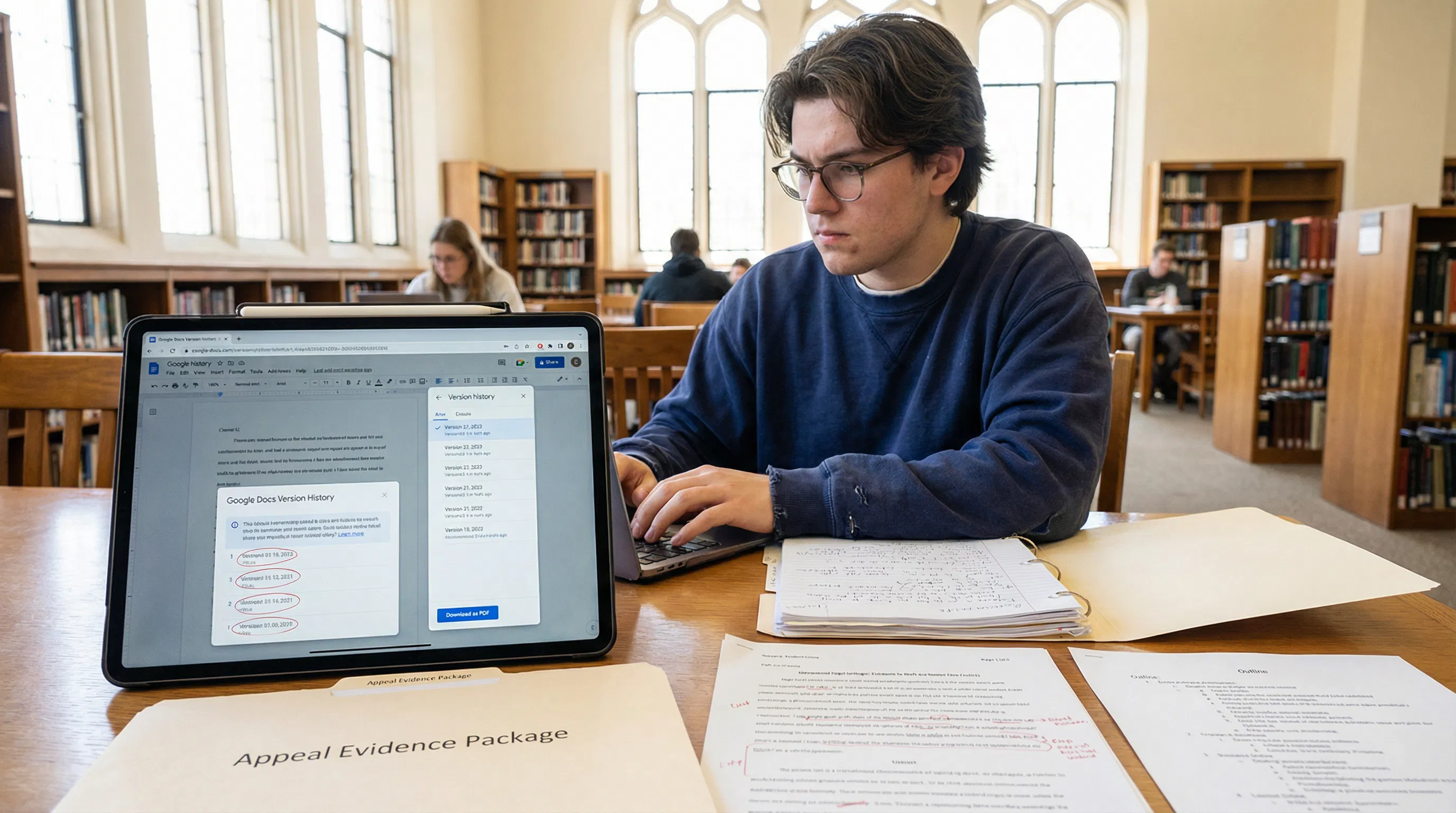
The evidence package is the foundation of a successful appeal against a false positive. Its purpose is to demonstrate the human writing process that produced your submission, because a documented incremental drafting process is directly inconsistent with the AI generation hypothesis. AI-generated text appears as a single-event insertion, not as a document that developed across multiple sessions over days or weeks. How to fix a Turnitin false positive with evidence: The specific materials that consistently resolve instructor-level disputes: draft histories with timestamps, version control records, and research notes that predate the final submission.
Evidence Type | What It Demonstrates | How to Produce It |
Google Docs version history | Incremental human composition across multiple sessions on different dates, inconsistent with a single-event AI paste | File, Version History, See Version History. Take a screenshot of the full timeline showing dates, times, and word counts for each session. Export as PDF for sharing. |
Microsoft Word Track Changes or AutoRecover history | Progressive editing, revision, and refinement over time, showing the messy, iterative process of human writing | Review and Track Changes. Enable and save tracked versions. AutoRecover files with different timestamps also demonstrate incremental development. |
Dated draft files | Independently timestamped intermediate versions showing the paper developing over time | Save named draft files throughout writing (Draft 1, Draft 2, After Research) with file system timestamps visible. Screenshot file properties showing creation and modification dates. |
Research notes, annotated sources, outlines | Demonstrates the intellectual research process that preceded the writing, which AI generation does not have | Screenshots of bookmarked sources, handwritten or digital research notes, annotated PDFs, outline documents, and any notes taken during source reading. |
Course-related communications | Shows real-time intellectual engagement with the topic during drafting, consistent with human authorship | Emails or messages to your instructor asking about the topic, discussion board posts made during the writing period, or writing center consultations. |
Grammarly or spell-check usage logs | Explains why the final text appears more polished than earlier drafts, countering any claim that polish itself indicates AI generation | Grammarly session logs if available, screenshots of Grammarly suggestions applied, or a note documenting which grammar tools were used during editing. |
Previous work in the same style | Demonstrates that your writing style, vocabulary, and structure are consistent with your established pattern across the course | Earlier papers or assignments from the same course or similar courses were submitted before AI detection tools existed or before AI use became common. |
How to Export Your Google Docs Version History
The Google Docs writing history will automatically be saved with session time stamps if you drafted your work in Google Docs. To retrieve this, open your document, click File, click Version History, and click See Version History. The right-hand panel will show a timeline of all editing sessions with their respective dates and times. Take a screenshot of this panel showing the entire timeline from your first session to your final version. Take another screenshot showing individual versions with significant development, e.g., 20%, 50%, 80%, etc. If your document spans multiple sessions over multiple days, this is among the strongest evidence of human authorship.
Step One: Approaching Your Instructor
A large number of false-positive disputes are settled with instructors only if students provide clear proof of the process and do so quickly and professionally. An instructor generally does not like to take a student to the academic integrity board if the use of AI can be reasonably disproved. The main concern is ensuring equal treatment for all students in the course. Your job in this discussion is to provide them with the information they need to resolve the flag without escalation.
Writing the Initial Email
Send a factual email within 48 hours of receiving the flag notification. Do not send any apology for the flag, and do not get defensive in writing. Make it clear you did not use AI in writing, provide evidence of your writing process, and suggest a meeting to discuss this evidence with you. Do not attach anything to this email; simply suggest a meeting and bring your evidence with you to this meeting. Keep a copy of all emails sent in this regard.
The Meeting Itself
In the meeting, walk your instructor through your evidence in chronological order: research notes first, then early drafts, then a version history showing progressive development, and finally the final submission. Offer to discuss the paper's specific arguments, sources, and conclusions in detail, because the ability to discuss your own work verbally is itself evidence of authorship. Ask which specific passages were flagged and address each one directly. If any of the flagged passages coincide with sections you wrote before any grammar tool edits, point this out explicitly. A Stanford study on ESL bias in AI detection is worth citing if your writing style or language background is relevant: it found that AI detectors misclassify over 61% of non-native English speakers' essays as AI-generated, a limitation Turnitin has acknowledged.
Step Two: Filing a Formal Institutional Appeal
If the instructor does not resolve the matter or if the flag has already been escalated to a formal academic integrity proceeding, you need to engage the institution's formal appeal process. Most universities have a structured appeal ladder: department chair, then the academic integrity office, then the academic ombudsman or the dean of students. Each stage requires a written submission. Vanderbilt's institutional AI detection policy is a useful reference in any formal appeal: Vanderbilt is among the institutions that disabled Turnitin's AI detection feature after calculating the expected number of false-positive flags per year for its student population and concluding that the harm from wrongful flags was unacceptable. Citing peer institutions' decisions strengthens the argument that relying solely on Turnitin scores violates the spirit of academic integrity policies.

Step | Action | Timeline | Key Documents |
1 | Do not respond immediately. Read your institution's academic integrity policy and the specific Turnitin report before making any contact with your instructor. | Within 24 hours of flag notification | Turnitin AI Writing Report, course syllabus, AI policy, institution academic integrity handbook |
2 | Assemble your evidence package: all drafts with timestamps, version history screenshots, research notes, outlines, and any communications related to the work. | 24-48 hours | Google Docs version history export, Word Track Changes history, dated draft files, research bookmarks, or notes |
3 | Request a meeting with your instructor by email. Keep the tone factual and non-defensive. State that you did not use AI and that you have documentation to share. | Within 48 hours of flag notification | Written email request (retain a copy), your prepared evidence package |
4 | Attend the instructor meeting. Walk through your process, share your evidence, and offer to discuss the paper's content in detail to demonstrate authorship. | As scheduled, typically within 1 week | Evidence package, notes on your research process, and the ability to discuss sources and arguments verbally |
5 | If the instructor does not resolve the flag, request escalation to the academic integrity office or department chair. Submit your evidence package in writing. | Within the institution's stated appeal window, typically 5-14 days after the instructor meeting | Formal written appeal, all evidence, record of instructor communication, institution appeal form if required |
6 | If the formal appeal is unsuccessful, escalate to the academic ombudsman, dean of students, or equivalent. Request that the detection tool limitations be acknowledged in the review. | As specified by the institutional appeal ladder | All prior documentation, written record of each stage, and any institutional policy that limits reliance on detection tools alone |
7 | If academic consequences have been imposed and informal processes have been exhausted, consult a student advocate or an attorney with higher education experience regarding due process rights. | As needed, ideally before accepting any formal finding | All documentation from steps 1-6, the institution's stated due process policy, and any written communications from the academic integrity office |
Writing Your Formal Appeal Letter
The four issues your formal appeal letter should cover in sequence are the following: first, the facts of your case, i.e., what you submitted, when, Turnitin's report, and your claim of not using AI; second, Turnitin's own admitted shortcomings in accuracy, i.e., its own published false positive rate, its published disclaimer that the results of Turnitin should not be used as the sole factor in determining adverse action against a student, and any independent research on accuracy. Third, your evidence package, presented in the letter as exhibits, is numbered accordingly. Fourth, your requested resolution of the case, i.e., dismissal of the academic integrity charge, grading on the merits, and no notation on your academic record.
Special Considerations for ESL and Neurodivergent Students
Students who are not native English speakers and those with specific writing styles associated with neurodivergence are at higher risk of false positives. ESL students exhibit writing styles characterized by low lexical diversity, predictable syntactic structures, and consistent grammatical structures, all of which are common in AI-generated writing. Neurodivergent students, especially those with ADHD and autism spectrum disorder, have writing styles that include highly organized and consistent writing structures. Real-world AI detection accuracy across student populations confirms that no major detection tool has demonstrated uniform accuracy across diverse student populations, with documented elevations in false-positive rates for ESL writers, neurodivergent writers, and students who write in formal academic prose.
If any of these conditions are true for you, make sure to include this in your appeal statement explicitly. Disability Services and International Student Services are available to provide letters supporting your writing style, which will affirm that your writing style is consistent with a documented pattern known to result in false positives with current AI detection software.
This type of letter, which affirms that your writing style is consistent with a documented pattern known to produce false positives in current AI detection software, is strong evidence in academic integrity investigations, as it provides a broad context for a result that reflects software bias.
Protecting Yourself Against Future Flags
Once you have cleared this current flag, implement these habits to avoid future occurrences:
The most critical habit to adopt is to set Google Docs as your default drafting tool, so you have a version history for all your writing.
Save draft copies at regular intervals.
Carry out a pre-submission check of your work using a second tool alongside Turnitin to identify and correct flaggable areas before submission.
If certain passages are flagged, examine them for uniformity in sentence rhythm, identify AI fingerprint words, and correct them before submission. An AI text humanizer that reduces detection risk provides a practical tool for introducing the lexical and structural variation that detection tools associate with human writing, which is particularly useful for polishing passages that grammar tools have over-standardized.
It is recommended to turn on version history in Google Docs prior to writing the first word of any assigned writing. This should only be a one-time action.
It is recommended to create explicitly named drafts at least three times during the writing process: after outlining and initial research notes, after the initial complete draft, and after editing. This will provide a documented timeline.
The final draft should be run through a detection tool before submission. If sentences in the document are consistently detected across multiple tools, they should be revised for variety prior to submission. It is always better to fix this before submitting than to appeal the grade.
If you have Grammarly or another such tool, please include a copy of your work before running it through the tool. Grammar tools improve sentence structure to decrease perplexity scores, and the unprocessed version will give a better sense of your natural writing style.
If in doubt about any use of an AI tool, even if it is permissible, such as grammar checking, spell checking, or research summarization, please include a footnote or note in your submission. It is better to be clear about permissible use than to have any ambiguity.
Conclusion
Being flagged by Turnitin when you have not used any AI is a very common, very stressful, but fully solvable problem. The solution is not based on winning a theoretical debate about whether Turnitin's technology is infallible. Your version history is evidence. Your research notes are evidence. Your ability to explain your work orally is evidence. A numerical result from a process that Turnitin itself describes as yielding only probabilities that should not be acted on exclusively is not evidence. You gather your evidence, go to your instructor professionally and expeditiously, and use the formal process if the instructor level does not work out. The majority of students who have clear process documentation and follow the process described in this guide will resolve the matter at the instructor or department level without going to the academic ombudsman.
Frequently Asked Questions
Does Turnitin admit its AI detection can produce false positives?
Yes. Turnitin's documentation indicates that its AI-based writing detection tool is not infallible and can incorrectly identify human-written, AI-written, and both human- and AI-written texts, including paraphrased texts. It is explicitly stated that the tool should not be relied on as the sole basis for taking adverse action against a student. Turnitin also admits that it does not report scores below 20% due to the high false-positive rate in this range. These are admissions by the tool's developer and should be cited.
What is the most important evidence in a Turnitin false positive appeal?
The Google Doc version history showing the document evolving incrementally over time, with many sessions on different days, is always the strongest single piece of evidence. It shows the exact process that the AI-generation hypothesis cannot account for: the incremental evolution of the writing process over time, with many sessions across different days. The introduction of AI-generated content is recorded as a single event, and no timeline of the drafting process is provided. Any document with this type of version history provides direct evidence against the AI generation hypothesis.
What if I used Grammarly and that caused the flag?
The use of Grammarly is a known cause of high Turnitin scores for AI detection because Grammarly regularizes sentence structure, standardizes sentence length, and substitutes idioms with more conventional sentence forms, all of which decrease the perplexity level that Turnitin uses to detect AI. You should inform your meeting of the use of Grammarly and, if you have a meeting, produce your pre-Grammarly draft. The pre-Grammarly draft will retain the natural variability of language that is lost after using Grammarly. Using Grammarly is not cheating and is universally allowed.
What if I am an international or ESL student?
Reference the Stanford HAI report (Liang et al., 2023) in your appeal. The report found that more than 61% of TOEFL essays written by non-English speakers are incorrectly flagged by AI detectors as AI-generated. This is not an unusual circumstance; it is a systematic bias documented in peer-reviewed research and acknowledged by Turnitin. Request a letter from your international student office or, if applicable, your disability support office. Add a note to your appeal stating that your writing style is consistent with second language acquisition, not AI generation. This puts the onus on the correct context.
What are my rights if the institution refuses to engage with my evidence?
Typically, students at most colleges are allowed a formal hearing before any academic sanction is imposed. They may present evidence and even call witnesses during the hearing if they wish. Following the hearing, they can still appeal their case to the institution's higher governing body. Students at public colleges in several states have constitutional due process rights under the Fourteenth Amendment. If you feel the college is unfairly relying on a Turnitin score as irrefutable evidence without a fair process of presenting evidence, get in touch with the student advocacy office or ombudsman at your college. If you have already tried these options and are still not satisfied, you should get a lawyer who is experienced in higher education matters who can guide you on the possibilities, including a formal grievance or, if the violation is too serious, contacting the courts. Court precedents are increasingly siding with students who prove that the college punished them academically solely on the basis of an AI detection tool, a tool the developer has acknowledged as "probabilistic" and "not suitable" as the sole basis for taking adverse action.
The information in this guide is accurate as of March 2026 and reflects Turnitin's capabilities for detecting AI, handling institutional processes, and handling appeals. The process at your institution, Turnitin's capabilities for detecting AI, and case law are constantly evolving. It is always a good idea to verify your institution's process for appealing a decision before proceeding with a formal appeal. The information contained in this guide is not intended to be legal advice.