AI content detection has gone from a niche academic tool to everyday infrastructure in education, publishing, enterprise content governance, and search engine quality systems — all within the span of three years. Yet most people who encounter detection results, whether as students, writers, content managers, or educators, have only a surface-level understanding of how these tools arrive at their conclusions. A clear technical explanation of how AI detectors analyse text patterns, sentence structure, and predictability confirms that AI detection is not a magic process of 'knowing' whether a human or machine wrote something. It is a set of statistical and learned algorithms that look for patterns associated with machine generation and every one of those algorithms has specific conditions under which it works well and conditions under which it fails.
This guide explains each of the core algorithms behind AI content detection in plain, accessible language. It covers what the algorithm measures, why that measurement is associated with AI-generated text, what the algorithm gets right, and critically where it goes wrong. Understanding this not only makes detection results more interpretable; it makes every downstream decision that depends on those results more defensible, whether you are an educator responding to a detection flag, a publisher setting content quality standards, or an enterprise compliance team selecting a platform for governance at scale.
Key Takeaways
AI content detection is probabilistic, not deterministic. Every detection algorithm produces a probability estimate, a measure of how closely the text resembles patterns associated with machine generation, not a verified fact about authorship. No algorithm, regardless of claimed accuracy, can confirm definitively that a specific human or machine wrote a specific piece of text.
The most widely used algorithms perplexity scoring and burstiness analysis have well-documented structural failure modes that go beyond simple miscalibration. Research on why perplexity and burstiness fail as standalone detection signals on human-written text demonstrates that famous human-authored texts such as the Declaration of Independence are routinely flagged as AI-generated by perplexity-based tools, because those documents are so frequently reproduced in LLM training data that the model assigns them low perplexity scores regardless of their human origin.
Neural classifiers trained on large datasets of human and AI-generated text consistently outperform statistical methods across all tested conditions but they require continuous retraining as new LLMs are released, and they still exhibit bias against non-native English writing styles and out-of-distribution content types.
The most effective evasion of AI detection comes not from sophisticated technical attacks but from simple content revision. Tools that rewrite machine-generated text to remove statistical AI signatures while preserving meaning represent the most common real-world evasion pathway, and their effectiveness means that detection results on edited or revised content are systematically less reliable than results on raw, unedited AI output.
Watermarking is the only algorithm that could in principle deliver near-zero false positives, because human text cannot contain a watermark inserted by an LLM. Its adoption depends entirely on voluntary implementation by model providers, and most commercial LLMs have not yet deployed watermarking as a default output feature.
How Language Models Generate Text: The Foundation of Detection
Why This Matters: To understand how AI detection works, you first need to understand how AI text generation works. Detection algorithms are designed to identify the specific statistical signatures that the generation process leaves behind. Every weakness and limitation of detection technology traces back directly to the nature of the generation process it is trying to identify. |
Modern large language models generate text through a process called next-token prediction. Given a sequence of words, the model computes a probability distribution over its entire vocabulary, typically tens of thousands of words or word fragments and selects the next token based on that distribution. The key feature of this process is that it is fundamentally statistical: the model selects what is most probable given everything that came before, based on patterns learned from the billions of human-authored documents it was trained on. Technical overview of how AI detection algorithms identify the statistical patterns left by the language model generation process confirms that because LLMs are optimised to produce statistically probable text, the output systematically exhibits lower unpredictability, lower variation, and higher structural consistency than human writing produced through genuine cognitive engagement.
This is the core insight that makes AI detection possible: a text generated by maximising statistical probability will exhibit different statistical properties than a text generated by a human mind operating with creativity, emotion, context, and idiosyncratic choice. The detection algorithms described in this guide are each different approaches to measuring that difference and different ways of asking the question: does this text look like it was produced by statistical optimisation, or by human thought?
The challenge is that as language models improve, the difference between statistically probable text and authentically human text becomes progressively smaller. The statistical signatures that reliably identified GPT-2 output in 2019 were insufficient for GPT-3.5 output in 2023, and detection platforms must continuously update their models to keep pace with generation advances. This is the arms race dynamic that defines the AI detection field and it is the reason that no single detection algorithm or platform can claim permanent reliability against the full range of current and future LLM outputs.

Algorithm 1: Perplexity Scoring
What It Measures
Perplexity is a statistical measure of how 'surprised' a language model is by each word in a sequence. Technically, it is calculated as the exponentiated average negative log-likelihood of the word sequence which in plain terms means: how unlikely were the specific words chosen, given everything that came before them? A text with low perplexity contains highly predictable word choices the model would have predicted the same words. A text with high perplexity contains unexpected choices of words or phrases the model would not have predicted.
Detection tools that use perplexity assume that because LLMs are designed to produce maximally probable word sequences, AI-generated text will systematically exhibit lower perplexity than human-written text. A human writer's unexpected idioms, personal references, emotional word choices, and stylistic idiosyncrasies all create higher perplexity; the model would not have predicted those particular words in those particular positions. AI generation, optimising for probability, avoids those surprises.
Where Perplexity Works
Pure, unedited AI text from well-represented models: Perplexity scoring achieves detection rates of 85–95% on raw, unedited output from major commercial LLMs such as GPT-3.5 and GPT-4. The statistical signal is strong when the model has been trained on similar content and the output has not been modified.
Long-form content: Perplexity scoring requires a statistically meaningful sample. On documents of 500 words or more, the accumulated perplexity signal provides a reliable average across many word choices, reducing the impact of any single unusual word.
Batch content screening: For workflows where speed matters more than precision screening large volumes of content for anomalies that warrant human review, perplexity scoring provides a fast, low-cost first pass that can identify the most obvious AI-generated content for further investigation.
Where Perplexity Fails
Edited AI text: A single round of paraphrasing, synonym substitution, or sentence restructuring is sufficient to push AI-generated text into the perplexity range of human writing. Perplexity is a surface-level signal that does not survive meaningful revision.
Training data contamination: Language models are trained on massive internet corpora that include famous texts, historical speeches, classic literature, and widely reproduced academic content. These texts score extremely low perplexity because the model has memorised their word sequences. Perplexity-based detectors routinely flag the Declaration of Independence, Abraham Lincoln's speeches, and well-known literary passages as AI-generated, purely because of their familiarity to the model.
Non-native English writing: Writers working in English as a second language tend to use common vocabulary, short sentences, and standard grammatical constructions all of which produce low perplexity scores. False positive rates for non-native English writers exceed 20% above baseline on several leading platforms.
Short texts: Below approximately 100 words, perplexity scores are statistically unreliable. Short-answer responses, email subject lines, and brief social media content should not be evaluated by perplexity-based tools.
Algorithm 2: Burstiness Analysis
What It Measures
Burstiness measures variation in perplexity across a document specifically, how much the sentence-level predictability fluctuates from one sentence to the next. Human writing exhibits what is called high burstiness: the natural rhythm of human thought produces short, punchy sentences interspersed with long, complex ones; simple declarative statements followed by nuanced analysis; dense technical passages relieved by personal observations. AI generation, producing each sentence through the same statistical process, tends toward uniformity, moderate sentence length, consistent complexity, and regular rhythm throughout.
Burstiness analysis works by computing the variance of perplexity scores across sentences. A high-burstiness document has large variance; some sentences are highly predictable, others unexpectedly idiomatic. A low-burstiness document has small variance every sentence sits in a similar predictability range. Detection tools that use burstiness assume that low variance is associated with machine generation and high variance with human authorship.
Where Burstiness Works
Long-form structured content: Academic essays, marketing articles, and structured informational content produced by AI tend to maintain consistent complexity throughout an introduction at one level of complexity, body paragraphs at a similar level, a conclusion mirroring the introduction. This consistency produces a measurably flat burstiness profile.
As a complementary signal to perplexity: Burstiness and perplexity are most powerful when combined. A text with both low average perplexity and low burstiness variance provides a much stronger AI signal than either metric alone. Detection platforms that combine both produce significantly fewer false positives than platforms relying on perplexity alone.
Where Burstiness Fails
Deliberately varied AI text: Burstiness is straightforward to defeat by adding deliberate sentence length variation to AI-generated content. Rewriting tools and AI humanization platforms that specifically target burstiness can push AI-generated content into the high-burstiness range that detectors associate with human writing.
Formal writing styles: Academic writing instruction specifically discourages excessive variation in sentence structure in favour of clarity and logical flow. A student who follows their institution's writing style guide may produce low-burstiness prose regardless of human authorship.
Technical and scientific writing: Engineering reports, scientific abstracts, and legal documents use highly consistent structural patterns by convention producing low burstiness that reads as AI-like to detection tools regardless of the actual author.
Algorithm 3: Neural Classifier Models
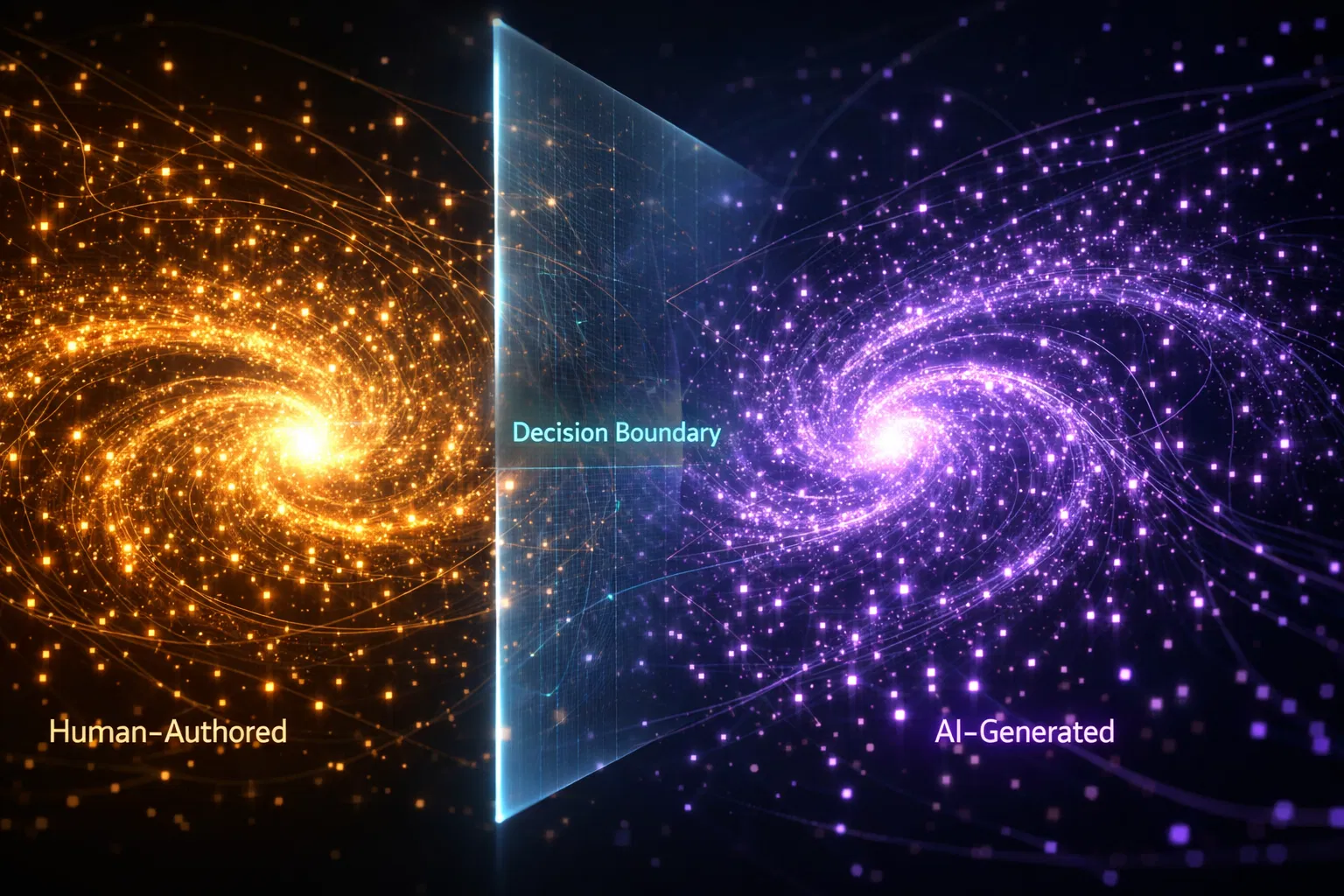
Neural classifiers are machine learning models trained specifically to distinguish between human-written and AI-generated text. Unlike statistical approaches that measure a single metric, classifiers learn from large datasets of labelled examples thousands or millions of paired texts, each identified as human-authored or AI-generated and discover their own multi-dimensional representations of what distinguishes the two categories. How AI detection tools use machine learning algorithms and natural language processing to identify patterns across multiple dimensions simultaneously confirms that the most sophisticated classifiers analyse text across semantic coherence, stylistic consistency, grammatical framing, phrase-level repetition, and information density patterns that emerge from how LLMs structure content features that are genuinely beyond the reach of any single statistical metric.
How Neural Classifiers Work in Practice
The most capable detection classifiers use transformer-based architectures, the same fundamental architecture that underlies the LLMs they are designed to detect. A transformer classifier converts input text into numerical vector representations (embeddings) that capture the semantic relationships between words and sentences in a high-dimensional space. The classifier then learns, through training on labelled examples, which regions of that high-dimensional space correspond to AI-generated text and which correspond to human-authored text. At inference time, new text is converted to its vector representation and classified based on which region of the trained space it falls into.
This architecture has a critical practical advantage over statistical methods: it captures features of text that are genuinely non-obvious and multi-dimensional features that survive light paraphrasing because they reflect deep structural properties of how LLMs organise information, rather than surface-level word choice. The best classifiers in 2026, including those underpinning leading commercial platforms, achieve 90–99% detection rates on pure AI-generated text and maintain meaningfully higher accuracy on edited content than any purely statistical approach.
The Continuous Retraining Problem
The fundamental limitation of neural classifiers is model drift. A classifier trained on GPT-3.5 outputs learns the specific statistical patterns of GPT-3.5 patterns that may differ meaningfully from GPT-4o, Claude 3.5, Gemini 1.5, or DeepSeek V3 outputs. When a new LLM is released, detection classifiers that are not immediately retrained on that model's output experience a reduction in detection accuracy, sometimes dramatic, until the model update is deployed. Evaluating a detection platform's update policy and retraining schedule is therefore one of the most important procurement considerations for enterprise users, and one of the least visible factors in consumer tool comparisons.
Algorithm 4: N-gram Frequency Analysis
N-gram analysis examines the frequency and distribution of specific word sequences within a text. Language models are trained on the same vast internet corpora and learn to reproduce the most statistically common phrasing for any given concept producing characteristic overuse of specific multi-word sequences that appear with high frequency in LLM output relative to human writing. Phrases including 'it is worth noting that,' 'in today's digital landscape,' 'delve into,' 'it is important to,' 'showcases,' and 'underpins' appear with dramatically elevated frequency in AI-generated text because they represent the high-probability phrase completions that LLMs learn from training data.
N-gram detection flags content when it contains above-threshold frequencies of these characteristic sequences, or when the distribution of n-gram repetition across the document differs from what is typical of human writing in the same genre. It is most effective as a supporting signal: it catches a class of AI-generated content that statistical perplexity measurement may miss, particularly domain-specific content where LLMs have been fine-tuned on genre-specific training sets. It is least effective as a standalone method, because it is defeated completely by synonym substitution and because the specific phrase patterns that signal AI generation vary substantially across content types.
Algorithm 5: Stylometric Fingerprinting
Stylometry is the quantitative analysis of writing style for the purpose of authorship attribution — a discipline with roots in literary scholarship that has found direct application in AI detection. Stylometric AI detection analyses writing style across multiple dimensions simultaneously: vocabulary richness and diversity, the frequency of specific function words (prepositions, conjunctions, articles, pronouns), punctuation usage patterns, sentence complexity distribution, preference for active versus passive voice, and the statistical distribution of rare versus common words across a document. How AI detection methods combine statistical and stylometric signals to identify machine-generated writing patterns confirms that modern detection platforms extend classical stylometry with transformer-based embeddings converting each paragraph into a point in a high-dimensional mathematical space where the clustering patterns of AI-generated text differ measurably from human-authored text.
The practical advantage of stylometric analysis is that it captures writing behaviour rather than content the how of writing rather than the what. This makes stylometry more resilient to simple paraphrasing than perplexity or n-gram methods, because stylistic patterns persist through synonym substitution and light sentence restructuring. The characteristic function word frequencies of AI-generated text, the consistent syntactic complexity distribution, the specific punctuation patterns these survive moderate editing in a way that surface perplexity scores do not. Stylometry is most powerful when combined with other detection methods as part of a layered ensemble approach, where it provides a signal that complements and partially compensates for the weaknesses of statistical methods.
Algorithm 6: Watermark Detection
The Most Reliable Approach — With a Major Caveat: Watermark detection is the only AI detection algorithm that could in principle achieve near-zero false positives. Because human writers cannot embed an LLM-specific statistical token pattern in their writing, any text that contains a verified watermark must have been generated by a watermarked model. The caveat is significant: watermarking must be implemented at the point of text generation, and most commercial LLMs have not yet deployed it by default. |
Statistical watermarking for LLM outputs works by dividing the model's vocabulary into two sets informally called 'green list' and 'red list' tokens at each token generation step, using a secret key. The model is then biased to preferentially select green-list tokens. The resulting text contains a statistically detectable pattern: far more green-list tokens than would appear by chance. A detector that knows the secret key can verify whether the pattern is present, confirming that the text was generated by the watermarked model. The pattern is imperceptible to human readers; the text reads normally but statistically unmistakable to the detector.
The four technical requirements for an effective watermarking scheme are imperceptibility (the watermark should not degrade text quality), robustness (the pattern should survive moderate paraphrasing and editing), security (the scheme should resist adversarial attempts to remove or forge the watermark), and capacity (sufficient information should be embedded for reliable attribution at realistic text lengths). Current research implementations satisfy these criteria to varying degrees, but most commercial deployments have not yet achieved robust robustness against aggressive paraphrasing meaning that a determined actor who subjects watermarked text to extensive rewriting can partially degrade the detection signal.
The EU AI Act's requirement that AI-generated content distributed within the EU be labelled with detectable signals has significantly accelerated commercial interest in watermarking as a compliance mechanism. Several major AI providers are actively developing watermarking implementations as part of their regulatory compliance roadmaps. Whether this regulatory pressure translates to widespread default watermark deployment within the next two to three years is the single most consequential open question for the long-term future of reliable AI content detection.
Algorithm Comparison: Strengths, Weaknesses, and Use Cases
Algorithm | What It Measures | Accuracy on Pure AI Text | Accuracy on Edited Text | False Positive Risk |
Perplexity Scoring | Word-level predictability — how likely each word is given its context | High (85–95%) | Low (drops sharply after light paraphrasing) | High — flags formal writing, ESL text, and texts well-represented in LLM training data |
Burstiness Analysis | Sentence-level rhythm variation — how uniform or varied sentence lengths and structures are | Moderate-High (works best on long texts) | Low-Moderate (degrades with deliberate sentence variation) | Moderate — uniform prose styles and technical writing score low burstiness regardless of origin |
N-gram Frequency | Overuse of specific word sequences common in LLM output ('it is worth noting', 'delves into', 'crucial') | Moderate (effective on specific domains) | Low (defeated by synonym substitution) | Moderate — penalises legitimate writers who happen to use common phrases |
Neural Classifier | Complex multi-dimensional learned patterns from large human and AI training datasets | High (90–99% on well-represented models) | Moderate-High (most resilient of all methods) | Lower than statistical methods — but still affected by out-of-distribution content types |
Stylometric Analysis | Vocabulary diversity, function word frequency, punctuation patterns, syntactic complexity distribution | Moderate-High (effective on unedited text) | Moderate (survives light paraphrasing better than perplexity) | Moderate — mimicry of a specific author's style or highly edited formal writing can confuse the analysis |
Watermark Detection | Presence of embedded statistical token-selection pattern inserted at point of LLM generation | Very High (when watermark is present) | High (robust to moderate editing) | Near zero (human text cannot contain LLM watermarks) — but requires model-side implementation |
How Modern Detectors Combine Multiple Algorithms
The most accurate AI detection platforms in 2026 use ensemble approaches that run multiple algorithms simultaneously and combine their outputs into a single weighted probability score. The weighting is typically dynamic adjusted based on the content characteristics of the specific text being evaluated. A short technical document receives more weight from neural classifier analysis and stylometry than from burstiness scoring, which requires longer texts to produce reliable results. A long-form essay receives strong signals from all methods. Social media content and short-form copy, which are below the minimum reliable text length for most statistical methods, should ideally be evaluated only by classifiers specifically trained on short-form content. Overview of how the most accurate AI detection tools perform across multiple content types and detection scenarios in 2026 confirms that platforms combining multiple detection methods outperform any single-method tool across all tested content categories — particularly on edited, mixed human-AI, and short-form content where individual statistical methods produce the least reliable results.
The practical implication for users of AI detection tools is that the headline accuracy figure claimed by any platform reflects its ensemble performance on the specific test set used for evaluation, not its performance on any arbitrary piece of content. A platform that achieves 99% accuracy on its own benchmark of unedited, pure AI-generated text from well-represented models may achieve far lower accuracy on the edited, hybrid, short-form, or multilingual content that constitutes the bulk of real-world detection workloads. Understanding this gap and asking platforms specifically about performance on the content types you will actually be evaluating is the most important step in responsible AI detection tool selection.
Evasion: Why Detection Is Not Permanent
Every algorithm described in this guide can be partially or fully defeated under specific conditions. Perplexity scoring is defeated by paraphrasing. Burstiness analysis is defeated by deliberate sentence variation. N-gram detection is defeated by synonym substitution. Neural classifiers are defeated by content from recently released models that have not yet been incorporated into the classifier's training data. Stylometry is partially defeated by style-mimicry tools and aggressive rewriting. Only watermarking provides inherent evasion resistance and it requires model-side implementation that has not yet been widely adopted. How AI content detection performs across real-world use cases including edited and AI-humanized content confirms that AI detection technology continues to improve alongside generation technology, but the generation frontier consistently advances faster than the detection update cycle creating systematic windows where newly released models produce text that existing detectors cannot reliably identify.
The honest position on AI detection in 2026 is that it is a useful and improving probabilistic tool not a solved technical problem. Detection results provide meaningful signals about content authenticity that is worth incorporating into editorial, academic, and governance decisions. They are not grounds for definitive conclusions about authorship, and they should not be deployed as automated enforcement mechanisms without human review of flagged content. Understanding the algorithms, their individual strengths and failure modes, and the conditions under which each is most and least reliable is the foundation for using detection results responsibly and interpreting them accurately.
Conclusion
AI content detection works by measuring the gap between the statistical predictability of machine-generated text and the organic unpredictability of human writing using perplexity scoring, burstiness analysis, n-gram frequency, neural classifiers, stylometric fingerprinting, and watermark detection, each capturing a different dimension of that gap. No single algorithm is reliable across all content types and conditions. The most accurate platforms combine all of these methods in ensemble systems that dynamically weight each signal based on the content being evaluated. Even those systems produce results that should be treated as probabilistic inputs to human judgment not automated verdicts. As language model outputs become more human-like with each model generation, the gap that detection algorithms measure continues to narrow, making both the technology and its responsible use more important to understand than ever.
Frequently Asked Questions
What is the most accurate AI detection algorithm in 2026?
Neural classifier models trained on large, diverse datasets of human and AI-generated text consistently outperform all statistical methods across real-world content conditions. They achieve 90–99% detection rates on pure AI-generated text and maintain significantly higher accuracy on edited content than perplexity or burstiness scoring alone. However, no single algorithm and no current platform is reliably accurate across all content types, all LLMs, and all editing conditions. The most accurate detection results come from ensemble platforms that combine neural classifiers with statistical methods and stylometric analysis, dynamically weighting each signal based on the text being evaluated.
Why do AI detectors produce false positives on human writing?
False positives occur because every detection algorithm measures statistical patterns that tend to be more common in AI-generated text but those same patterns can appear in human writing under the right conditions. Perplexity scoring flags any text with predictable word choices, regardless of whether a human or a machine produced them. This includes formal academic writing, non-native English writing, highly edited professional prose, and texts that appear frequently in LLM training data. Burstiness scoring flags uniform sentence structure regardless of authorship. The result is systematic false positive risk for specific populations and writing styles that the algorithms associate with machine generation, even when the content is entirely human-authored.
What is the difference between AI detection and plagiarism detection?
Plagiarism detection works by comparing submitted text against a database of existing published content, looking for direct matches or close paraphrases. It answers the question: was this copied from somewhere? AI detection works by analysing the statistical and stylometric properties of the text itself, looking for patterns associated with machine generation. It answers the question: does this text exhibit the characteristics of LLM output? A piece of content can be original (passing plagiarism detection) while also being AI-generated (flagged by AI detection). Conversely, human-authored content that happens to use common phrasing may pass AI detection while containing plagiarised passages. The two tools address different aspects of content authenticity and should be used together, not as substitutes for each other.
How does text editing affect AI detection accuracy?
Editing has a significant and well-documented negative effect on AI detection accuracy particularly for statistical methods. Even light paraphrasing, synonym substitution, or sentence restructuring can push AI-generated text into the perplexity and burstiness ranges characteristic of human writing, defeating surface-level statistical detection. Neural classifiers are more resilient to editing because they capture multi-dimensional learned patterns that survive surface-level changes, but they also lose accuracy as editing becomes more substantial. Research has shown that after three passes through a quality humanization tool, no currently tested detector consistently identifies the content as AI-generated. This is why detection results on edited content are systematically less reliable than results on raw AI output.
Will watermarking replace other AI detection methods?
Watermarking has the potential to become the most reliable detection mechanism particularly for false positive elimination, since human text cannot contain an LLM-generated watermark but it requires fundamental changes to how commercial LLMs are deployed. Most major LLM providers have not yet implemented default watermarking, and open-source models cannot be compelled to do so. Regulatory pressure from the EU AI Act and similar frameworks is accelerating commercial interest in watermarking implementations, and several major providers are developing watermarking capabilities as part of their compliance roadmaps. Whether watermarking becomes the default attribution mechanism for AI-generated content within the next few years depends primarily on the pace of regulatory adoption and voluntary industry alignment, not on the technical readiness of the approach, which is substantially established.
This guide reflects the state of AI content detection technology and algorithm development as of March 2026. Both generation and detection capabilities are advancing rapidly, and specific accuracy figures and platform capabilities are subject to change. Readers should verify current platform performance with up-to-date independent benchmarks before making procurement or policy decisions.