Academic writing is built on precise vocabulary. In philosophy, "epistemic" and "doxastic" are not interchangeable. In molecular biology, "transcription" and "translation" are distinct processes whose names cannot be substituted for one another without describing something different. In legal writing, "shall" and "may" carry different levels of obligation. In social theory, "habitus" is not the same as "habit," and substituting one for the other misrepresents an entire theoretical framework.
AI paraphrasers' content rewriting 2026 acknowledges that AI paraphrasers can still introduce inaccuracies or subtle shifts in intent, making human review essential. The question for academic writers is not whether AI rewriting tools can handle general prose, but how they handle the specific vocabulary and conceptual structures that academic writing depends on. The answer varies considerably by tool architecture, by the type of academic vocabulary encountered, and by whether the writer has taken steps to protect critical terminology before submitting text for rewriting.
This guide explains how modern AI rewriting tools process academic vocabulary at the technical level, where they characteristically fail, how to configure or prompt tools to protect critical terms, and which tools in the current market are best suited for discipline-specific academic vocabulary. An AI humanizer tool should be understood in relation to this question: it adjusts statistical properties of text for detection purposes, but it does not substitute discipline-specific vocabulary. Understanding which rewriting tasks belong to which tools is the foundation of effective use.
Key Takeaways
Modern AI rewriting tools use transformer-based language models that understand contextual meaning rather than relying on fixed synonym lookup tables. This means they can, in principle, distinguish "bank" as a financial institution from "bank" as a river feature and choose appropriate paraphrases accordingly. In practice, however, this contextual understanding degrades at the edges of their training data, where specialized academic vocabulary resides.
AI rewriting tools fail most predictably on four categories of academic vocabulary: defined technical terms with no valid synonyms, theoretical framework terms that carry discipline-specific meaning distinct from their everyday usage, multi-part compound concepts where the combination carries meaning that the parts do not, and precision quantitative language where approximation is not acceptable. Each category requires different protective strategies.
The most reliable protection against unwanted vocabulary substitution is the "freeze" or "lock" feature offered by several AI rewriting tools, which prevents specified words and phrases from being changed. Writers who identify their critical vocabulary before rewriting and lock it explicitly get substantially better results than writers who rely on the AI to recognize which terms should not be changed.
General-purpose AI rewriting tools perform worse on complex academic vocabulary than tools specifically trained on academic corpora. Tools like Paperpal, Writefull, and research-oriented paraphrasers are trained on published academic text and therefore have better representations of discipline-specific terminology than tools trained on general web content.
The appropriate response to AI vocabulary-handling limitations is a targeted post-rewrite review focused on the terms most at risk: defined technical terms, theoretical framework vocabulary, precision quantitative claims, and multi-part compound concepts. This targeted review is faster and more effective than a general quality read of the entire document.
How AI Rewriting Tools Process Academic Vocabulary
In 2026, researchers identified that the biggest differentiator between weak and strong paraphrasing tools is semantic accuracy, and that, for academic writing, accuracy matters more than creativity. General-purpose paraphrasing tools often perform poorly on academic texts, whereas research-oriented tools are designed to handle the specialized vocabulary required in academic writing. Understanding why requires understanding how these tools actually process text.
The Contextual Embedding Approach
Modern AI rewriting tools use transformer-based language models that represent each word not as a fixed entry in a synonym dictionary but as a contextual embedding, a vector representation that captures the word's meaning in the specific surrounding context. This is why current tools can distinguish "positive" in a mathematical sense (the result is positive) from "positive" in a medical sense (the test is positive) from "positive" in an attitudinal sense (she has a positive attitude). The surrounding tokens shift the embedding, and the model draws on different regions of its learned vocabulary distribution for each context.
Where Contextual Understanding Reaches Its Limits
The contextual embedding approach works well for vocabulary that appears frequently in the model's training data with consistent usage patterns. It reaches its limits when the vocabulary is rare in general text, used differently in academic contexts than in general usage, domain-specific to a field that may be under-represented in the training corpus, or defined within a specific theoretical framework that exists only in academic literature. All four of these conditions describe large portions of academic technical vocabulary. A term like "intersectionality" appears infrequently in general web text, carries a specific theoretical meaning in sociology and critical theory that differs from its everyday usage ("the intersection of multiple identities"), and is defined within a specific scholarly tradition. A general-purpose AI rewriting tool trained on web content will have weaker representations of this term than a tool trained on academic social science literature, and may therefore substitute it with approximations that are meaningfully wrong.
This is why research-specific tools consistently outperform general paraphrasers for academic vocabulary. For more on our pricing options at BestHumanize, which focuses on statistical adjustment rather than vocabulary substitution, the vocabulary preservation question is less central: the tool is not designed to substitute academic vocabulary, so the risk of vocabulary corruption is lower than with general paraphrasers.
Where AI Rewriters Fail on Academic Vocabulary
How to paraphrase academic writing identifies the critical rule that synonym substitution should be selective, preserving technical terminology and discipline-specific language while replacing common words. In a psychology paper, you would not replace "cognitive behavioral therapy" with "mental thinking treatment." The rule is clear in principle; the challenge is that AI tools do not always follow it correctly in practice. The following four categories represent the most common and consequential failure modes.
Category 1: Defined Technical Terms
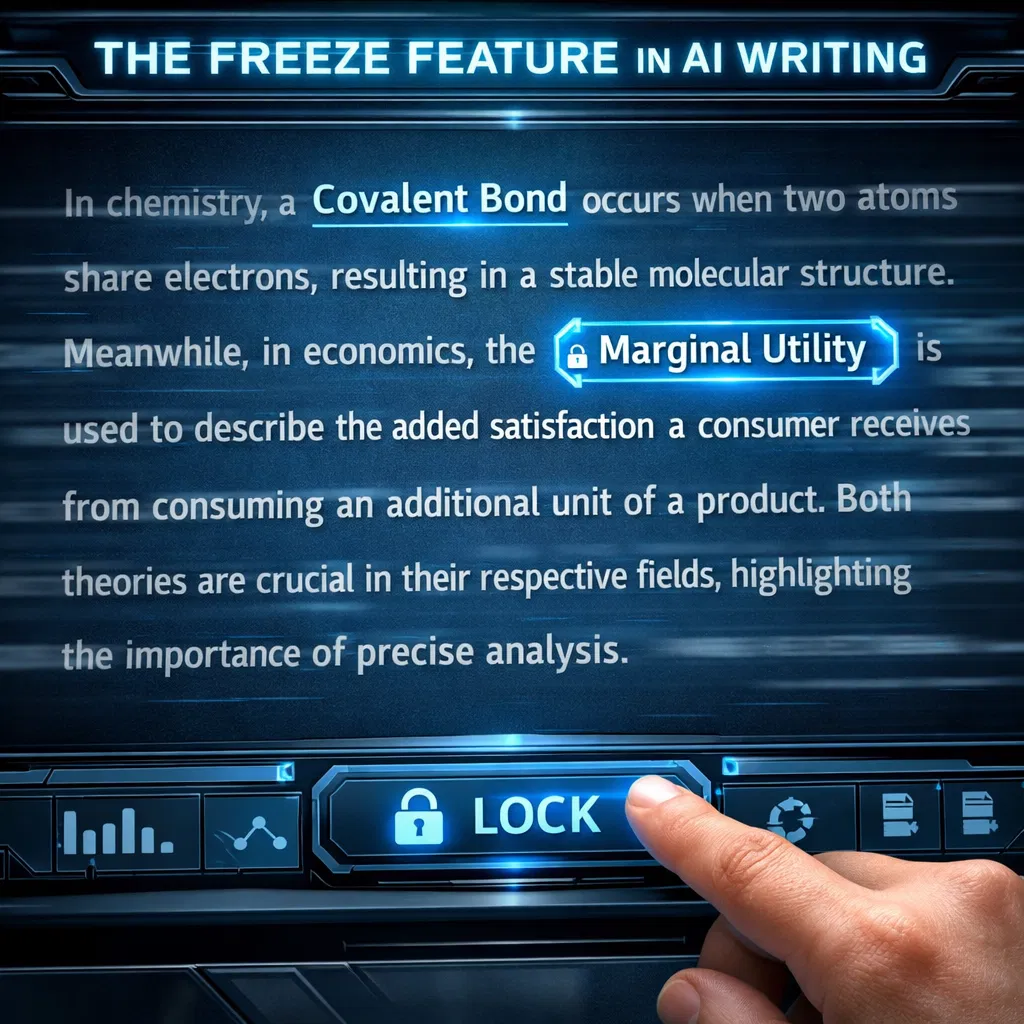
Defined technical terms are words or phrases whose meaning is specified in the literature of the field and that cannot be approximated without losing precision. In chemistry, "covalent bond" is not interchangeable with "molecular connection." In economics, "marginal utility" is not interchangeable with "usefulness at the edge." In statistics, "p-value" cannot be paraphrased as "significance indicator" without losing specific quantitative meaning. AI tools that encounter these terms face a straightforward decision: recognize the term as a defined technical item that should not be changed, or treat it as ordinary vocabulary subject to substitution. General-purpose tools more often make the wrong choice.
Category 2: Theoretical Framework Terms
Theoretical framework terms are words borrowed from everyday language but given a specific technical meaning within an academic theory. "Capital" in Bourdieu's sociology (social capital, cultural capital, economic capital) means something different from "capital" in everyday use. "Discourse" in Foucauldian analysis carries a specific theoretical meaning that "language" or "discussion" does not capture. "Agency" in sociological theory is distinct from "agency" as a business entity or from "agency" in everyday usage. AI rewriting tools that lack strong representations of these theoretical usages will substitute the everyday meanings' synonyms for the technical term, producing text that sounds plausible but misrepresents the theoretical framework. For technical guidance on protecting these terms, read our blog at BestHumanize for ongoing practical writing guidance.
Category 3: Precision Quantitative Language
Academic writing frequently includes quantitative claims that must be exact: specific percentages, specific statistical measures, specific time ranges, and specific quantities. AI rewriting tools can corrupt these claims through approximation. "Between 1990 and 2010" may be rephrased as "over the past few decades." "A 23 percent reduction" may become "a significant reduction." "An effect size of d = 0.42" may become "a moderate effect." Each of these substitutions changes the factual content of the claim. Quantitative precision is particularly important in scientific and social scientific writing, where other researchers rely on exact figures to compare studies, replicate methods, and build on findings.
Category 4: Multi-Part Compound Concepts
Academic writing frequently uses multi-part compound concepts where the combination carries meaning that the individual parts do not. "Cognitive behavioral therapy" means something that neither "cognitive therapy" nor "behavioral therapy" separately fully captures. "Logical positivism" is not the same as "logic" plus "positivism." "Critical race theory" carries theoretical and political implications that "critical analysis of race" approximates but does not replicate. AI rewriting tools that encounter multi-part terms may break them apart, substitute one part while leaving another unchanged, or replace the whole compound with a partial synonym that misses the compound's specific meaning.
Key Diagnostic: After any AI rewriting, pass on an academic essay, specifically search for every technical term, theoretical framework term, quantitative claim, and multi-part compound concept in the original. Compare each to its counterpart in the rewrite. Any substitution in these categories deserves scrutiny regardless of whether the sentence reads naturally. |
How to Protect Critical Vocabulary from AI Substitution
Top AI tools academic writing 2026 describes how Paperpal's rewriting tool can paraphrase, adjust tone to academic, improve fluency, or shorten passages while keeping the core meaning, with an important qualification: these features should be applied to small units of text and followed by careful review, and full paragraph rewrites can subtly change meaning and introduce claims that have not been checked. The same principle applies to vocabulary protection: targeted rewriting with explicit term preservation produces better results than whole-document rewriting with post-hoc correction.
Method 1: The Freeze or Lock Feature
Several AI rewriting tools offer an explicit vocabulary freeze or lock feature that prevents specified words and phrases from being changed. Paraphraser.io offers a "freeze words" feature for important terminologies and keywords. QuillBot's synonym slider can be moved toward the conservative end to reduce overall substitution frequency. Some tools allow specific terms to be marked for preservation. Before submitting any academic essay for AI rewriting, identify every term that falls into the four failure-mode categories and, where the tool supports it, explicitly lock those terms. This is the single most effective protective measure available.
Method 2: Conservative Mode Selection
Most AI rewriting tools offer multiple rewriting modes ranging from conservative (minimal changes, focused on fluency) to aggressive (substantial restructuring and vocabulary substitution). For academic essays with complex technical vocabulary, always select the most conservative or least aggressive mode available. Conservative modes adjust sentence structure and clarity while making fewer vocabulary substitutions, which reduces the risk of technical term corruption. The trade-off is that conservative modes produce less dramatic statistical transformation of the text, which may be relevant if detection profile adjustment is a goal. The solution is to run conservative rewriting for vocabulary-heavy academic sections and save more aggressive modes for sections with less technical vocabulary.
Method 3: Section-by-Section Submission
Submitting an essay to an AI rewriting tool section by section, with review between sections, allows vocabulary errors to be caught and corrected before they accumulate across the whole document. This is more time-consuming than whole-document submission, but it substantially reduces the damage that vocabulary-substitution errors can cause in heavily technical sections. For practical guidance on this workflow, visit our BestHumanize FAQ for commonly asked questions about rewriting workflows.
Method 4: Pre-Rewrite Glossary
Creating a pre-rewrite glossary of all technical terms in the essay before submitting it to an AI tool serves two purposes. First, it forces the writer to identify all the terms that will need post-rewrite verification, making the review process more systematic and less likely to miss something. Second, it provides a reference document for the post-rewrite check: the writer can go through the glossary term by term and verify each against the rewritten text. A pre-rewrite glossary also helps writers identify which terms are truly non-substitutable (defined technical terms, theoretical framework terms, quantitative claims) versus which terms are ordinary academic vocabulary that the AI can reasonably vary.
How AI Rewriters Handle Multi-Part and Complex Concepts
AI paraphrasing tool Academic Paperpal states that its advanced AI paraphraser understands technical context, maintains scientific accuracy, adapts to writing style, and ensures clarity while preserving the original meaning, while also maximizing retention of citations and references. This represents the upper end of what academic-focused AI rewriting tools aim to do. Understanding how even well-designed tools handle multi-part concepts helps writers calibrate their trust appropriately.

How AI Processes Multi-Part Terms
When an AI rewriting model encounters a multi-part term like "cognitive behavioral therapy," it must decide whether to treat it as a single unit (a named concept that should not be decomposed) or as a sequence of separate words (each of which could potentially be varied independently). Models trained on academic corpora are more likely to represent established compound terms as units, since those terms appear consistently as units in the training data. Models trained on general web text may have weaker representations of the same compounds as units, and therefore decompose and partially substitute them more often.
The Decomposition Failure
The most common failure mode for multi-part concepts is decomposition: the AI changes one component of the compound term while leaving another unchanged, producing a hybrid that is neither the original term nor a valid synonym. "Critical race theory" might become "critical theory of race" (which subtly shifts the theoretical lineage). "Social cognitive theory" might be rephrased as "social learning theory" (a related but distinct framework). "Working memory" might be rebranded as "active memory" (which is not an established term in cognitive psychology). These substitutions are particularly dangerous because they read naturally in context while introducing genuine theoretical or terminological errors.
Writers who work with multi-part theoretical concepts should consider adding the full compound term to their freeze list or locked vocabulary before submitting for AI rewriting. If the tool does not support explicit vocabulary freezing, a post-rewrite search for the second component of each compound term (e.g., "theory" after verifying that "critical race theory" is intact) can efficiently identify decomposition failures. For specific questions about how to handle these situations with BestHumanize, contact us directly.
AI Rewriting Tools: Academic Vocabulary Handling Comparison
Tool | Training Data | Freeze/Lock Feature | Technical Vocabulary Handling | Best For Academic Writers |
Paperpal | Academic publications (journal articles, research papers) | Preserve citations automatically; manual selection of terms | Strong: trained on academic corpora; understands scientific terminology | Researchers and graduate students in STEM and social sciences preparing journal submissions |
Writefull | Published academic text across disciplines | No explicit freeze; conservative mode available | Strong: corpus-based suggestions from published academic writing | Non-native English academic writers; PhD students refining language clarity |
Jenni AI | Academic and general text | Can specify terms to preserve through prompting | Good: academic mode available; citation preservation built in | Students who need guided paraphrasing with citation management |
QuillBot | General web text | Synonym Slider (conservative end) reduces substitution frequency | Moderate: "Academic" mode helps; general training means some technical term mishandling | General academic paraphrasing; less reliable for highly technical field-specific vocabulary |
ChatGPT / LLMs | Broad web and academic text | Instruction-based: "Do not change [term X]" in the prompt | Variable: GPT-4 handles well-established academic vocabulary better than specialized or emerging terms | Writers comfortable with prompting who need control over specific vocabulary decisions |
BestHumanize | N/A (statistical adjustment, not vocabulary substitution) | N/A (does not substitute vocabulary) | Not applicable: tool adjusts statistical properties without vocabulary substitution | Writers whose primary need is detection profile adjustment without vocabulary change risk |
Solution Section: Choosing the Right Tool for Academic Vocabulary
Best paraphrasing tools for academic writing 2025 identifies that a good paraphrasing tool should know what not to paraphrase, and that academic paraphrases are engineered specifically for context preservation, retaining technical meaning, key terms, and research context. For writers with complex academic vocabulary, tool selection should be based on how well the tool handles the specific vocabulary types that appear most frequently in their discipline.
For STEM Writers
STEM writers with highly specific technical terminology should prioritize Paperpal or Writefull, both trained on academic literature and both better at recognizing established scientific terms as non-substitutable units. For detection profile adjustment specifically, BestHumanize can be run after the vocabulary-preserving academic tool has been applied, in the sequence: Writefull or Paperpal for language improvement, then BestHumanize for detection profile, then manual review of all technical terms.
For Humanities and Social Science Writers
Humanities and social science writers with a theoretical framework vocabulary should use instruction-based approaches with tools that accept explicit vocabulary protection instructions. ChatGPT, with carefully crafted prompts that specify non-substitutable terms, gives writers the most direct control over theoretical vocabulary. Alternatively, Paperpal's academic paraphrase modes applied conservatively to short sections preserve more theoretical vocabulary than general tools applied to whole documents.
For Statistical and Quantitative Writers
Writers with precision quantitative claims (specific statistics, effect sizes, p-values, dates, quantities) should use the most conservative rewriting mode available for any section containing these claims, and should add all specific quantitative expressions to the pre-rewrite glossary for post-rewrite verification. No AI rewriting tool reliably preserves all quantitative precision; the post-rewrite verification step is non-optional for quantitative academic work.
For the statistical adjustment layer specifically, BestHumanize handles detection profile without touching vocabulary, which means it is safe to use on quantitatively dense academic text without additional vocabulary protection measures. Learn about BestHumanize to understand how the tool's design ensures that vocabulary, factual content, and argument structure are preserved while statistical detection properties are adjusted.
Conclusion
AI essay rewriting tools handle complex academic vocabulary through contextual embedding models that perform well on frequently occurring vocabulary and less well on the specialized, rare, theoretically defined, and precision-quantitative vocabulary that academic writing depends on. The four failure categories, defined technical terms, theoretical framework terms, precision quantitative language, and multi-part compound concepts, represent the areas where writers must apply active protection measures: vocabulary freeze features, conservative mode selection, section-by-section submission, and targeted post-rewrite verification. Tools trained on academic corpora (Paperpal, Writefull) perform substantially better than general-purpose tools at handling academic vocabulary, but no tool eliminates the need for targeted human review of critical terms. Understanding both what AI rewriting tools can do and where they characteristically fail is the foundation for using them effectively in complex academic writing contexts.
Frequently Asked Questions
How do modern AI essay rewriting tools process academic vocabulary at the technical level?
Modern AI rewriting tools use transformer-based language models that represent words as contextual embeddings: vector representations that capture each word's meaning in its specific surrounding context. This allows them to distinguish different uses of the same word (for example, "bank" as a financial institution versus "bank" as a river feature) by drawing on different regions of the learned vocabulary distribution for each context. In practice, this contextual understanding is stronger for vocabulary that appears frequently and consistently in the model's training data, and weaker for vocabulary that is rare in general text, domain-specific to an under-represented field, or defined within a specific academic theoretical framework. For specialized vocabulary, contextual embeddings may not accurately reflect the term's disciplinary meaning, leading to substitutions that are contextually plausible in general English but semantically incorrect in the academic context.
Where do AI rewriters typically fail when encountering complex academic terminology?
AI rewriters fail most predictably on four categories of academic vocabulary. Defined technical terms (like "covalent bond" in chemistry or "p-value" in statistics) have no valid synonyms and should not be changed, but general-purpose AI tools may substitute approximate paraphrases that lose precision. Theoretical framework terms (like "habitus" in Bourdieu's sociology or "intersectionality" in critical theory) carry specific meanings within their respective theoretical contexts that differ from their everyday approximations, and AI tools with weak representations of those frameworks may substitute for everyday synonyms. Precision quantitative language (specific percentages, effect sizes, dates, quantities) may be approximated into general descriptions that change the factual content of the claim. Multi-part compound concepts (like "cognitive behavioral therapy" or "critical race theory") may be decomposed and partially substituted, producing hybrid terms that are neither the original concept nor a valid synonym. Each category requires different protective strategies before and after rewriting.
How can writers protect critical technical terms from unwanted AI substitution?
Four methods provide effective protection. The vocabulary freeze or lock feature, available in tools like Paraphraser.io, allows writers to specify which words and phrases should not be changed; identifying all non-substitutable terms before rewriting and locking them explicitly is the most reliable protection method. Conservative mode selection reduces the overall frequency of vocabulary substitution by instructing the tool to prioritize fluency over rewording aggressiveness; this is appropriate for sections with dense technical vocabulary, even if more aggressive modes are used elsewhere. Section-by-section submission allows vocabulary errors to be caught and corrected within each section rather than accumulating across the whole document. Pre-rewrite glossary creation forces systematic identification of all critical terms before submission and provides a verification checklist for post-rewrite review. These methods can be combined: explicitly lock the most critical terms, select the conservative mode for high-density technical sections, and use the glossary for post-rewrite verification of everything that was not locked.
How do AI rewriters handle multi-part and compound academic concepts?
AI rewriting models handle multi-part concepts better when trained on academic corpora where those concepts appear consistently as units, and worse when trained on general text, where the individual components may appear more frequently in other combinations. The most common failure mode is decomposition: the model changes one component of a multi-part term while leaving another unchanged, producing a hybrid that misrepresents the original concept. "Critical race theory" might become "critical theory of race," shifting the theoretical lineage. "Working memory" might be redefined as "active memory," which is not an established term in cognitive psychology. "Social cognitive theory" might be rephrased as "social learning theory," which is a related but distinct framework. Writers can protect against decomposition failures by adding the full compound terms to the freeze list, by searching the rewritten text for both components of each compound term to verify they appear together correctly, and by using tools trained on academic corpora that have stronger representations of established compound academic terms as units.
Which AI rewriting tools are best equipped for discipline-specific academic vocabulary?
Tools trained on published academic literature consistently outperform general-purpose tools for discipline-specific academic vocabulary. Paperpal is trained on academic publications and specifically designed to understand scientific terminology and preserve citations; it is well-suited for STEM and social science writers preparing journal submissions. Writefull uses a corpus of published academic text organized by discipline and provides suggestions based on actual usage patterns in the academic literature of the relevant field; it is particularly valuable for non-native English academic writers. Research-oriented paraphrasers, like those evaluated by researchers for academic use, are designed to handle specialized terminology while preserving context as the primary goal. General-purpose tools like QuillBot and ChatGPT perform better with instruction-based vocabulary protection (explicit freeze lists or "do not change this term" instructions in prompts) than without it. For specifically detecting profile adjustments, BestHumanize adjusts statistical properties without vocabulary substitution, making it safe to use on technically dense academic text without introducing vocabulary preservation risk.