The benefits of using AI-based tools for rewriting papers include improved fluency, reduced risk of detection, and increased efficiency in producing clean text. However, one risk that writers might overlook until they encounter issues is source inconsistency. This refers to the danger of the program rewriting passages in a way that unintentionally changes quotations, paraphrases, statistics, dates, and other information from sources. The issue here is that while the program is rewriting the text, it cannot distinguish which data in the text is important and should not be altered.
This problem is not hypothetical. Researchers studying AI-assisted academic writing have documented that AI tools can change the year a historical event occurred, shift statistics, introduce assertions the original source did not make, and generate citation-style references to works that do not exist. In each case, the rewritten text reads fluently and looks correct to a casual reader. The errors only become visible when someone checks the AI output against the original source.
This article provides a systematic guide to checking AI-rewritten essays for consistency with original sources. It covers the four main categories of source inconsistency, a step-by-step verification workflow, practical tools and techniques for catching errors, and guidance on using a humanization tool, such as BestHumanize, in ways that minimize source-inconsistency risk during the rewriting process itself.
Key Takeaways
AI rewriting tools alter language, not facts, which means they can change numbers, dates, statistics, and claims without any indication that something has gone wrong.
Source inconsistency is one of the most underestimated risks of AI-assisted writing - errors that sound fluent and look correct can only be caught by checking against originals.
Every paraphrase, quotation, statistic, and date in an AI-rewritten essay requires direct verification against the source before the essay is submitted.
A systematic, section-by-section checking workflow is more reliable than a single end-to-end review, which can miss subtle distortions in dense academic text.
Building source consistency checks into your standard rewriting process - rather than treating them as optional - is the only dependable protection against factual drift.
The Four Types of Source Inconsistency in AI-Rewritten Essays
Factual Drift
Factual drift refers to the change in specific factual details when an AI-based text paraphrasing application rewrites other pieces of text in its vicinity. The following are some frequent instances of factual drift: alterations of dates; changes in statistical figures; modifications of proper nouns; and changes in numbers. For example, a scientific study that reported 23 percent progress becomes a study that showed considerable progress. A legislation enacted in 2019 has become one enacted recently. An actual researcher’s name becomes "scientists" in the paraphrased sentence.
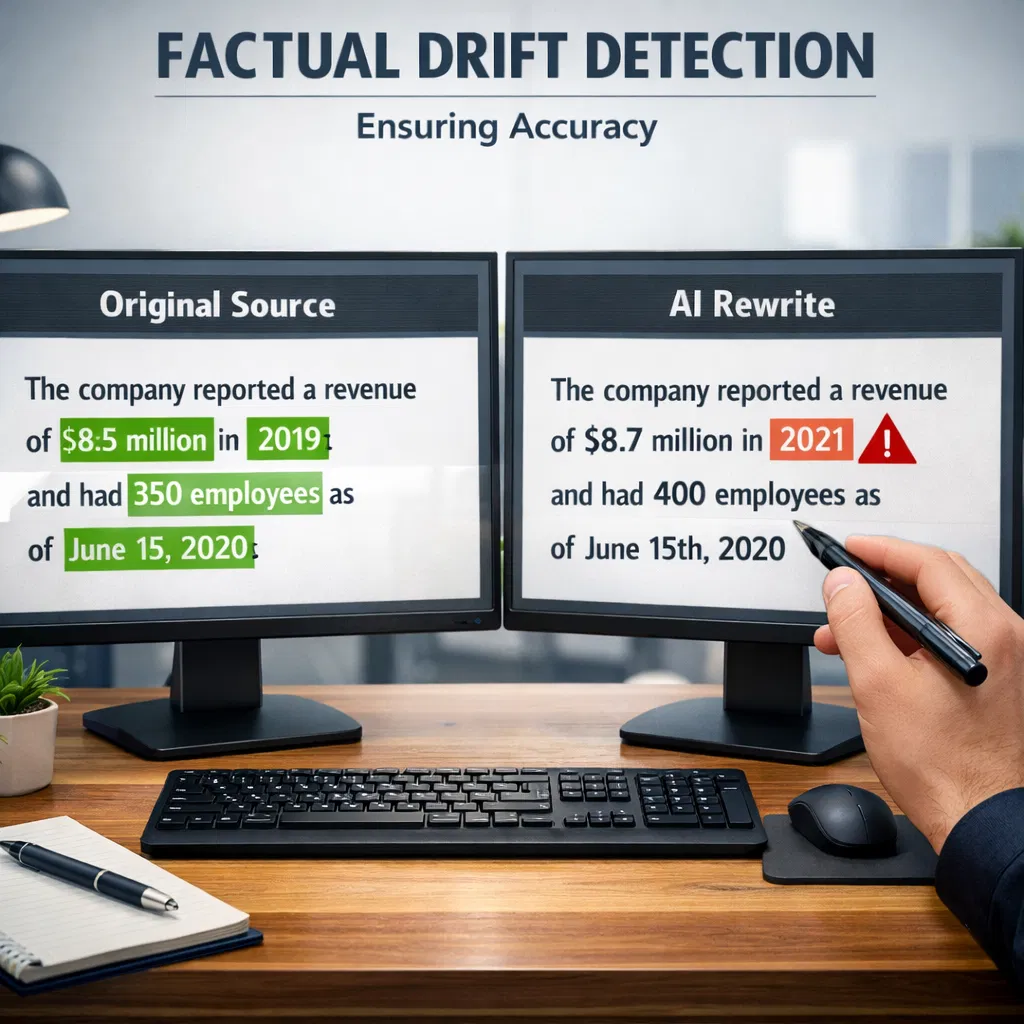
Misrepresentation of facts is especially risky in academic essays, since readers and tutors expect that any numbers or dates presented in a paper represent accurate information drawn from relevant sources. An essay in which the author states that 27 percent of AI-generated references are fake has a markedly different level of credibility than one stating that some percentage of AI-generated references can be inaccurate. In the first case, you present a claim that can be verified, whereas in the second case, you give your opinion. According to recommendations on the appropriate use of artificial intelligence for rewriting, the most common type of factual distortion is often unnoticed because of its smoothness.
Meaning Shift
Meaning shift occurs when an AI rewriting tool changes the logical relationships among ideas rather than simply the words expressing them. This can manifest as the softening of a definitive claim into a tentative one, the reversal of a qualified assertion into an absolute one, or the blurring of a precise distinction into a general observation. A source that argues X causes Y under specific conditions may be rewritten as a source arguing that X is associated with Y, which implies a much weaker and different relationship.
Meaning shifts are harder to catch than factual drift because they do not involve discrete, verifiable details. They require the reader to hold both the original source argument and the rewritten version in mind simultaneously and to compare their logical content. Writers who do not return to their original sources during the post-rewriting review will often miss meaning shifts entirely, because the rewritten version reads coherently on its own terms even when it misrepresents the source.
Citation Corruption
Citation corruption refers to changes that affect how a source is cited rather than how it is described. This includes altered author names, changed publication years, modified title wording, and incorrect journal names. It can also include the wholesale invention of citations that appear plausible but refer to nonexistent works, a behavior documented in AI generation tools and that paraphrasing tools can inadvertently reproduce when processing text that already contains AI-generated citations.
Citation corruption represents one of the most serious forms of source inconsistency because it directly undermines the academic integrity of the essay. An essay with a corrupted citation cannot be independently verified and may constitute misrepresentation of scholarly sources. Research in the AI writing literature has found that AI tools face significant limitations in handling citations accurately, particularly when processing long passages with embedded citations in multiple styles.
Qualifier and Hedge Removal
The fourth category of source inconsistency involves the removal or weakening of epistemic qualifiers: words and phrases that indicate the degree of certainty with which a claim is made. Academic sources use language like may suggest, the evidence indicates, under certain conditions, and in the context of this study deliberately. These qualifiers are not stylistic timidity; they are precise representations of what the evidence actually supports. When an AI rewriting tool removes them to make the prose sound more confident and direct, it produces a version that overstates the source's conclusions.
Why AI Rewriting Tools Introduce Source Inconsistencies
Understanding why AI rewriting tools produce source inconsistencies helps writers target their verification efforts more effectively. The root cause is that these tools process text as sequences of tokens with statistical relationships rather than as carriers of factual content with verifiable relationships to real-world sources. The tool evaluates what a plausible paraphrase of each sentence would look like based on its training data, not what the sentence actually claims about a source.
This means that numbers, dates, and proper nouns are particularly vulnerable. From the tool's perspective, the words thirty and twenty-three have similar statistical relationships with the surrounding context words in many training examples, making it easy to substitute one for the other without triggering any internal checks. Similarly, words like may and does occupy similar distributional positions in many sentences, making qualifier removal a statistically natural rewriting move even though it fundamentally changes the meaning of a claim.
The limitations of AI rewriting tools in this domain are well-documented. An analysis of the challenges and limitations of AI text rewriting tools identifies the inability to understand factual context as a fundamental constraint that makes human review essential after every AI rewriting session. The analysis specifically notes that AI tools make local changes to sentence structures without holistically understanding the claims those structures make, which is precisely the mechanism by which factual drift and meaning shift occur.
A Step-by-Step Workflow for Checking Source Consistency
Step One - Annotate Before Rewriting
The most efficient time to prepare for a source consistency check is before submitting the essay to an AI rewriting tool, not after. Before rewriting, read through the draft and annotate every sentence that contains: a specific number, statistic, or percentage; a date or year; a named researcher, institution, or study; a direct or indirect quotation; a citation in any format; and any claim that depends on a qualifier for its accuracy.
The annotations here produce a checklist of all parts of the essay that need verification after the rewrite. This can be done within minutes for an ordinary essay and helps save valuable time that would otherwise be required for verification after the rewriting process. If there were no such annotations, then the writer would have to make a list of things to verify while simultaneously going through a document he has already worked on.
Step Two - Run the Rewriting Session
Upon annotation of the essay, you are to submit your essay for humanization through the use of AI rewriting. Nonetheless, you need to be cautious when humanizing your essay and limit the areas you address to those that need improvement in fluency or detection. The sections of the essay that have already been clarified and well cited should remain untouched. To find out more about what happens during the humanization of citations or technical claims, refer to the BestHumanize FAQ.
Step Three - Run the Source Consistency Check
Once you receive the output from the AI text rewriter, follow the checklist of annotated elements to verify them. Compare the reworded text against the original source for each annotation. Use the original source material to ensure consistency, but do not rely on your memory alone. Compare the elements at the sentence level, not just at the paragraph level. Four questions must be answered regarding each annotation:
Does the number or date appear exactly as it is in the source document? Does the exact cause-and-effect or correlation relation hold in the rephrased version? Are all fields in the citation reference consistent with those in the original source? Have all qualifiers used in the original been preserved in the rephrased version?
Elements failing these tests will need to be corrected before submitting the assignment. You will need to correct these elements to their accurate forms without paraphrasing them again. Any AI reworking of an inaccurate element could lead to even greater inaccuracy. Correct the inaccurate element manually and then rewrite the rest of the sentence manually.
Step Four - Verify Citations Independently
Citations within the essay require another procedure for checking those citations independently from the normal procedure required to check sources. Every time you refer to a particular source within the body of your essay or provide bibliographical details for all your sources listed in the References section, ensure to check each and every one of them in order to confirm their authenticity as well as the accuracy of the bibliographical details you have cited. Any academic journal or book can be verified through an online search in databases such as Google Scholar. Understanding how AI paraphrasing detection works alongside citation verification is addressed in Turnitin's resource on AI paraphrasing in academic writing, which explains how institutions approach the intersection of paraphrasing, source attribution, and detection.
Techniques for Catching Specific Types of Source Errors
Detecting Factual Drift Using a Numbers and Dates Search
The fastest way to detect factual drift is to use a numbers-and-dates search. This involves scanning the rewritten essay, reading only the numerical values, percentages, dates, and proper nouns, and comparing them with the original drafts and source documents. It is a fast process since it avoids looking at the rest of the text altogether.

One good thing is to mark numbers and dates in the initial draft and the rewritten one, then compare the marked parts side by side. In this way, differences can be easily spotted, as no reading of the entire paragraph is necessary. Best practices for preserving the original meaning when using AI suggest always referring to the original text at the end of the AI rewrite process.
Catching Meaning Shifts with a Claim-Level Comparison
Changes in meaning require a different method, as they involve logic rather than individual pieces of information. For each paragraph where an argument presented in the source is paraphrased, there should be a one-sentence description of what that argument is saying within the source, and also one describing what the argument says in the newly constructed paragraph. Where those two sentences convey logically identical information, no change has occurred, while if not, then a change in meaning has occurred.
This technique takes longer than a numbers-and-dates scan but is the only reliable method for catching the more subtle forms of meaning distortion introduced by AI rewriting tools. It is particularly important in argumentative and analytical essays where the relationship between a source's claim and the writer's argument is the substance of the essay rather than merely a supporting background.
Catching Qualifier Removal with a Hedge-Word Audit
A hedge-word audit involves reading through the original draft with attention to epistemic qualifiers and then verifying that each qualifier survived the rewriting pass. Key words and phrases to track include: may, might, could, suggests, indicates, appears to, under certain conditions, in this context, according to the authors, and similar expressions of conditionality or limitation. These expressions are small in size but significant, and AI rewriting tools often remove them.
How Source Consistency Relates to AI Detection Risk
Writers who are managing both source consistency and AI detection risk simultaneously face a trade-off that is worth understanding clearly. The corrections required for source consistency and the adjustments required to reduce detection risk pull in different directions. Source consistency requires restoring specific original language, especially for numbers, dates, citations, and qualifiers. Detection risk reduction often benefits from varied phrasing, synonym diversity, and sentence restructuring. When a writer restores a fact or a qualifier that the AI tool removed, they may inadvertently restore language that scores less favorably on a detection check.
The correct resolution of this trade-off is always to prioritize source consistency over optimizing the detection score. A factually accurate essay that scores slightly higher on a detection tool is academically sound. A fluent, low-detection-score essay that misrepresents its sources is not. Detection score is a presentation concern; factual accuracy is an integrity concern, and integrity must come first.
The practical implication is that source-consistency corrections should be made before any final detection-optimization humanization pass. Once all facts, citations, and qualifiers have been verified and restored to their accurate forms, the writer can apply a targeted humanization pass to the prose surrounding those verified elements, improving fluency and detection performance without touching the accuracy-critical content. Research on false positives in AI detectors confirms that human-reviewed and manually corrected content performs more consistently across detection tools than purely AI-processed output, which supports this correction-first, humanization-second workflow. Writers can review BestHumanize's plans and pricing to find options that include detection preview features useful for the final humanization pass.
Building Source-Checking into Your Regular AI Rewriting Routine
Writers who use AI rewriting tools regularly will find it more sustainable to build source-checking into their standard workflow than to treat it as an optional extra step. The most effective way to do this is to establish a fixed sequence that every rewritten essay must pass through before it is considered complete, regardless of the level of AI assistance used or the time pressure under which the writer is working.
The fixed sequence should include: the pre-rewriting annotation pass, the rewriting session, the numbers-and-dates scan, the claim-level comparison for argumentative and analytical sections, the hedge-word audit for passages that paraphrase source conclusions, and the independent citation verification. This sequence takes between fifteen and thirty minutes for a standard academic essay and eliminates most source-inconsistency errors before submission.
Writers who want to understand how AI tools are reshaping the broader landscape of source verification and academic integrity can find useful context on the BestHumanize blog, which covers current developments in AI writing tools, detection systems, and academic integrity practices. For writers who want to discuss a specific source consistency challenge with the BestHumanize team, the contact page is the fastest route to personalized guidance.
Understanding Institutional Expectations Around Source Verification
Most academic institutions do not have separate policies on source consistency in AI-rewritten essays, but their existing policies on plagiarism and misrepresentation of sources apply directly. Submitting a rewritten essay that misrepresents a source's claim or fabricates citation details, even if the misrepresentation was introduced by an AI tool rather than by the writer intentionally, places the writer in a position of academic risk. The standard in most academic integrity frameworks is that the student is responsible for the accuracy of the work they submit, regardless of the tools used to produce it.
This institutional context gives source verification a significance that goes beyond quality control. It is the writer's primary line of defense against inadvertent academic misconduct. A writer who can demonstrate that they verified their AI-rewritten essay against original sources, corrected every factual drift, and independently verified every citation is in a fundamentally stronger position than one who simply submitted the AI output without review.
The challenges traditional verification methods face in the AI era are substantial, prompting institutions to develop new approaches to source attribution assessment. Research consistently confirms that source verification must be a human-led process rather than a tool-dependent one, and writers who understand this distinction are better equipped to navigate institutional expectations around source accuracy. The BestHumanize about page explains that the platform's approach to humanization is designed to support responsible, accuracy-preserving revision rather than wholesale rewriting that compromises source fidelity.
Conclusion
AI rewriting tools are powerful aids for fluency, clarity, and risk detection and management. They are not reliable guardians of source accuracy. Factual drift, meaning shift, citation corruption, and qualifier removal are all real and documented failure modes that require active human verification to catch. The good news is that catching them is not difficult when it is approached systematically. A structured pre-rewriting annotation, a targeted post-rewriting comparison against original sources, and an independent citation verification pass will eliminate the majority of source inconsistency errors before they affect the writer's academic standing.
The writer who integrates source-checking into their standard AI rewriting routine is both more academically safe and more genuinely in control of their work. They use the AI tool for what it does well, which is surface-level fluency and structural variety, while taking personal responsibility for the accuracy of every factual claim, every citation, and every representation of a source's argument. That combination of AI efficiency and human accuracy is the ideal relationship between writers and rewriting tools.
Frequently Asked Questions
What is factual drift in AI rewriting?
Factual drift is the alteration of specific verifiable details, such as numbers, dates, statistics, or proper nouns, that occurs when an AI rewriting tool rephrases the text containing those details. Because AI tools process text statistically rather than factually, they can substitute one number or date for another without recognizing that the change affects a claim's accuracy. The resulting text reads fluently but no longer accurately represents the original source.
How do I know if an AI rewriter changed the meaning of a paraphrased source?
The most reliable technique is to write a one-sentence summary of what the original source claims and a separate one-sentence summary of what the rewritten paragraph claims, then compare the two summaries for logical equivalence. If they differ in direction, certainty, or scope, the meaning has shifted. Pay particular attention to changes in the strength of causal claims, the presence or absence of qualifiers, and the specificity of the conditions under which the claim applies.
Can AI rewriting tools fabricate citations?
Yes, though this is more commonly a feature of AI generation tools than of dedicated rewriting tools. However, if a draft already contains AI-generated citations and is then processed by a rewriting tool, the tool may alter citation details, further corrupting them. It is also possible for rewriting tools to alter embedded citation information, such as author names, years, and titles, while rephrasing surrounding text. Every citation in an AI-rewritten essay should be independently verified against its original source.
Should source consistency or detection score take priority in my review?
Source consistency should always take priority. A factually accurate essay that scores somewhat higher on a detection tool is academically defensible. An essay that misrepresents its sources is not, regardless of its detection score. The correct workflow is to complete all source consistency corrections first, then apply a final humanization pass to the prose surrounding the verified factual elements. This addresses detection risk without compromising accuracy.
How long does a thorough source consistency check take?
A typical 1,500-to-2,500-word academic essay requires approximately fifteen to thirty minutes to perform an exhaustive source consistency test, which includes the annotations review, numbers and dates test, claims comparison, hedge word check, and citation validation. It would be worth spending this much time on any essay that quotes sources, especially in an academic setting, where misrepresenting sources can have repercussions.
Disclaimer: This article is intended for informational and educational purposes only and does not constitute academic, legal, or professional advice. Academic integrity policies vary by institution, and writers are responsible for reviewing and complying with their own institution's guidelines before using any AI rewriting tool. BestHumanize does not encourage the misrepresentation of sources, fabrication of citations, or any form of academic dishonesty. Allrecommendations in this article are designed to support accurate, writer-led revision processes that preserve the integrity of original sources