The pace at which AI writing tools allow writers to create has been altered forever. What used to take hours can now be accomplished in a fraction of that time, and that is good for writers, marketers, and business owners who need to create more than any one writer can possibly hope to produce by themselves. The problem is not that it's too fast. The problem is how artificial writing sounds when it's put down on the page: the rhythm of the sentences, the predictable transitions, and words drawn from a database rather than a human experience or point of view. The core reasons AI-generated content feels robotic, and the practical fixes that restore natural rhythm and voice, confirm that the root cause is not a technical failure; it is the nature of next-token prediction. AI models are optimised to produce the most statistically probable word sequence. That process is efficient and coherent, but it lacks the cognitive messiness, the personal specificity, and the rhythm variation that make human writing feel like it comes from a mind rather than a machine.
The purpose of this guide is to help writers, content creators, marketers, and anyone using AI as a drafting tool produce content that is engaging and written by a human. It will cover why AI-generated content is so robotic, how to recognize exactly what makes it so robotic, and, step-by-step, how to take that content and make it engaging and written like a human being. The purpose is not to produce content that can fool a detector. It is to produce content that actually engages your audience.

Key Takeaways
The reason AI writing appears robotic is not because of any defect in the technology, but because of what the technology optimizes for. The very same mechanism that enables AI writing to be quick, coherent, and effectively predict the next word based on probability also ensures that the writing is overly predictable, monotonous, and dissimilar from the unpredictable decisions made by human writers.
The six most common patterns in AI writing are those that readers or detectors notice: uniform sentence lengths, overly used transition words, inflation of the passive voice, generic claims, predictable structural patterns, and the use of words that are simply LLM favorites.
This confirms that correcting these patterns is not about adding errors or forcing unnatural variability, but about editing with the reader in mind, not the detector.
Voice is what differentiates AI-assisted content from AI-generated content. An AI model lacks experience, lacks opinions based on living, and lacks a brand based on decision-making. Adding these things to your examples, your honest opinions, your characteristic language is the edit that no AI can replicate, and no detector can ignore.
The most effective workflow is hybrid: AI draft plus deliberate human editing, not AI draft plus cosmetic polish. Why running AI text through a paraphrasing tool alone is insufficient — and what genuine humanisation requires confirms that the biggest mistake writers make is paraphrasing the AI draft without restructuring it. Paraphrasing changes the words; humanising changes the architecture, the rhythm, and the perspective.
AI humanizer tools accelerate the editing process but do not replace the human judgment that produces genuinely good writing. Free AI text humanizer tools that transform machine-generated drafts into natural, reader-ready content can handle the mechanical work of sentence variation and vocabulary improvement, but the specific details, honest opinions, and brand voice that make content worth reading still require a human writer to supply them.
Why AI-Generated Content Sounds Robotic
The Core Problem: AI models do not write — they predict. Every word in an AI-generated draft is the statistically most probable next word given everything that came before it. That process is optimised for coherence and coverage, not for personality, rhythm variation, or the kind of unexpected choices that make writing feel alive. The result is text that is technically correct and structurally sound but emotionally inert and tonally flat. |
Understanding why AI content sounds the way it does is the foundation for fixing it effectively. Raw AI output exhibits four interlocking patterns that, individually, might not stand out but together produce the unmistakable sense that a machine, not a person, assembled the text. The four compound patterns that produce robotic AI tone and the specific edits that resolve each one identify these as: over-optimisation for clarity at the expense of rhythm, passive voice inflation from institutional training data, lexical safety bias toward mid-frequency globally understood terms, and structural symmetry that makes every paragraph look like a formatted template.
Pattern 1: Sentence Length Uniformity
Human writers vary their sentence length naturally, because thought itself varies. An analysis that builds over several clauses. Then: short. A question? The rhythm of real writing reflects the rhythm of real thinking. AI models, optimising for coherence, produce sentences of consistently moderate length, not long, not short, but relentlessly similar. Readers cannot always articulate why a piece of writing feels flat, but the absence of rhythm variation is a significant part of the answer.
Pattern 2: Transition Phrase Overuse
'Furthermore', 'additionally', 'it is important to note that', 'in today's rapidly evolving landscape', 'with that said', these phrases appear in AI writing because they are the most common connective tissue in the formal writing that dominates LLM training data. They are not wrong. They are just lifeless. They signal that a connection is about to be established without actually making it. Human writers use these phrases too, but far less often because we replace them with logic-driven connectors, subject changes, or simply the natural flow of one idea following another.
Pattern 3: Passive Voice Inflation
AI models learned from vast quantities of academic, regulatory, and corporate text genres, where passive voice dominates because it sounds 'objective'. The result is output loaded with 'it has been shown that', 'this can be understood as', and 'the following will be discussed'. Passive voice creates distance between writer and reader. It removes the person from the sentence. When every paragraph uses it, the writing feels institutional rather than human.
Pattern 4: Generic Claims Without Specificity
'Many experts believe', 'research has shown', 'it is widely accepted' AI models produce these phrases because they are accurate in a general sense and appear often in training data. The problem is that they are unverifiable and impersonal. Real human writers back claims with specifics: the study's author, the year, and the actual finding. Generic attribution signals that the writer has not conducted primary research, which is exactly what AI has not done.
Pattern 5: LLM Vocabulary Fingerprints
Certain words appear with dramatically higher frequency in AI-generated text than in human writing: 'delves', 'underscores', 'showcases', 'pivotal', 'crucial', 'comprehensive', 'nuanced', and 'it is worth noting'. How the statistical patterns of perplexity and burstiness in AI writing translate to the vocabulary and rhythm signals that readers notice confirms that these words are not wrong; they are just overrepresented. AI models select them because they sit at the high-probability end of the vocabulary distribution for formal English. Readers and reviewers who process a lot of content develop a sensitivity to these terms. Seeing several in a single paragraph is a strong signal of machine generation.
The Six Most Common AI Patterns and How to Fix Them
The table below maps the most identifiable AI writing patterns to the specific edits that address each one. These are the fixes that matter most, the changes that produce a genuinely more human result rather than simply a differently-worded AI output.
AI Draft Pattern | Why It Sounds Robotic | Human Edit Fix |
Uniform sentence length throughout the paragraph | Every sentence covers the same distance. No short punches, no long expansions. Readers feel the monotony even if they can't name it. | Alternate: one short sentence. Then a longer one that unpacks the idea fully, adds a clause, extends the thought. Then short again. |
Overused transition phrases: 'Furthermore', 'Additionally', 'It is important to note' | Reads like an academic essay outline, not a human voice. These phrases add nothing — they just connect clauses mechanically. | Replace with logic-driven connectors: 'That's why...', 'Here's the thing...', 'Which means...', 'Worth noting:'. Let the idea create the flow. |
Passive voice throughout: 'It was found that', 'This can be seen in' | Creates distance between the writer and the reader. Passive voice sounds institutional, not personal. | Flip to active: 'We found', 'You'll notice', 'The data shows'. Active voice puts a person in the sentence. |
Generic claims: 'Many people believe', 'Research has shown' | Vague attribution with no specificity. Reads as filler — the AI is stating a claim without the evidence to back it. | Add the specific source, number, or detail: 'A 2026 Grammarly survey found 78% of marketers...'. Specifics signal genuine research. |
Predictable opener-to-close structure: Introduction → 3 body points → Conclusion | AI defaults to the most common essay structure from its training data. Every paragraph looks and feels like the one before it. | Break the pattern: start with the conclusion, lead with a story, ask a question, bury the summary. Vary the architecture, not just the words. |
Overuse of LLM vocabulary: 'delves into', 'underscores', 'showcases', 'crucial', 'pivotal' | These words appear disproportionately often in AI text. Experienced readers and detection tools both flag them immediately. | Replace with direct, concrete language: 'explores' instead of 'delves into', 'shows' instead of 'showcases', 'important' instead of 'crucial'. |
Step 1: Identify and Document Your Voice Before You Edit
The most important step in transforming AI content into human content is one that most writers skip entirely: establishing what your voice actually sounds like before you start editing. An AI draft is a blank canvas with someone else's brushstrokes already on it. If you edit without a clear sense of your own voice, you will smooth the AI patterns without replacing them with anything distinctive, and the result will be a cleaner version of the same generic content. Why authentic voice is the single most important element that separates genuinely human content from AI-drafted copy confirms that the process of identifying your voice starts with reading your own best human-written work and noticing its patterns: the sentence structures you favour, the transitions you naturally reach for, the specific vocabulary that reflects how you actually think about your subject.
How to Document Your Voice
Write for ten minutes about your topic without stopping, as if you are explaining it to a colleague over coffee. Do not edit. Do not structure. Just write. The output will be imperfect, but it will be genuinely yours, and comparing it to the AI draft will reveal exactly where the two diverge.
Read your three best pieces of human-written content and note: How long are your typical sentences? Do you use contractions naturally? Do you use the first person? Do you ask rhetorical questions? Do you use humour or analogy? Do you state opinions directly or hedge them? These patterns constitute your voice. Your editing goal is to make the AI draft sound like those pieces.
Build a personal vocabulary list: words and phrases you actually use, and words that signal AI to you. Every writer has phrases they over-rely on and phrases they never use. Knowing both helps you edit the AI draft toward authenticity rather than toward a generic 'human-ish' style.
Define your brand or topic stance: what is your actual opinion on the subject? AI drafts are deliberately neutral to avoid being wrong. But neutrality is not a voice. A writer who says 'I think this approach is better, and here is exactly why' is immediately more credible than one who says 'both approaches have merits'.
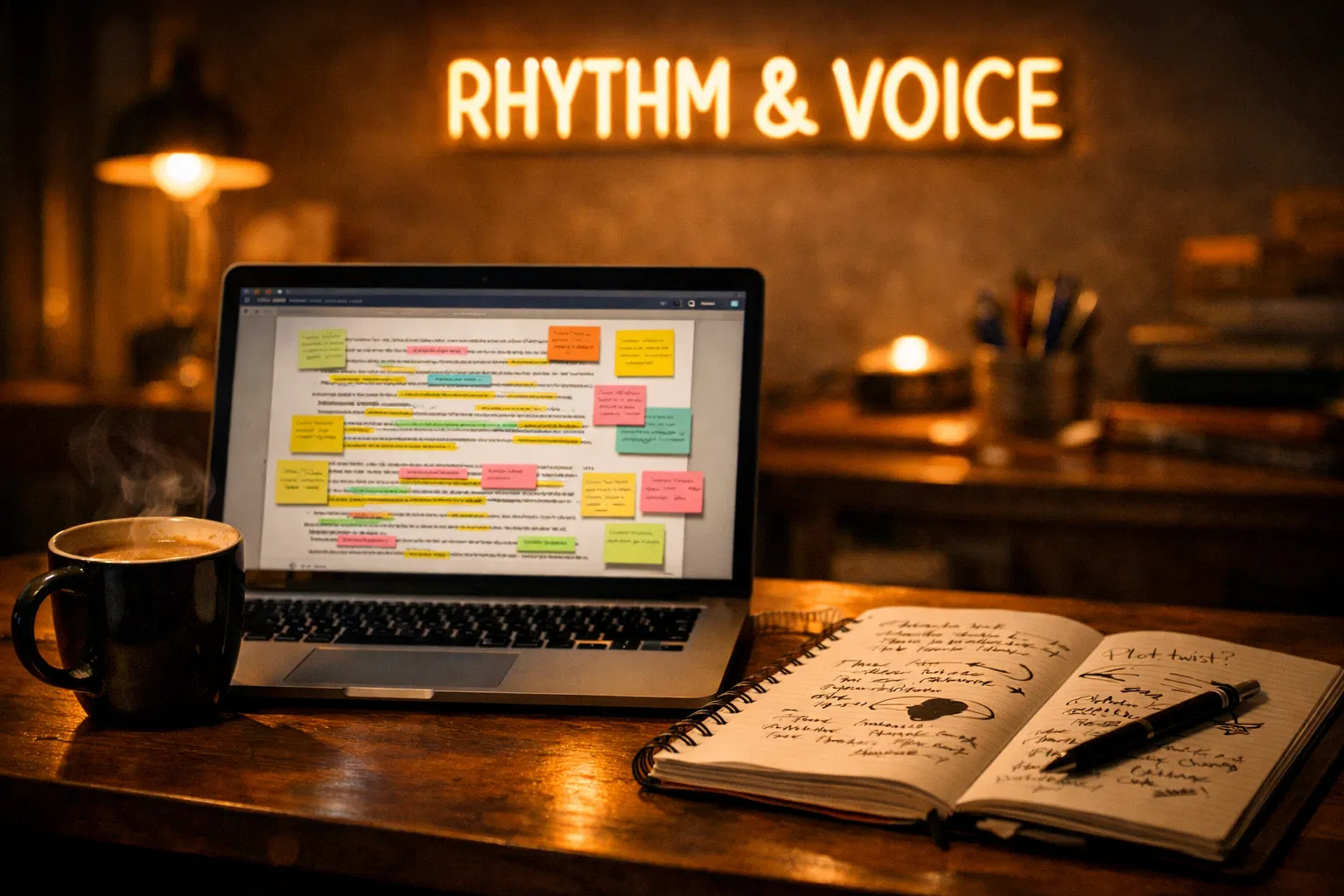
Step 2: Rewrite for Sentence Rhythm and Structural Variation
Once you know your voice, the most transformative edit you can make to an AI draft is restructuring its sentence rhythm. This is not about length for its own sake; it is about creating the ebb and flow that signals a thinking person rather than a probability model. Read your draft aloud. Seriously. Your ear will catch the monotony that your eye skips over. Every paragraph where you find yourself reading at the same pace and with the same weight per sentence needs structural intervention.
Practical Rhythm Editing Techniques
The three-beat rule: In any paragraph of four or more sentences, aim for at least one sentence under ten words, one sentence over twenty-five words, and at least one sentence in a register that differs from the others (a question, a direct address, a sentence fragment for emphasis). This is not a formula; it is a starting framework for variation.
Break the paragraph spine: AI drafts tend to open each paragraph with the topic sentence, develop it evenly across three or four sentences, and close with a summary. Break this pattern. Start with the example and arrive at the principle. Start with a question and answer it. Start mid-thought and explain the context. The reader's engagement tracks your structural unpredictability.
Delete the mechanical transitions: Go through the draft and strike every 'furthermore', 'additionally', 'in conclusion', 'it is important to note', and 'with that said'. Replace each with either nothing (let the ideas flow directly), a shorter connector ('That's why', 'Here's the thing', 'Worth noting:'), or a complete restructuring of the sentence order so no connector is needed.
Use the colon and dash for rhythm: These punctuation marks have a distinctly human rhythm. The em dash creates an interruption, a change of direction that feels like a mind reconsidering mid-sentence. The colon introduces a list or an explanation with a directness that is more confident than a subordinate clause. Both are underrepresented in AI text because they require editorial judgment about emphasis.
Step 3: Replace Generic Claims with Specific Details
This edit produces the most dramatic improvement in perceived authenticity and requires the most genuine effort. AI models produce generic claims because they are trained to be accurate across a wide range of contexts. They say 'many marketers report' because it is true across many contexts. A human writer who has actually read the source says, '78% of content marketers in Semrush's 2026 survey reported'. The difference is not stylistic. It is the difference between writing that informs and writing that proves its author did the work. Why adding specificity — real numbers, named sources, concrete examples — is the most effective single edit for making AI content sound human confirms that grounding abstract AI claims in verifiable specifics is the single technique most consistently associated with writing that reads as credible and human-authored.
Specificity Edits to Make in Every AI Draft
Find every 'many', 'some', 'most', 'often', 'research suggests', and 'experts believe', and either replace them with a specific source and figure or cut the claim entirely if you cannot verify it. Generic attribution without specifics adds nothing to a reader's understanding and signals that the writer has not engaged with the primary material.
Add one concrete example per major claim. If the AI draft says 'AI tools can improve content production efficiency', add the specific example: 'a 500-word product description that took two hours now takes twenty minutes, with the remaining time spent on fact-checking and voice editing'. Concrete examples are the DNA of human writing. They demonstrate that the writer has experience with the subject, not just knowledge of it.
Add your own first-person observations where the content permits. 'In my experience working with content teams...', 'The most common mistake I see is...', 'What surprised me when testing this approach . These phrases are things an AI model cannot generate authentically because they require an actual person with actual experience. They are the most powerful available signal of genuine authorship.
Update any statistics, tool names, or feature descriptions that the AI may have hallucinated or drawn from outdated training data. AI models can confidently state incorrect statistics, reference product features that have changed, or attribute findings to studies that do not exist. Checking these and correcting or removing them is both an accuracy edit and an authenticity edit.
Step 4: Convert Passive Voice and Add Natural Contractions
Two quick structural edits, converting passive voice and adding contractions where they fit, produce a significant improvement in natural voice with relatively low effort. Neither is difficult. Both are instantly readable in the final product.
Passive to Active Voice Conversion
Work through the draft and flag every sentence built around 'was', 'were', 'has been', 'can be', 'will be', 'should be' in contexts where a subject performs an action. 'The report was finalised by the team' becomes 'The team finalised the report.' 'It has been found that' becomes 'Researchers found that.' 'This approach can be used to' becomes 'You can use this approach to.' An active voice does not just sound more human; it is more direct, more confident, and easier for readers to follow. It puts a person or entity into the sentence, where human writing naturally lives.
Contractions: Where and When
AI models often avoid contractions because formal training data uses them less frequently. The result is prose that sounds as if it were translated from a second language, technically correct but subtly distant. Adding contractions where they fit naturally, ' it's' rather than 'it is', 'you're' rather than 'you are', 'don't' rather than 'do not', 'we'll' rather than 'we will'closes that distance significantly. The qualifier 'where they fit naturally' matters: contractions in technical documentation, legal writing, or formal academic submissions are inappropriate. In marketing copy, blog posts, email, and content aimed at a general audience, they are essential.
Step 5: Use Humanizer Tools for Structural Editing — Then Apply Human Judgment
After completing the manual editing steps above, voice identification, rhythm restructuring, specificity additions, passive voice conversion, and contraction introduction, AI humanizer tools provide a useful additional pass for catching remaining structural patterns that your manual edit may have missed. A complete guide to how AI humanizer tools work and what they can and cannot replace in the human editing process confirms that humanizer tools work by disrupting the statistical patterns that detection systems identify, primarily by increasing perplexity scores and burstiness. They are effective at making text less detectably AI-generated at the structural level. What they cannot do is add personal experience, insert specific data, create a brand voice, or make an editorial judgment about which claims are worth keeping.
The Right Role for Humanizer Tools in Your Workflow
Use them after manual editing, not instead of it. A humanizer tool applied to a raw AI draft will improve its statistical profile, but will not make it genuinely better writing. Apply your manual edits first: voice, rhythm, specificity, and active voice, then run the result through a humanizer for a final structural pass.
Review every output from the humanizer before publishing. Humanizer tools can introduce awkward phrasing, subtly change meaning, or produce sentences that read better to a statistical model than to a human reader. Always review the humanized output against the version you fed in, and restore any phrasing where the humanizer changed it in a way that weakened the meaning or voice.
Run a final detection check as a quality signal, not as the goal. After your manual editing and humanizer pass, running the content through a detection tool tells you whether the mechanical AI patterns have been adequately disrupted. A high human score on the detection check indicates that the structural work is complete. It is not the measure of whether the content is actually good that judgment still requires reading it as a human reader, not as a detector.
Do not over-humanize at the cost of quality. Some writers run content through humanizer tools repeatedly until the detection score reaches a threshold, without reviewing the output quality at each pass. Multiple humanizer passes tend to produce increasingly awkward phrasing as the tool tries to maximise variation. Two passes maximum, with human review between each, is the recommended practice.
The Complete Hybrid Writing Workflow
The Recommended Workflow: Generate AI draft → Identify your voice and brand stance → Restructure for rhythm (sentence length, transitions, paragraph architecture) → Replace generic claims with specific details → Convert passive voice and add contractions → Apply humanizer tool for final structural pass → Review humanizer output for quality → Run detection check as a quality signal → Publish. |
The most important principle in this workflow is the distinction between AI as a drafting tool and AI as the author. When you use AI to generate the initial structure, topic coverage, and factual summary and then apply genuine human editorial judgment to voice, specificity, rhythm, and stance, the result is AI-assisted content. When you apply cosmetic edits to an AI draft without injecting a genuine human perspective and experience, the result is AI content with better disguise. The first approach produces writing worth publishing. The second produces writing that may pass a structural check but fails the more important test: whether a real reader finds it credible, useful, and worth their time.
The AI content market is projected to reach $4.2 billion by 2026, with an estimated 78% of content marketers using AI generation tools. That scale of adoption means that genuinely human-sounding content that reflects real experience, real opinion, and real editorial care is increasingly the differentiator between content that builds an audience and content that fills a page. confirms that the winning approach is not choosing between AI tools and human writing, but developing the editorial skills to use both at their respective strengths.
Conclusion
Making AI-generated content sound more human is not primarily a technical problem. It is a writing problem. The tools that help humanize platforms, sentence restructuring techniques, and active-voice conversion are useful, but they serve a single editorial goal: producing writing that reflects genuine human thought, genuine human experience, and a genuine human voice. That means identifying your voice before you edit, restructuring AI's uniform rhythms into natural variation, replacing generic claims with specific details, putting a person back into passive-voice sentences, and using AI tools as accelerators of that process rather than replacements for it. The content that earns trust in 2026 is the content that demonstrates its author actually knows something, has actually thought about something, and is actually talking to the reader, not to a detection system.
Frequently Asked Questions
Why does AI-generated content sound robotic?
AI-generated content sounds robotic because language models generate text by selecting the most statistically probable next word at each step. This produces coherent, technically correct prose that lacks the rhythm variation, personal specificity, unexpected word choices, and idiosyncratic perspective that human writers bring to their work. The result is a characteristic set of patterns: uniform sentence length, overused formal transitions, passive voice, generic claims, and a vocabulary of LLM-favourite words that trained readers and detection systems both recognise.
What is the single most effective edit for humanising AI content?
Adding specificity, replacing generic claims with real data, named sources, concrete examples, and first-person observations, produces the most significant improvement in perceived authenticity. It also happens to be the edit that AI tools cannot replicate, because it requires the writer to have actually engaged with the subject matter. Sentence rhythm restructuring is a close second, because it addresses the most immediately perceptible quality of AI text: its monotonous pace.
Should I use an AI humanizer tool or edit manually?
Both, in sequence. Manual editing should come first, followed by voice identification, rhythm restructuring, specificity additions, active voice conversion, and contraction introduction. These are the edits that make writing genuinely better, not just statistically less AI-like. A humanizer tool then provides a useful additional pass for catching remaining structural patterns. Using a humanizer without first doing the manual work produces text that has better statistical properties but is not actually better writing. The goal is content that a real reader finds credible and engaging, and only the manual editing steps can guarantee that.
How do I develop a consistent voice when editing AI content?
Read your own best human-written work first. Identify the sentence structures you naturally use, the vocabulary that reflects how you actually think about your subject, and the opinions you hold about the topic. Write for ten minutes about the subject without stopping, as if explaining it to a friend, and compare that output to the AI draft. The gap between your natural writing and the AI draft is exactly what your editing should close. Building a written voice guide, preferred sentence structures, authentic vocabulary, characteristic phrases, and your brand's stance on key topics gives you a consistent reference for every AI editing session.
Does improving AI content quality also reduce detection flags?
Yes, and this relationship reflects an important aspect of what detection systems actually measure. AI detectors flag statistical patterns associated with machine generation: low perplexity, low burstiness, repetitive vocabulary, and predictable structural templates. When you edit for genuine voice, rhythm variation, and specific detail, you naturally disrupt those same patterns because authentic human writing exhibits high variation, unexpected word choices, and the structural asymmetry of real thought. The content that reads most naturally to a human reader also tends to produce the lowest AI detection scores, because both are measuring the same underlying quality: the presence of genuine human editorial judgment in the writing.
This guide reflects research on writing practice and content quality as of March 2026. Specific tool features and pricing change frequently; verify current capabilities directly with any platform before incorporating it into a production workflow.