The process of AI content detection has shifted from an optional step in the content creation and editing process, something editors perform on an ad hoc basis when something does not smell right, to an integral part of content creation at scale. This means that publishers, educational institutions, content creation firms, and even enterprise communications teams are starting to implement content detection at defined points in the content creation and editing processes. This is in stark contrast to the previous state, in which content detection was performed on an ad hoc basis. This difference is significant because ad hoc content detection is performed inconsistently, leaves no audit trail, does not provide aggregated information, and leaves it up to the individual editor to perform the content detection step. GPTZero, Copyleaks, and Originality, compared on accuracy and workflow integration, confirm that the ability to integrate the detection tool with other platforms via API or LMS plugin has become a key factor in the evaluation process for professional tools, alongside accuracy. While a detection tool with high accuracy but lacking API or LMS plugin support will require a process that eventually fails when scaled up, a detection tool with low accuracy but strong integration will allow a process to be consistently applied, which a more accurate but less integrated tool will struggle to achieve.
This guide outlines how to integrate AI-powered content detection into your current content management processes across four deployment scenarios: editorial and publishing teams, content marketing and SEO agencies, academic institutions and LMS platforms, and enterprise communications teams. This guide will discuss where in the workflow to integrate content detection for each scenario, which integration method is most suitable for your organization, and how to use the results in a fair and defensible way.
Why Detection Needs to Be Embedded in the Workflow, Not Added After the Fact
The main rationale for workflow integration over ad hoc detection is the need for operational consistency. With the optional, individualized application of the detection tool, it is not applied consistently: some editors apply it to all submissions, some to none, and the same writer is monitored in one assignment but not in another. The lack of consistency in the tool's application has two effects. The first is that it sends no meaningful signal about the quality of the organization's content in terms of authenticity. The second is the fairness issue: writers who are monitored more frequently are more likely to be detected, regardless of their AI use. AI content detection integration needs and practices for educational institutions document the same issue in academic institutions: "Institutions that check content in an inconsistent manner, such as checking some students' content but not others', will face legal and ethical issues if the students who were detected claim that the process was not applied consistently. The answer in both the publishing industry and academic institutions is the same: determining specific points in the process where content of a specific type is checked without discretion and the results documented."
Choosing the Right Detection Tool for Workflow Integration
The selection criteria for a tool to be used as a detection tool in a workflow integration scenario differ significantly from those for an individual user. The most critical selection criteria for an individual user are the tool's accuracy and cost. However, for workflow integration, the most critical selection criteria for a tool to be used as a detection tool are API availability, API documentation quality, rate limit, and throughput at scale for your workflow, data retention and privacy compliance of the tool, webhook/callback support for enabling asynchronous workflow processing, and output format support for workflow consumption and storage. A detection tool without an API cannot be integrated with any workflow. A tool with an API but poor rate limits will be a bottleneck when batch volume peaks. A tool with an API but poor output-format information will require parsing. GPTZero versus Originality.ai on integration capability and workflow fit. This confirms the practical integration differences: Originality.ai provides 500 API requests per minute, is well-documented, and supports endpoint batching. GPTZero is geared toward an educational and compliant use case, being SOC 2 Type II certified and FERPA-compliant, making it well-suited for student submissions where data privacy is a compliance necessity. Copyleaks offers white-label APIs with LMS support. The best tool for your workflow integration depends on which of these factors is most important for your use case.
API Integration, Native Plugins, and Manual Triage: Which Method Fits Your Stack
Detection tools provide three integration models. Each model suits a specific technical scenario. The API model offers the most flexibility because it enables detection at every event in the workflow, in every data system, and with every business logic system. The API model requires programming resources. The native plugins from detection tools like the WordPress plugin from Originality.ai, the Google Docs Chrome Extension and Canvas Integration from GPTZero, and the Google Docs add-on and LMS plugins from Copyleaks require no programming. They plug the detection tool directly into the tools instructors already use. The manual model uses the detection tool's web interface to check submissions one by one. The manual model requires no integration but becomes impractical above a few dozen checks per week. GPTZero in practice and how its integration capabilities work in 2026. This confirms the practical hierarchy:
For organizations with developer resources and high volumes of consistent detections, API integration is worthwhile for the implementation cost.
For organizations with standard platforms that support plugins, native plugins deliver 80 percent of the integration benefit at no development cost.
For small organizations with low volumes, manual triage via the tool's web interface is appropriate, although it would still benefit from being documented for consistency.
Where to Place Detection Gates in Your Workflow
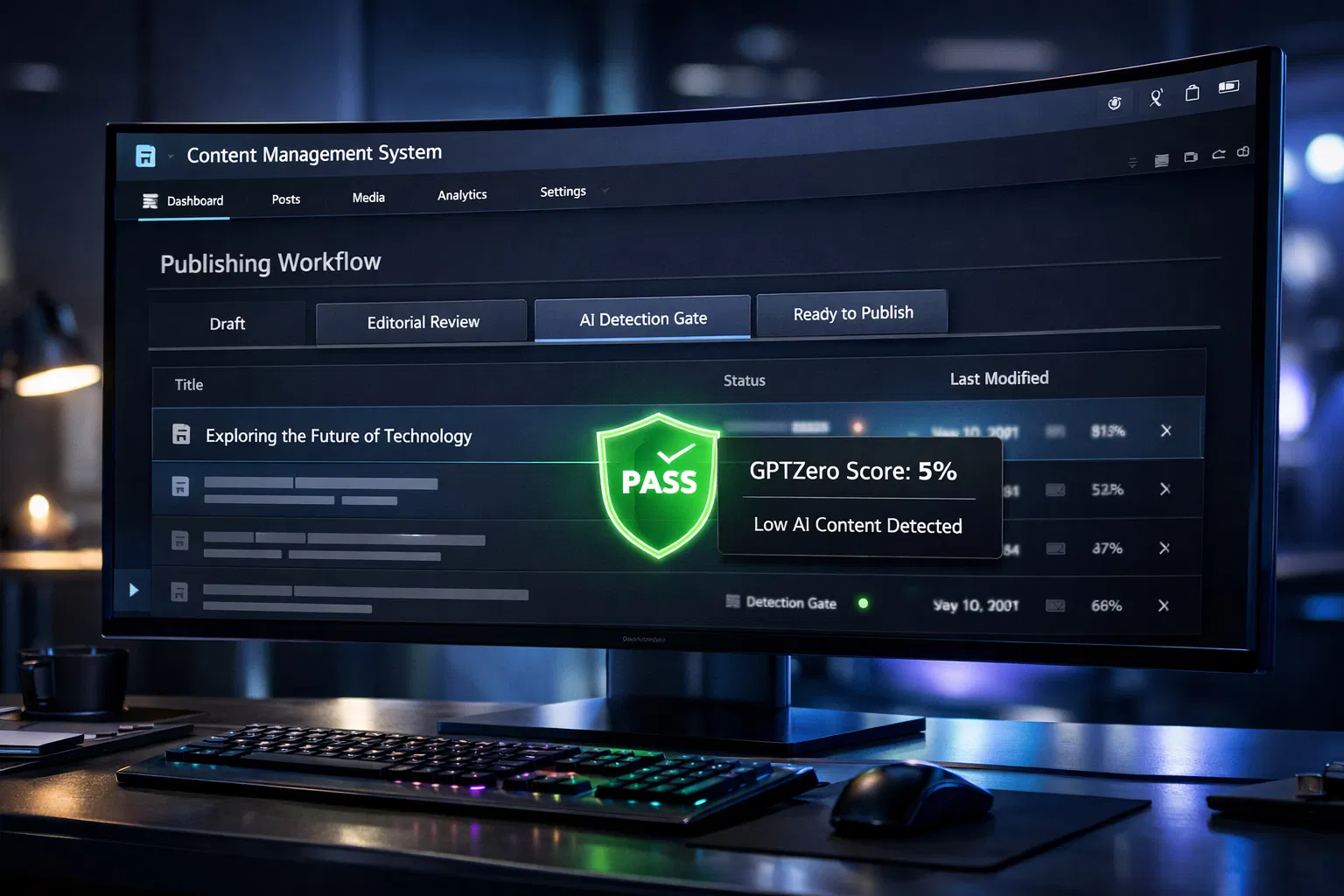
The single most important decision an architect must make with respect to workflow integration is where to insert the detection gate: where the detection check is made and where the result determines what happens next. Detection too early in the workflow, before the content is close to its final form, may not accurately reflect the AI profile of the submitted content. Detection too late will have wasted the editorial investment made in content that will be rejected. While the precise point will depend on the type of workflow, the general rule is to detect at the point of formal submission, before any editorial work begins, and again before entering the publication queue. How automation platforms can route flagged AI content through editorial review workflows documents how workflow automation platforms can trigger detection at submission and route flagged content to a review queue rather than the standard editorial queue, so that editors only spend time on flagged content when a human decision is required, rather than on every submission. This routing approach is the practical implementation of the two-gate model: an intake gate that screens all submissions, and a pre-publication gate that provides a final verification check before publication.
Workflow Stage | What Detection Adds | Integration Method | Tool Examples |
Submission intake | Flag content at the point of receipt before any editorial time is spent on it | API call triggered on file upload or form submission; result stored alongside the submission record | Originality.ai API, GPTZero API, Copyleaks API |
Pre-publication gate | Prevent content that exceeds the policy threshold from advancing to the publication queue without editor review | Automated workflow rule in CMS: submissions above threshold enter a review queue rather than auto-advancing | Originality.ai WordPress plugin, GPTZero Chrome extension for Google Docs, Copyleaks LMS integration |
Editorial review | Give editors sentence-level evidence to support or contradict the flagged result before making a decision | Editor-facing detection dashboard embedded in CMS review interface; score and highlighted sentences visible alongside the content | GPTZero Advanced Scan, Originality.ai dashboard, Winston AI report export |
Writer feedback loop | Return specific flagged passages to the writer with guidance on revision rather than an unexplained rejection | Automated email or CMS notification linking to the detection report and the team's revision policy | Any tool with shareable scan reports; GPTZero, Originality.ai, Winston AI all support export |
Publication record | Log detection scores and decisions alongside the published content record for audit and policy review purposes | CMS field or metadata tag storing scan date, tool, score, and disposition; linked to content version history | Custom API integration; Originality.ai's scan history; GPTZero's team dashboard |
Periodic retrospective | Review detection patterns across published content to identify systematic bias, tool degradation, or policy gaps | Monthly or quarterly data pull from detection API; aggregate analysis of scores, escalations, and outcomes | Originality.ai bulk scan history export; GPTZero team dashboard analytics; custom API logging |
Setting Detection Thresholds That Match Your Policy and Tolerance
No detection tool should trigger a consequential action at any score above zero. Every detection tool produces false positives on clean human writing, and treating any non-zero score as a policy violation will produce systematic unfairness toward writers whose natural style has AI-like statistical properties. The practical question is which threshold should trigger which action in your specific workflow. A low threshold for escalation to human review, typically anything above 20%, combined with a higher threshold for formal action, typically anything above 50% confirmed by a second tool, reflects the probability distribution of detection results appropriately. GPTZero benchmarking methodology and how detection thresholds affect outcomes documents that the best commercial tools have false-positive rates below 1% at well-tuned thresholds on standard text material, but the false-positive rate can be substantially higher for formal or technical writing, or for writing in ESL. The threshold that achieves a false positive rate of 1% on standard academic essays will have a false positive rate of 15% on technical documents. Your threshold policy should be tuned to your content types and your users, not the "accuracy" ratings touted in promotional material.
Integrating Detection into Editorial and Publishing Workflows
For editorial teams and publishers, AI content detection integration serves two distinct purposes: verifying the authenticity of freelance contributor submissions before editorial investment, and maintaining quality control on staff-produced or AI-assisted content before publication. The integration approach differs for each. Freelance submission verification should be automated at the intake stage, applied to all submissions above a minimum length threshold, and routed to an editor queue rather than triggering automatic rejection. Staff content verification is better implemented as a self-check step built into the editorial production process, where writers run their own content through the detection tool before submitting to the editor. Content marketing ROI and AI workflow measurement in 2026 confirm that the majority of content organizations have yet to develop a measurement framework for the performance indicators related to AI. This means the majority of teams will be unable to access the necessary information to determine whether the detection process is providing accurate or erroneous results. The first step in the process of integrating the editorial detection will be to create a baseline by running the detection on a set of pre-AI-generated content to assess how the detection tool performs on known human-created content.

CMS Plugin Integration for Publishers: WordPress, Google Docs, and Beyond
For publishers who use WordPress as their publishing platform, Originality's WordPress plugin is currently the most integrated solution for plagiarism detection, enabling scan capabilities from within the WordPress editor without requiring authors or editors to leave the system. The plugin will scan content in the draft editor and display an AI probability score and plagiarism results in the WordPress sidebar. For Google Docs-based teams, who likely utilize it as their main writing tool, both GPTZero's Chrome extension and Copyleaks' Google Docs add-on integrate plagiarism detection directly within the Google Docs editing interface. AI detection of false positives and how publishers can manage them in editorial workflows offers specific information relevant to publishers using the integration with the CMS system: the most frequently impacted process in the event of integration with the detection system is false positives. A writer who is found to be free of errors by the plugin will dispute the finding. The editor will require a process for disputing the finding that doesn’t rely on the plugin’s score. The minimum process required is: examine the content at the sentence level, obtain the writer’s draft history or notes, and make an editorial decision based on the available information rather than the plugin’s score.
Integrating Detection into Academic LMS Platforms
In academic institutions, integration with detection means integrating it with the student submission system and the instructor grading system. GPTZero integrates with Canvas, Google Classroom, Blackboard, Moodle, and Sakai. Copyleaks integrates with Canvas, D2L, Moodle, Blackboard, Schoology, Edsby, and Sakai. Turnitin is integrated at an institutional level with most LMS systems, but is only available through an institutional license. The effect of LMS integration is to display the detection tool's results within the instructor's grading system, eliminating the need for the instructor to access the detection tool's web interface for each student's work. A meta-analysis of AI detection accuracy studies and implications for academic deployment synthesizes 13 independent studies and verifies that the false-positive rates of various detection tools are sufficiently high to render it both unethical and legally questionable for any LMS-integrated detection policy to rely on scores as determinative evidence. The recommended LMS-integrated detection policy framework is the same for each tool: the result of a detection tool is not used as a penalty against the student’s grade. Every institution that uses LMS-integrated detection must have a written escalation policy detailing the criteria for evidence needed outside of the score before any grade consequence is applied.
Designing a Student Feedback Loop That Is Fair and Defensible
The most important piece missing in the LMS detection integration process, and the one most frequently missing in the initial implementation, is the structured student feedback loop, a process by which a student whose work has been detected has the opportunity to provide context and evidence and a voice in the process before a determination or action is taken. This doesn’t have to be a complicated process. For instance, a minimum requirement for the process might be to inform the student that the submission triggered a detection flag, to inform the student what the trigger means and what it does not necessarily mean, to provide a window in which the student has the opportunity to provide evidence to the instructor, and to provide a process by which the instructor makes a final determination. A Stanford HAI study on AI detector bias across student populations found that 61.3% of TOEFL essays from non-native English speakers were incorrectly flagged as AI-generated. Any academic institution that does not include ESL writer adjustment in its feedback loop will inherently generate false accusations against a certain student demographic. This feedback loop must include the recognition that ESL writing will lead to higher scores, but this in itself does not indicate AI use.
Integrating Detection into Content Agency and SEO Team Workflows
The challenge for content agencies and SEO teams is slightly different. Their main concern is not detecting AI misuse but ensuring that AI-assisted content development continues to adhere to the standards of content authenticity and quality recognized and rewarded by search engines and demanded by clients. In this case, detection serves as a quality-control filter to determine whether content requires more human voice, greater structural complexity, or deeper factual depth before it is delivered to the client. The integration point is at the internal review phase before the client delivery package is built. how GPTZero and Turnitin serve different institutional workflow needs This illustrates the workflow integration philosophy by which tools for educational integrity are separated from those for content marketing: GPTZero is designed for conversations about educational integrity, while Originality.ai is specifically designed for high-volume content marketing workflows, including features like team accounts, WordPress integrations, URL scanning, and API access, which are optimized for agency-scale operations. Agencies looking to integrate tools on this axis will find tools designed for their specific context integrate better than those designed for another context and adapted.
Batch Scanning and API Automation for High-Volume Agency Operations
For content agencies producing hundreds or thousands of articles per week, a manual copy-paste method is impossible. Batch scanning and API integration are the most important aspects of a content detection tool for determining whether it is feasible for content agencies. Originality.ai offers 500 requests per minute via its API and supports batch endpoints. GPTZero offers an API for batch file uploads, with results returned asynchronously. This means a content agency can upload all its content for a week in a single step for scanning. Pangram offers an API for content verification, with documented throughput for developer integration. GPTZero's accuracy and workflow integration across different operational contexts confirm that batch scan results from GPTZero's team dashboard provide aggregate statistics for a submitted batch, allowing agency managers to identify which writers consistently produce content that scores above the threshold and address the underlying production issue rather than reviewing individual scans in isolation. This aggregate view is one of the most valuable workflow-integration features for agency contexts, converting document-level detection into a contributor-level quality signal.
Handling False Positives at Scale: The Workflow Component Most Teams Miss
False-positive management is the component of the detection workflow integration that receives the least attention during implementation and causes the greatest operational disruption post-deployment. Every detection tool has a false-positive rate, and it is always significant at an institutional scale. For instance, the false-positive rate of GPTZero is 0.24% for regular text, meaning that, for a publishing operation scanning 10,000 pieces per month, 24 pieces of clean human-written content will result in false positives. This increases to 500 pieces at a 5% false-positive rate, which is more realistic across different content types. In the absence of a false-positive handling process, each of these becomes an ad hoc process that wastes disproportionate time. A comprehensive analysis of false positives in AI detection and how to reduce them documents the issue across different deployment scenarios and offers guidance on threshold selection and process design to minimize the operational impact of false positives. The optimal false-positive process uses an initial review threshold below the formal action threshold, so that content scoring above 20% is placed in the review queue, while content must score above 50% according to a second independent tool to proceed to the formal dispute process. This approach greatly reduces the number of false positives entering the formal dispute process while still effectively capturing relevant detections.
Building a Dispute Escalation Process That Protects Both the Organization and the Writer
There are four questions to be addressed in the dispute escalation process for detection flags: What conditions trigger the dispute right? What evidence may the flagged party present? Who makes the decision in the dispute process and on what schedule? What recourse is available if the flag turns out to be a false positive? The first of these should be addressed in the policy before detection is applied. The second should be as general as possible. Draft history, research materials, outlines, editing history, and process documentation are all valid forms of evidence. The third should be carried out by someone with the authority to override the decision. The fourth should be a real recourse, not just a formality. what AI detection percentages mean for professional and institutional content decisions offers useful guidance on the manner in which the detection score threshold should be communicated to the writers and contributors in such a manner that the overall disputes arising from the process are minimized: if the writers and contributors are made aware in advance that the detection score threshold would actually call for a review conversation and not necessarily a consequence, then they would be more inclined to work with the process and would be less inclined to dispute the process itself.
Governance and Ongoing Maintenance of Your Detection Workflow
Detection flow, if integrated once and not reviewed again, will inevitably degrade. The detection tool models are updated quarterly. The quality of the AI-generated content improves. The populations of writers and the varieties of content change. The detection flow created for the detection capabilities and AI quality of 2024 may be under- or over-detecting the content in 2026. For the detection flow to remain functional, the governance reviews must be scheduled and answer four questions: Is the detection tool currently producing reliable results at the current threshold? Has the rate of false positives changed significantly from the last review? Is the current threshold treating certain varieties of content or populations of writers unfairly? Are the writers and/or editors using the flow correctly? Reducing false detection flags on your content before workflow integration is a valuable tool for writers in the writer-facing aspect of detection governance. Writers aware of what detection tools measure can write content that is less likely to trigger false-positive signals, thereby reducing the overall volume in the detection workflow and making the true signals stand out more clearly. Learning this the hard way, rather than as part of the onboarding process for new writers, is a governance practice that will yield significant returns on the volume of false positives eventually detected.
The Quarterly Governance Review: What to Measure and What to Change
There should be five key metrics in the quarterly review of the detection governance process. The first is the total number of scans in the quarter; the second is the number of scans that resulted in flags above the review threshold; the third is the percentage of the previous two; the fourth is the number of these flags that were confirmed as true positives; and the fifth is the number of these flags that were recorded as false positives. The five metrics will give you visibility into whether your detection is working, whether your threshold is set correctly, whether your false-positive rate is reasonable, and whether your dispute process is in proportion to your flags. If your confirmation rate is under 20%, your threshold is set too low; if it's over 80%, it's probably set too high. How to evaluate AI detector accuracy and what the scores mean in practice. It confirms that quarterly accuracy evaluation is the minimum responsible review cycle for any professional detection workflow. It is explained that the performance of the detectors across certain content types changes as both the tools used for content creation and the detection tools evolve. The increase in false positives among certain writer groups or content types should not necessarily be linked to the rise of AI usage without reviewing the thresholds.
Conclusion
The actual challenge in integrating AI content detection into existing content management systems isn't really technical. The technical integration of the system is relatively easy if the team has access to the API and has basic programming capabilities. The challenge really lies in designing detection gates that can be universally applied, threshold policies that meet the false positive tolerance levels of your specific situation, handling false positive detection in a way that is fair and defensible, and governance reviews that ensure the system remains properly calibrated as the tools for both generation and detection continue to improve. The teams that handle the integration of the detection system most successfully tend to be those that recognize it as simply one step in an overall process, rather than the sole arbiter of the situation.
Frequently Asked Questions
Which detection tool has the best API for CMS integration?
Originality.ai offers the friendliest API for integrating with content management systems at agency and publishing scale, with 500 requests per minute, detailed documentation, batch endpoint support, and a WordPress plugin for organizations not using custom API integration. The GPTZero API is the best choice for educational or compliance-heavy workflows that need FERPA and SOC-2 compliance. The Copyleaks API is the most comprehensive LMS integration suite available for educational institutions with native integration support in Canvas, Moodle, Blackboard, D2L, and Schoology. Pangram is the best choice for organizations seeking the highest API throughput with the lowest documented false-positive rate, making it ideal for developer-built content verification systems where precision is more important than an out-of-the-box editor.
At what score should a detection result trigger human review?
There is no hard-and-fast rule, and if a vendor recommends a threshold without considering your content types and writer populations for false positives, they are not giving you appropriate advice. As a starting point, 20% should trigger a review queue in most workflows, meaning human review of the sentence-level evidence occurs before any decision is made. Fifty percent confirmed by a second independent tool should be the threshold before any formal consequence is considered. Any threshold below 10% will yield too many false positives for formal or ESL content. Any threshold above 60% for the initial routing will result in a significant portion of actual AI content being misflagged. This is a starting point; run your tool against a baseline set of known human content for your content types and adjust accordingly until you achieve an acceptable false-positive rate.
How should I communicate the detection policy to freelance contributors?
The detection policy should be communicated in the contributor agreement or content brief before any content is commissioned. This policy should include details on what is being detected, what is done with the content based on the results, what the contributor can provide in their own defense if their work is detected, and the resolution time period. The best way to present the detection policy is to avoid concern, as it is simply part of the quality control process for all content. The conversation is started because of a flag rather than any accusation of wrongdoing, and the contributor's own documentation is the best defense they can provide.
Can detection be integrated into Google Docs workflows without an API?
Yes. The Chrome extension for GPTZero integrates the detection tool directly into Google Docs. This means users can easily scan their content from within the document. Another tool offering this feature is Copyleaks. They provide a Google Docs add-on. The plugin-based integration route is the best option for teams that use Google Docs for the entire editing process and cannot afford the API integration. The drawback of the plugin-based integration route is that detection results cannot be automatically logged. The user has to manually document the detection results if needed.
How often should I re-evaluate my detection workflow?
The least frequently at which this review should take place is quarterly, which is the same rate at which most detection tool models are updated. The single most important trigger for review is a significant change in either the generation tools used by your contributors or the model version used by the detection tool. If there has been a significant update to your detection tool's model version, it is highly recommended that you run a baseline test right away, even if it is in the middle of a quarterly review cycle. Similarly, if there has been a major version update to the AI generation tools commonly used by your contributors, it is recommended that you verify whether the detection tool has been updated before assuming the new output is accurate.
This article is based on the capabilities of AI content detection tools, API integration specifications, and workflow integration practices as of March 2026. The prices for these tools, API rate limits, LMS integration availability, and accuracy may change frequently. It is recommended to obtain information on specifications directly from the vendors providing these tools. This article does not constitute any kind of legal, compliance, or academic integrity policy advice.