In January 2026, Nassau County Supreme Court Judge Randy Sue Marber issued a ruling that the legal community immediately described as groundbreaking. A freshman at Adelphi University, Orion Newby, had been accused of using AI to generate a history essay. A professor ran his work through Turnitin and received a reported score of 100 percent AI-generated. The university issued a plagiarism finding, gave Newby a zero, and required him to complete an anti-plagiarism workshop before re-enrolling. His appeal was denied in December 2024. He and his family hired an attorney and sued in July 2025. The judge annulled both the violation and the denial of appeal, ordering Adelphi to expunge the finding from Newby's record. She found the university's decision to be "without valid basis and devoid of reason."
That ruling established something courts had been reluctant to do: overturn a university's academic integrity decision based on a factual dispute about whether AI was used. It was possible in this case because Newby is on the autism spectrum and had worked with tutors through Adelphi's Bridges program, which specifically markets its grammar assistance to students with neurodevelopmental disorders. The Turnitin flag, without supporting documentation on how the score was calculated, became the sole basis for a finding that could have led to suspension or expulsion.
That case is one data point in a rapidly developing legal landscape. Across the country, students, professionals, and freelancers are asking the same question: if an AI detector wrongly flags me for cheating, do I have legal recourse? The answer in 2026 is sometimes, under specific legal theories, with significant practical obstacles. An AI text humanizer that adjusts the statistical properties of genuine writing before submission helps prevent these situations, but understanding the legal framework helps you respond when prevention is not enough.
Key Takeaways
Courts have overturned false AI detection findings in academic contexts. The Adelphi University case, decided in January 2026, is the clearest example: a state court annulled a university's plagiarism finding based on a Turnitin score, ruling that the decision was arbitrary and lacked a valid basis. The family spent over $100,000 in legal fees to achieve this outcome.
Breach of contract is the most actionable legal theory for students. Universities have contracts with enrolled students. When an institution fails to follow its own academic integrity procedures, uses unreliable evidence without adequate process, or applies a standard that its own policies do not support, breach-of-contract claims become viable.
Defamation claims against institutions for accusations of AI detection face significant hurdles. Defamation requires a false statement of fact communicated to a third party that causes harm. A detection score expressed as a probability, a disciplinary finding in a protected proceeding, and a private communication within an institution's staff may all fail to meet the required legal elements.
Discrimination claims under Title VI are available when AI detection disproportionately affects students on the basis of national origin. The Yale lawsuit, filed in 2025 by a French non-native English speaker, explicitly alleges national-origin discrimination under Title VI, arguing that the use of GPTZero to flag his exam answers penalized him for his non-native English writing style.
No general anti-AI-detection law exists in the United States yet. No statute specifically prohibits institutions from using AI detection tools or provides a private right of action when those tools produce false positives. Legal remedies depend on applying existing frameworks, including contract law, civil rights statutes, and common law defamation, to the specific facts.
The strongest protection is documented process evidence combined with institutional appeal. Before litigation, the standard approach is to present version history, tutor records, prior writing samples, and other process documentation through the institution's formal appeal process. Litigation has resulted in attorney fees exceeding six figures, and courts are generally reluctant to intervene in academic integrity decisions absent clear procedural failures or discrimination. Using humanized AI content tools before submission to reduce the risk of false positives is the most practical first line of defense.
The Adelphi University Ruling: What Changed
The Adelphi case is the most important development in AI detection litigation as of March 2026, and it warrants a detailed understanding. Orion Newby submitted a history essay on Christianity and Islam in fall 2024. His professor reviewed the paper and noted that the grammar was unusually polished for a first-year student. Turnitin reportedly returned a 100 percent AI score. The professor did not include documentation of how that score was achieved or what specific passages triggered it. Newby, who is on the autism spectrum, had received grammatical assistance from tutors in Adelphi's Bridges to Adelphi program, a service specifically designed and marketed for students with neurodevelopmental differences. He denied using AI to generate the essay and explained his writing quality.
Adelphi AI's plagiarism lawsuit win, reported by Inside Higher Ed, says that Judge Marber found the plagiarism finding to be "without valid basis and devoid of reason" and ordered Adelphi to expunge the violation from Newby's record. The court ordered both the violation and the denial of the appeal annulled. This was a full vindication of the factual question: the court found that Newby had not used AI and that the university's decision-making process could not support the finding it reached.
Adelphi student sues AI detection from EdScoop adds important context: the Newby family spent more than $100,000 in legal fees to clear their son's name. Former U.S. Attorney Mark Lesko, who represented Newby, called the result groundbreaking for students seeking due process in AI-related academic disputes. The complaint specifically argued that the university's use of Newby's writing voice against him, the very quality that came from working with tutors for a disability-related program, was "particularly disturbing."
Key Point: The Adelphi ruling was groundbreaking not because courts had never overturned academic integrity decisions but because this one turned on a factual dispute that the AI detection score could not resolve. Courts historically defer to academic institutions on questions of academic integrity. When the question is not "Did he violate the rule?" but "Did the institution have a valid factual basis for finding that he did?" courts are more willing to engage. A Turnitin score with no supporting documentation, challenged by a student who demonstrated the source of his writing quality, did not survive judicial scrutiny. Tools that bypass AI detectors statistically reduce the probability of reaching this situation. The Adelphi case shows what can happen, at considerable legal cost, when prevention fails. |
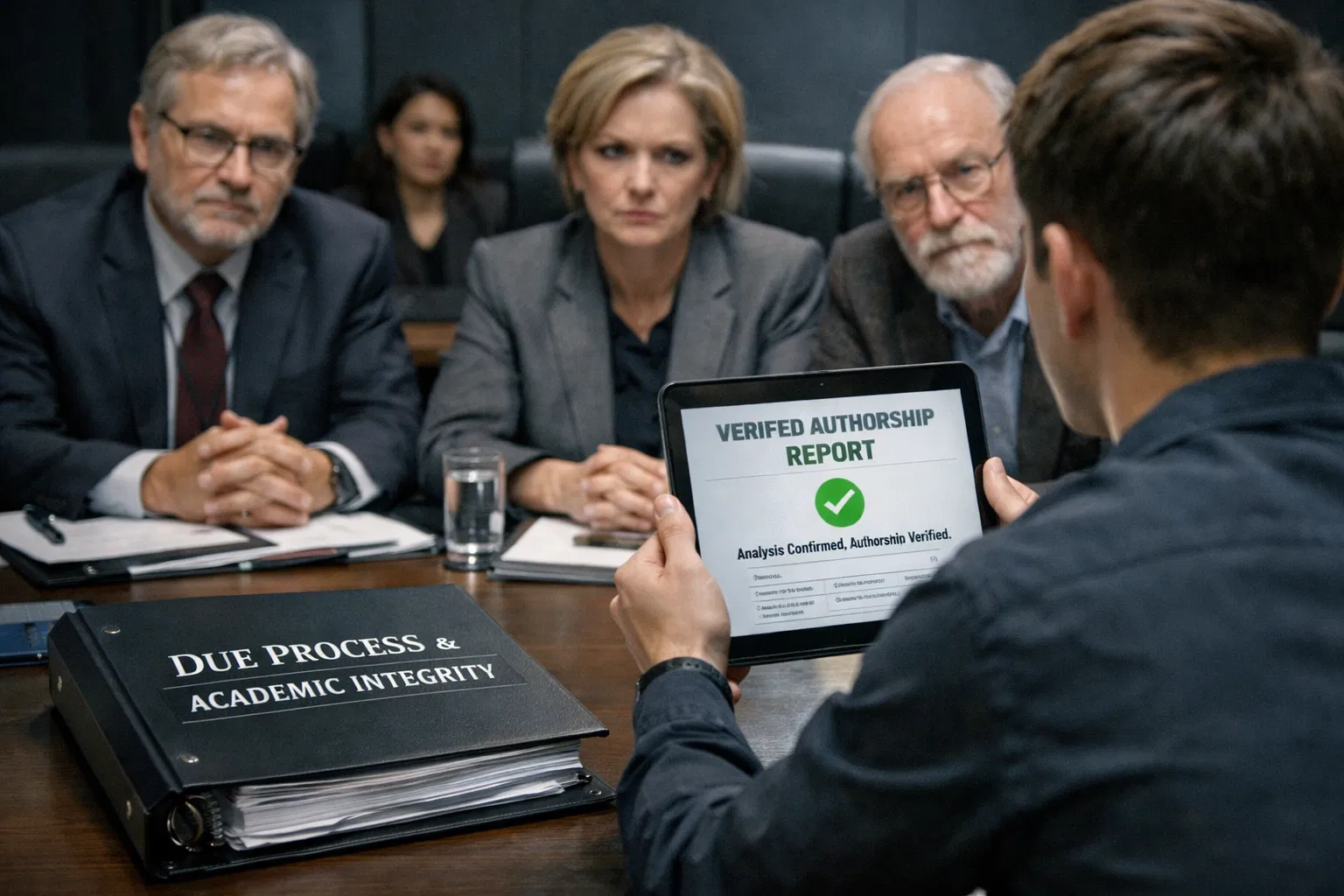
The Yale Lawsuit: Discrimination and Due Process Claims
The Yale School of Management case raises different and equally important legal questions. Thierry Rignol, a French entrepreneur enrolled in Yale's Executive MBA program, was accused of using AI on a final exam in spring 2024. A teaching assistant flagged his answers as "unusually long and elaborate in formatting" with "near-perfect punctuation and grammar." The exam was open-book but closed internet. An instructor ran portions of his answers through GPTZero.
The Yale AI cheating lawsuit describes what followed: a one-year suspension and a failing grade in the Sourcing and Managing Funds course. The lawsuit Rignol filed in federal court in February 2025 alleges breach of contract, breach of the implied covenant of good faith and fair dealing, national origin discrimination under Title VI of the Civil Rights Act of 1964, retaliation after complaining of discrimination, and intentional and negligent infliction of emotional distress. One of Rignol's specific allegations is that the Honor Committee process was mismanaged and that Yale failed to reveal to him the identities of those who had accused him, as its own Honor Code requires.
The Yale lawsuit also explicitly noted that Rignol believed he was discriminated against on the basis of his national origin and non-native English-speaking status. This is the legal articulation of the documented statistical bias: AI detectors flag non-native English writing at disproportionately higher rates than native English writing, and when an institution acts on a detection flag against a non-native English-speaking student, it may be applying a facially neutral tool with discriminatory effect. The Rignol case was still pending as of March 2026. A federal judge denied his motion for an injunction that would have allowed him to graduate with his cohort in May 2025, finding that any harm from delayed graduation could be compensated with money damages if his lawsuit ultimately succeeds. Using an AI humanizer tool to ensure that genuine writing falls within the statistical range that detectors read as human helps prevent this class of cases, but the Yale lawsuit shows that the discrimination theory applies when it does not.
Defamation Claims: When They Apply and When They Do Not
Defamation is a common first instinct when someone is falsely accused, but in the context of AI detection, the legal elements of defamation pose significant obstacles. Defamation requires a false statement of fact, communicated to a third party, that identifies the plaintiff and that causes reputational harm. The specific fault standard (negligence or actual malice) depends on whether the plaintiff is a public or private figure.
The "Statement of Fact" Problem
A Turnitin score of 85 percent AI is a probability, not a statement of fact. It says the text has properties statistically similar to AI-generated text, not that the text was generated by AI. Most detection platforms explicitly state in their documentation that their scores are not evidence of AI use and should not be used as the sole basis for adverse action. A court evaluating whether a detection score constitutes a false statement of fact must grapple with whether a probability expressed in statistical terms can be false in the legally required sense.
Qualified Privilege for Internal Communications
Communications within an academic institution about academic integrity matters are typically protected by qualified privilege. This means that a professor who reports a suspected violation to an Honor Committee, a teaching assistant who flags suspicious work to an instructor, or an administrator who communicates a finding to other administrators is protected from defamation liability as long as they act in good faith and without malice. Proving malice sufficient to overcome qualified privilege is very difficult in practice.
When Defamation Might Be Viable
AI defamation legal analysis from Quinn Emanuel identifies the circumstances where AI-related defamation claims are more viable: when false statements are published to a wide audience, when an institution makes false claims about an individual to a third party outside the institution, or when a detection score is communicated publicly in a way that identifies the subject and states as fact that they used AI. An instructor who publicly posts that a student was caught cheating with AI, even though no cheating occurred, stands in a different position from an honor committee that conducts a private proceeding. Tools that beat AI detectors prevent the scenario from arising, but if a false public statement does occur, defamation may be the appropriate claim.
Breach of Contract: The Strongest Academic Theory
The most actionable legal theory in academic AI detection cases is breach of contract. When a student enrolls at a university and pays tuition, both parties enter a contract. The university's academic integrity policy, honor code, student handbook, and course syllabi are all generally considered part of that contractual relationship. When an institution fails to follow its own stated procedures, that failure may constitute a breach of contract.
Procedural Violations Create Breach Claims
The Yale complaint explicitly alleges that Yale's Honor Code requires the university to reveal to an accused student the identities of those who accused them and that Yale failed to do so. If accurate, this is a textbook breach of the contractual duty to follow stated procedures. Similarly, the Adelphi complaint argued that the university acted "arbitrarily and capriciously" in relying on an AI score without supporting documentation, in a manner inconsistent with its own academic integrity standards.
Due Process Arguments Within Contract Claims
Even at private universities, which are not constitutionally required to provide due process in the same way public institutions are, contract law often produces similar practical protections. Courts have long held that private university students have a contractual right to the procedures their institutions promise to follow. Notice of the specific charges, an opportunity to respond, access to the evidence against them, and an appeal mechanism are all procedural requirements and are often contractually guaranteed. When an institution skips or shortcuts any of these steps in reliance on a detection score, breach-of-contract arguments follow directly.
The reduced AI detection tools that help writers prevent false positives do not affect contractual rights in any way. Those rights exist regardless of whether your work was ever flagged, and knowing them before you face a dispute is valuable.
Discrimination Claims: Title VI and the ESL Connection
Title VI of the Civil Rights Act of 1964 prohibits discrimination based on race, color, and national origin in programs that receive federal financial assistance. Most universities receive federal funding, making Title VI applicable. The connection to AI detection lies in the documented statistical bias: AI detectors misclassify non-native English writing as AI-generated at dramatically higher rates than native English writing.
A facially neutral policy, applied uniformly to all students, can still violate Title VI if it has a disparate impact on a protected class. Using an AI detection tool that disproportionately flags writing by students from non-English-speaking countries could, in theory, satisfy the disparate impact standard. The harder question is causation: the plaintiff must show that the tool's bias, not other factors, was the reason for the adverse action.
The Rignol-Yale Claim as a Model
Rignol's federal lawsuit is the first major case to articulate the national origin discrimination theory in the context of AI detection and academic integrity. He explicitly links his status as a French non-native English speaker to the detection flag and to the university's decision to pursue and sustain a disciplinary finding. If this theory holds up, it would establish that universities must account for documented detection bias when making adverse decisions based on AI scores. Using an AI content humanizer to bring the statistical profile of ESL writing within the range that detectors read as human is a practical protective measure. Title VI is the legal protective measure when those tools are not enough.
ADA and Disability Discrimination
The Adelphi case adds another dimension: the Americans with Disabilities Act and Section 504 of the Rehabilitation Act, which prohibit disability discrimination in educational programs. Newby's complaint argued that using his writing quality against him, where that quality resulted from a disability-related accommodation program the university itself provided, constituted discrimination based on disability. While the court resolved the case on a factual question rather than on the discrimination theory, the ADA/Section 504 argument is available in cases where detection flags disproportionately affect students who use disability accommodations.
Legal Theories at a Glance
The table below summarizes the legal theories available in false AI detection cases and their viability in academic and professional contexts.
Legal Theory | When It Applies | Key Challenge |
Breach of Contract | The university fails to follow its own stated academic integrity procedures, and it uses unreliable evidence inconsistently with its policies | Must show a specific contractual obligation was violated; courts still generally defer to academic judgment on merits |
Title VI National Origin Discrimination | AI detector disproportionately flags non-native English writing; institution acts on the flag; student is from a protected national origin group | Must prove the tool's bias caused the specific adverse action; disparate impact theory requires statistical evidence of systemic effect |
ADA / Section 504 Disability Discrimination | Detection flag results from writing characteristics caused by disability or disability accommodation | Must link the disability-related writing characteristic to the detection flag and to the adverse action |
Defamation | False factual statement (not just a probability score) communicated publicly or to a third party outside institutional privilege; identifies plaintiff; causes reputational harm | Detection scores may not be "statements of fact"; internal communications typically protected by qualified privilege; malice standard is high |
Intentional Infliction of Emotional Distress | Conduct in pursuing the accusation is extreme and outrageous; it causes severe emotional harm | Very high standard; academic integrity proceedings, even unfair ones, rarely qualify as outrageous conduct |
Due Process (public universities) | A public university fails to provide adequate notice, hearing, or appeal; suspension or expulsion is imposed without procedural protections | Federal due process applies at public universities; the content of the required process varies by the severity of the sanction |
Wrongful Contract Termination (professional) | An employer or client terminates the contract based on the detection flag without following contractual termination procedures | Depends entirely on contract terms; at-will employment eliminates most claims; specific contractual procedures may apply |
Producing undetectable AI text from genuine human writing by adjusting statistical properties before submission prevents the scenario from arising. This table describes the remedies available after a false flag has already triggered adverse action.
The Practical Barriers to Litigation
Even where a legal theory is available, pursuing litigation over a false AI-detection accusation faces significant practical obstacles that warrant honest accounting.
Cost. The Newby family spent over $100,000 in legal fees to clear a finding that resulted in a zero on one assignment and a required workshop. This cost is prohibitive for most students and families. In professional contexts, the cost of litigation typically far exceeds recoverable damages from a single contract termination or rejected submission.
Deference to academic judgment. A groundbreaking AI plagiarism ruling from Plagiarism Today notes that courts have historically been very reluctant to intervene in academic integrity cases. The Adelphi ruling was groundbreaking precisely because such interventions are rare. The case succeeded because it was framed as a factual dispute rather than a challenge to academic judgment. A student arguing that the university was wrong to consider AI use a violation faces a very different standard than a student arguing that no valid factual basis supported the finding that AI was used.
Evidence availability. Proving a negative, that you did not use AI, is inherently difficult. Process documentation helps enormously: version history, Grammarly Authorship reports, tutor records, and draft evidence. Without this documentation, the litigation becomes a credibility contest against a detection score.
Time. Litigation takes months or years. An academic integrity dispute that could affect graduation timing, scholarship eligibility, or professional licensing cannot wait for a lawsuit to resolve. The institutional appeal process is almost always the appropriate and more efficient first response.
At-will employment in professional contexts. Most professional relationships in the United States are at-will, meaning a client or employer can terminate a contract without cause. A content platform that stops working with a writer because their work triggered a detection flag faces minimal legal exposure if the underlying relationship was at-will. Specific contractual protections, freelance payment obligations under state law, or public accommodation statutes may provide limited relief in specific circumstances. Using a free AI humanizer to prevent the flag is far more practical than litigating its consequences.
What to Do Before Considering Legal Action
Given the costs and difficulty of litigation, the right sequence of responses to a false AI-detection accusation is an internal administrative appeal first, ongoing documentation gathering, and legal consultation before any formal claim.
Step 1: Request the Full Evidence Record
Before doing anything else, formally request in writing the complete evidentiary basis for the accusation. This means the specific detection tool used, the exact score or probability returned, the sections of your work that were flagged, and any documentation of how the score was calculated. Many institutions lack full documentation when challenged, and requesting it demonstrates that you understand your rights and are prepared to contest the finding.
Step 2: Compile Your Documentation Package
Simultaneously, gather every piece of process documentation you have: Google Docs version history with timestamps, Grammarly Authorship reports if you generated one, tutor records or collaboration notes, rough drafts, research notes with dates, and prior writing samples demonstrating your established style. This documentation package is what you present in your institutional appeal and, if necessary, in any subsequent legal proceeding.
Step 3: Exhaust Institutional Appeals
Most universities require that you exhaust internal appeal mechanisms before any external remedy becomes available. File a formal appeal through every available level: instructor, department, academic integrity committee, dean's office, and ombudsperson, where available. Document every communication in writing. Note any procedural failures, including failure to provide required notice, failure to reveal accusers where required by policy, or deviation from the stated appeal process. These procedural failures form the basis of breach-of-contract claims. AI detection-bypass tools address the statistical-profile problem; appeal procedures address the institutional decision-making problem.
Step 4: Consult a Qualified Attorney
Before filing any formal legal claim, consult an attorney who specializes in education law, academic integrity disputes, or employment law, depending on the context of your dispute. An attorney can assess the strength of your specific claims, identify procedural vulnerabilities in the institution's process, advise on the likely cost and duration of litigation, and help you understand whether settlement, further institutional escalation, or formal litigation is the appropriate path.
False AI Detection in Professional and Employment Contexts
The legal landscape is less developed in professional contexts than in academic ones, partly because professional disputes are typically resolved through contractual mechanisms rather than litigation and partly because the at-will employment doctrine eliminates most termination claims.
Freelance Contracts and Payment Disputes
A freelancer whose completed work is rejected or whose payment is withheld due to a detection flag may have claims that depend entirely on the terms of their contract. If the contract requires payment for accepted work and the publication rejects work without contractual grounds for rejection, a breach of contract claim is available. If the contract requires a specific termination process and the publication skipped it, the same applies. Without contractual protection, at-will service relationships leave limited legal recourse.
State Freelancer Payment Laws
Several states, including New York, California, Illinois, and New Jersey, have enacted freelancer protection statutes that require payment for completed work within specified timeframes, regardless of disputes about the work's quality or origin. If a publication withholds payment for completed work that it claims was AI-generated, and the freelancer has documentation of their process, these statutes may provide a basis for a claim independent of any contract terms.
Employment Discrimination in AI-Screened Hiring
The use of AI detection tools in hiring, where job applications or work samples are screened for AI content, raises potential employment discrimination issues when those tools produce a disparate impact on protected classes. This area of law is developing rapidly. The Equal Employment Opportunity Commission has issued guidance noting that AI hiring tools can violate anti-discrimination laws when they produce adverse effects on protected classes. Using Humanize AI writing to ensure that genuine human applications fall within the statistical range that detection tools read as human-written is a practical protective measure in this context.
Solution Section: Protecting Yourself Before a Legal Dispute Arises
The most effective legal protection against a false AI-detection accusation is never having to invoke it. Here is a practical framework that reduces the risk of a false flag and strengthens your position if one occurs.
Proactive Statistical Management
Before submitting any high-stakes document, run it through at least one detection tool yourself. Review which sections score highest for AI probability and assess whether the statistical variation in those sections can be improved. Using humanized neurodivergent writing, or other genuine human writing, to adjust its statistical profile to the human writing range addresses the specific metric detection tools use without altering content, accuracy, or compliance with style requirements. This is not concealing AI use; it is preventing a detector from misclassifying human writing.
Contemporaneous Documentation
Document the build process as you write, not after the fact. Enable Grammarly Authorship before starting any important document. Write in Google Docs to capture automatic version history. Save named versions at key stages. Keep your research notes with dates. The Newby case succeeded in part because there were tutors who could speak to the process and drafts that showed the work's development. Documentation that exists at the time of the dispute is far more persuasive than documentation assembled afterward.
Know Your Institution's Policy Precisely
Before submitting any high-stakes work, read your institution's academic integrity policy and course-specific AI guidelines carefully. Know what specific evidence standard the institution claims to use, what appeal procedures exist, and what documentation rights you have in a dispute. Being familiar with these procedures before a dispute means you can identify procedural failures immediately.
Build Relationships That Can Serve as Evidence
The strongest evidence in the Newby case was that the tutors in the Bridges program could directly speak to his writing process. Collaborators, tutors, writing center advisors, research librarians who helped you locate sources, and instructors who reviewed earlier drafts all potentially have knowledge relevant to proving your authorship. Maintain these relationships and be prepared to name them if challenged.
Conclusion
The legal landscape around false AI detection accusations is developing rapidly and unevenly. The Adelphi ruling of January 2026 established that courts will annul academic integrity findings that lack a valid factual basis, but the $100,000 cost of achieving that result is prohibitive for most people. The Yale lawsuit is testing whether the documented statistical bias against non-native English speakers constitutes actionable discrimination under federal civil rights law, and its outcome will matter far beyond the individual case. For students, the most viable theories are breach of contract when an institution fails to follow its own procedures, discrimination when detection bias affects protected classes, and fact-based challenges to the evidentiary sufficiency of a score. For professionals, contractual protections and state freelancer payment statutes provide the most developed remedies. What runs through all of these situations is the same core insight: a detection score is not evidence, and treating it as definitive proof is both legally and factually wrong.
Frequently Asked Questions
Can a student sue a university over a false AI detection accusation?
Yes, in specific circumstances. The Adelphi University case, decided in January 2026, is the clearest example of a successful challenge: the court found the university's plagiarism finding "without valid basis and devoid of reason" and ordered the record expunged. The most viable legal theories are breach of contract when the institution failed to follow its own stated procedures and discrimination under Title VI or the ADA when detection bias disproportionately affected a student based on national origin or disability. Courts are generally reluctant to intervene in academic integrity decisions, and the litigation in the Adelphi case cost the family over $100,000 in legal fees. Exhausting institutional appeals before pursuing litigation is essential both legally and practically.
What legal theories apply when AI detection wrongly flags your work?
The primary theories in academic contexts are breach of contract (when the institution fails to follow its own procedures), Title VI discrimination (when the tool's documented bias against non-native English speakers causes disparate impact on students from non-English-speaking countries), ADA discrimination (when detection flags result from disability-related writing characteristics or accommodations), and factual challenges to the evidentiary basis of the finding itself. Defamation is theoretically available but faces high hurdles: detection scores are probabilities, not statements of fact, and internal institutional communications typically carry qualified privilege. In professional contexts, contractual remedies and state freelancer payment statutes provide the most developed frameworks.
What did the Adelphi University ruling establish?
Nassau County Supreme Court Judge Randy Sue Marber issued a ruling in January 2026, annulling Adelphi University's plagiarism finding against Orion Newby, a student with autism who was accused of using AI to write a history essay. The judge found the finding "without valid basis and devoid of reason." The court ordered the university to expunge the violation from Newby's academic record. The ruling was described by Newby's attorney as groundbreaking because US courts have historically been very reluctant to intervene in academic integrity cases. It was possible here because the dispute was framed as a factual question about whether AI was used, not a challenge to whether AI use would constitute a violation, and because the university's sole evidence was a Turnitin score with no supporting documentation.
What is the difference between a defamation claim and a breach of contract claim in this context?
Defamation concerns false statements communicated to third parties that damage a person's reputation. In AI-detection cases, defamation faces obstacles because detection scores are probabilistic expressions, not statements of fact, and internal institutional communications typically carry qualified privilege. Breach of contract refers to an institution's failure to fulfill its stated obligations to a student. If a university's honor code requires it to follow specific procedures and it fails to do so, that is a breach of contract, regardless of whether the underlying accusation was correct. Breach of contract claims are generally more viable in academic AI detection disputes because they turn on what the institution promised and whether it delivered, not on the harder questions about the nature of detection scores as factual statements.
What should you do before considering legal action over a false AI detection flag?
Follow the four steps in sequence. First, request in writing the complete evidentiary basis for the accusation: the specific tool, the exact score, the flagged sections, and any documentation of how the score was calculated. Second, compile your process documentation: version history, Grammarly authorship reports, tutor or collaboration records, rough drafts, research notes, and prior writing samples. Third, exhaust all institutional appeal mechanisms and document every procedural failure that occurs in that process. Fourth, consult a qualified education law attorney before filing any formal claim. Using an AI text transformer to adjust the statistical profile of genuine human writing before submission is the most practical first-line measure to prevent the false flag from occurring in the first place.