AI detection tools promise to separate human writing from machine output with near-perfect accuracy. The reality tells a different story. Independent testing consistently reveals a significant gap between marketed claims and real-world performance, with consequences that affect students, professionals, and institutions worldwide.
This guide aggregates the most comprehensive independent data available on AI detection accuracy in 2026. It examines how these tools work, where they fail, who they disproportionately hurt, and what the future holds. For a foundational overview of how these systems evaluate your text, see our guide to understanding detection methods.
Whether you are an educator evaluating whether to deploy AI detection in your classroom, a writer worried about false accusations, or an institution developing AI use policies, this guide provides the evidence you need.
Key Takeaways:
AI detector accuracy ranges from 65% to 90% in controlled tests, but real-world performance averages just 73% across eight major tools tested independently in 2026.
False-positive rates range from 2% (Originality.ai) to 83% (the worst-performing tools on student essays), indicating that authentic human writing is routinely misclassified.
The Stanford study found 61.3% of TOEFL essays by non-native speakers were incorrectly flagged as AI-generated across seven detectors.
OpenAI shut down its own AI classifier in July 2023 after only 26% accuracy on AI text and 9% false positives on human text.
No major academic or professional organization recommends using AI detector scores as standalone evidence for misconduct decisions.
BestHumanize provides multi-detector content protection that prevents false positives before they damage careers and reputations.
Research Findings: What Independent Data Reveals About AI Detection
The gap between AI detection marketing claims and independent research findings is substantial. This section presents the data from the most rigorous studies available.
The Stanford Study: Systemic Bias Against Non-Native Speakers
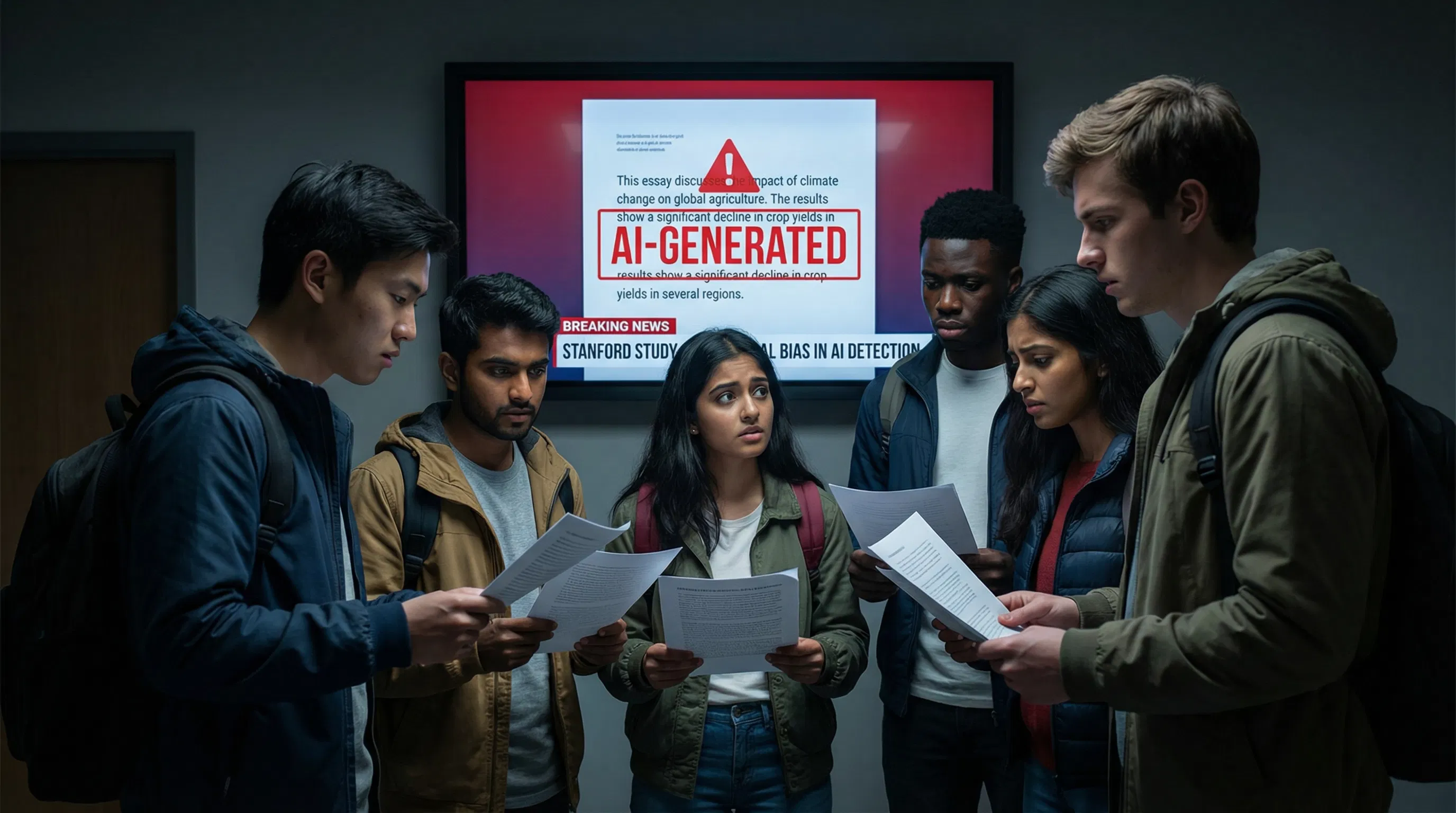
The most cited study on AI detection bias was conducted by Liang et al. at Stanford University and published in Patterns (Cell Press) in 2023. The researchers evaluated seven widely used AI detectors using TOEFL essays written by non-native English speakers. The detectors classified 61.3% of these genuine human essays as AI-generated. On approximately 19% of the essays, all seven detectors unanimously and incorrectly flagged the text as machine-written.
The bias is structural. Non-native speakers produce text with lower lexical richness, less syntactic diversity, and more predictable word choices, the exact patterns that detectors associate with AI output. As The Markup reported, a Johns Hopkins professor noticed Turnitin was much more likely to flag international students’ writing. For writers affected by this bias, our content protection strategies offer practical techniques to reduce the risk of false positives.
The OpenAI Classifier: When the AI Creator Cannot Detect AI
OpenAI launched its AI Text Classifier in January 2023 and shut it down less than six months later, on July 20, 2023. The company posted a terse notice: the classifier was discontinued due to its low rate of accuracy. The tool correctly identified only 26% of AI-written text while incorrectly flagging 9% of human-written text.
This event is significant because OpenAI possesses the deepest understanding of how large language models generate text. If the creator of ChatGPT cannot build a reliable detector for its own output, the fundamental challenge of AI detection becomes clear. The problem is not insufficient engineering. It is that the statistical distributions of human and AI writing overlap in ways that no classifier can cleanly separate.
2025–2026 Independent Testing: The Numbers
Multiple independent evaluations conducted in 2025 and 2026 paint a consistent picture of unreliability:
Average real-world accuracy: 73% across eight major tools tested on a standardized dataset of 150 texts with known origins.
False-positive rates: 2% to 28%, depending on the tool. Turnitin reported approximately 6%, while Sapling produced 28%.
Mixed content accuracy: below 62% for all tested tools. When AI text was edited by a human, no detector exceeded 62% accuracy.
Paraphrased content: detection drops 20–60%. After three passes through a quality humanization tool, no detector consistently identified AI content.
Student essay false positives: 43–83% across commercial detectors in a 2026 study of 192 texts.
The Scale Problem
Even seemingly low false-positive rates can be devastating at the institutional scale. A university processing 100,000 submissions annually with a detector claiming 1% false positives would generate approximately 4,800 false accusations per year. The JISC National Centre for AI has flagged this as a burden too large for institutions to investigate properly.
Industry Trends: How Detection Technology Is Evolving
The AI detection industry is responding to criticism with several emerging approaches, though none have solved the fundamental accuracy problem. For writers navigating this shifting landscape, our guide to detection evasion techniques provides practical strategies that adapt to evolving detection methods.
Multi-Signal Detection
Newer detectors are moving beyond pure perplexity and burstiness analysis to incorporate additional signals, such as stylometric analysis, metadata examination, and statistical pattern matching across larger text corpora. While these approaches show promise in controlled tests, they have not yet demonstrated significant reductions in real-world false-positive rates.
AI Watermarking
Google, OpenAI, and Meta are developing watermarking systems that embed invisible signals in AI-generated text at the point of creation. However, watermarking only works when all AI providers participate, when the watermark survives editing and paraphrasing, and when detectors check for watermarks rather than linguistic patterns. None of these conditions is currently met at scale.
Institutional Policy Shifts
A growing number of universities are scaling back their reliance on AI detection. Vanderbilt University publicly disabled Turnitin’s AI detection feature due to excessive false positives. Multiple institutions now treat detector scores as conversation starters rather than evidence. The University of San Diego Legal Research Center maintains a comprehensive guide documenting the problems with AI detectors that has informed many of these policy shifts.
Expert Commentary: What Researchers and Institutions Are Saying
MIT Sloan Teaching & Learning Technologies has published an unequivocal position: AI detectors don’t work. Their guidance recommends that educators avoid relying on these tools and instead redesign assessments to be resilient against AI use.
Professor James Zou of Stanford University, the senior author of the Liang et al. study, has stated that current detectors are clearly unreliable and easily gamed, and that the stakes are too high for students to place their faith in these technologies without rigorous evaluation.
The International Center for Academic Integrity advises against using AI detection scores as sole evidence in misconduct cases. For a broader perspective on responsible AI use in content creation, our ethical usage guidelines provide a framework for transparency and accountability.
Future Outlook: Where AI Detection Is Headed
The trajectory of AI detection technology reveals a fundamental tension. As AI language models improve, their output becomes increasingly indistinguishable from human writing. Detection tools must continually retrain to keep pace, creating an ongoing arms race.
The more likely future is a shift away from binary detection toward content-provenance systems that track how content was created, rather than trying to reverse-engineer its origin. This approach, supported by initiatives like C2PA, would verify the creation process rather than the product.
In the interim, the practical reality is that detection technology remains unreliable for high-stakes decisions in 2026. Writers, students, and organizations need content protection strategies that do not depend on advances in detection technology.
The BestHumanize Solution: Comprehensive Content Protection for an Unreliable Detection Landscape
The data throughout this guide makes one thing clear: AI detection technology in 2026 is not reliable enough for the high-stakes decisions it is being used to make. Our automated protection platform provides a practical solution.
Unlimited Humanization Access
BestHumanize provides unlimited content protection without per-word restrictions. Students can check every assignment before submission. Freelancers can verify every client deliverable. Marketing teams can process entire content calendars without budget constraints. The unlimited model enables iterative refinement refining your text multiple times until it achieves consistently safe scores across all major platforms.
Competing tools that charge per word or impose daily limits force tradeoffs between protection and budget. BestHumanize eliminates this tradeoff. Protection is unlimited for under $10 per month.
Multi-Detector Compatibility
The detection landscape is fragmented across Turnitin, GPTZero, Originality.ai, Copyleaks, ZeroGPT, and Winston AI. As the independent testing data shows, no single detector exceeded 80% overall accuracy in real-world conditions. BestHumanize optimizes against all major platforms simultaneously, eliminating the whack-a-mole problem of passing one detector only to fail another.
Content Protection Integration
BestHumanize preserves original meaning, voice, and tone while adjusting only the specific linguistic patterns that trigger detection algorithms. Your academic writing still sounds scholarly. Your professional communication still sounds authoritative. The platform integrates into existing content workflows as an automated protection checkpoint, ensuring every piece meets detection safety thresholds before going live.
The transformation is fundamental. Writers stop living in fear of algorithmic misjudgment and start operating with confidence that their work will be evaluated on its merits. Organizations scale content production without scaling risk.
Conclusion
AI detection technology in 2026 operates well below the accuracy thresholds required for high-stakes decisions. Independent data show average accuracy of 73%, false-positive rates up to 83% in student writing, and documented systematic bias against non-native English speakers at 61.3%. Even OpenAI could not build a reliable detector for its own AI’s output.
For writers, students, and organizations navigating this landscape, the path forward requires both awareness and action. Understanding the limitations of AI detection accuracy is the first step. Implementing proactive content protection through tools like BestHumanize is the second.
Frequently Asked Questions
What is AI detection accuracy, and how is it measured in 2026?
AI detection accuracy measures how correctly a tool classifies text as either human-written or AI-generated. In 2026, independent testing across eight major tools shows an average real-world accuracy of 73%, with false-positive rates ranging from 2% to 28%. Scribbr’s guide provides a detailed technical breakdown of how these measurements work.
What is the difference between false positive rates across major AI detectors?
False-positive rates vary significantly across tools. Turnitin reports approximately 6%, Originality.ai approximately 2%, GPTZero approximately 9%, and ZeroGPT approximately 15%. These rates increase dramatically for ESL writers (12–45%) and academic writing (8–15%). Grammarly’s analysis explains why these variations occur.
How often do AI detectors wrongly flag non-native English speakers?
The peer-reviewed Stanford study by Liang et al. (2023) found that seven AI detectors misclassified 61.3% of TOEFL essays by non-native English speakers as AI-generated. On 19% of essays, all seven detectors unanimously made this error.
How much does poor AI detection accuracy cost institutions and individuals?
A university processing 100,000 submissions with a 1% false positive rate generates approximately 4,800 false accusations annually. For freelancers, a single false positive can mean a rejected deliverable. For businesses, flagged content damages brand credibility. The Hyatt et al. (2025) study found that aggregating multiple detectors reduces false positives to nearly zero, but few institutions implement this approach.
How does BestHumanize protect against inaccurate AI detection?
BestHumanize optimizes your text’s perplexity and burstiness patterns across all major AI detectors simultaneously. It preserves your original meaning and tone while adjusting only the statistical signatures that trigger false positives. For more details, see our guide on reliable content protection.